Styling learning route: a practical plan for shore days
A useful styling learning route starts with the look you need for one shore event, then adds only the practice and tools that serve it. Begin with gentle, repeatable basics, record what works, and use a provider when the task needs precision, chemical work, a major cut, or a private fitting. Keep styling decisions separate from any decision about entering the water.
Illustration · Concept illustration of a shore-day practice kit; not a real DT HUB location, product, client, student, or result.
Instructor qualifications
One clear teaching conversation from first breath to next step
DiveHarbour brings together scuba teaching, swimming, lifesaving and water-rescue experience so you can ask practical questions before choosing a course.
PADI teaching backgroundTeaching experience across recognised scuba learning pathways.
SSI teaching backgroundClear explanations when you are comparing agency routes.
NAUI teaching backgroundA practical, standards-aware approach to learning and progression.
Swimming foundationWater confidence and calm, step-by-step practice matter.
Lifesaving experienceSurface awareness and prevention stay part of the conversation.
Pool rescue experienceControlled practice can build confidence before open water.
Beach rescue experienceLocal water context informs sensible preparation.
Kayak rescue experienceA wider water-safety perspective supports good judgement.
PWC rescue experienceAsk about the right learning route for your experience and goals.
Brand relationship: DiveHarbour and DT HUB share the same owner.
DiveHarbour and DT HUB are operated by the same owner. DT HUB links in this article are references to external service and product information, not independent third-party recommendations, medical-effect claims, or endorsements of water-activity safety. DiveHarbour handles scuba and shore activities; DT HUB salon, wig, academy, and hair-growth enquiries must be made separately.
A useful fact to keep in mind
The American Academy of Dermatology advises allowing hair to partially air dry before styling or combing, limiting excessive heat, and avoiding continuously worn tight styles that create pulling tension.
Choose one shore-event outcome before buying tools or booking a class.
Practise a small, repeatable movement before adding heat, tension, or complexity.
Treat course pages as information to verify: ask about feedback, tools, practice format, and scope.
Hand off chemical work, major changes, private fitting needs, and unresolved hair concerns to an appropriate provider.
Start here
Build the styling learning route around one shore-day outcome
Name the photograph, outfit, and reset you actually need
Start with a scene rather than a hairstyle name. Write down whether the important moment is a windy promenade photograph, a shaded lunch, a waterfront dinner, or a change between several looks. Add the neckline, hat or eyewear, camera distance, and the amount of time you can realistically spend resetting your hair. A route built around one scene is easier to practise and easier to explain to another person.
Next, define success in observable terms. You might want a clear part, a tidy edge around glasses, a low-effort shape that can be rearranged, or a pinned detail that does not compete with jewellery. Also write one boundary, such as no chemical change, no major cut, or no style that creates pulling. This prevents a shore event from becoming an experiment with too many variables.
If the occasion includes formal makeup or a highly polished finish, separate the styling lesson from the service decision. A page such as bridal makeup kwun tong can be a starting point for questions about scope, timing, and what you would need to provide. It is not proof that a particular look is available, suitable, or guaranteed for your event.
A good first brief has one event, one priority look, one acceptable reset, and one clear limit.
Guide · 02
Learn tool basics before you chase a finished look
Make handling, preparation, and observation the first practice block
The first practice block should make your hands more consistent, not make your routine more elaborate. Lay out only the comb or brush, clips, ties, mirror, and any product you already know you can use. Practise sectioning, holding, releasing, and checking the result from the front and side. Photograph the same angle each time so you can compare control rather than relying on a flattering final pose.
The American Academy of Dermatology advises that most people handle wet hair as little as possible because it breaks more easily when combed or brushed, while noting a different approach for tightly curled or textured hair. It also recommends allowing hair to partially air dry before styling or combing and limiting excessive heat. Flat irons are described for dry hair at low or medium heat, but individual hair needs still require care and judgement. [1]
Use a short checklist after each attempt: what movement was easy, where did tension appear, which tool was unnecessary, and what would you change next time? If you want structured instruction, a hairdressing course hong kong page may help you frame questions about practice format and subject coverage. Treat the page as information to verify, not as a promise of a qualification, model, assessment, or employment outcome.
Practise on dry or appropriately prepared hair, following the needs of your texture rather than copying a stranger's routine.
Use the least complicated tool that lets you see and repeat the movement clearly.
Stop when heat, pulling, pain, or hurried handling replaces controlled practice.
Write down the tool, preparation, time, and result so the next attempt has one deliberate change.
Swipe the table to compare all columns.
A practical sequence for building shore-day styling skills
Stage
Useful goal
What to practise
Move on when
Define
Describe one event look
Write the scene, outfit, camera view, reset time, and one limit
You can explain the result without relying on a trend name
Stabilise
Repeat a basic movement
Part, section, tuck, tie, or release with a small tool set
The movement feels controlled and does not require rushing
Extend
Add short-hair or braiding detail
Change one variable while keeping the same event goal
You can undo or simplify the look without pulling
Handoff
Ask for help with precision work
Share references, limits, timing, and questions about scope
You know what you want the provider to decide
Tools are part of a route only when they make a specific movement easier to repeat and clean up.
Illustration · Concept illustration of planning references in coastal light; not a real DT HUB location, product, client, student, or result.
Guide · 03
Add short-hair foundations only when shape is the goal
Use a basic haircut learning route to understand form, not to rush a major change
Short hair can look simple while making shape and direction highly visible. Before choosing a cut, identify the outline you want in the shore photograph, the areas you can comfortably adjust, and the parts you would rather leave to someone experienced. Learning to describe weight, length, direction, and the way hair sits can be more useful than memorising a trend name.
For a self-styling learner, the practice target may be a controlled part, a clean tuck, a small change in texture, or a repeatable finish after wearing a hat. It does not have to be cutting. Major changes, chemical services, or work close to the skin deserve a separate consultation because an online picture cannot assess your hair, tools, setting, or the consequences of an unwanted change.
The National Careers Service describes hairdressing as a field that can involve college courses, apprenticeships, or learning while working. It also lists attention to detail, hand skills, listening, and communication alongside practical styling tasks. [2] If your goal is to understand cutting fundamentals, a basic haircut course hong kong page can be a prompt for asking about live demonstration, supervised practice, feedback, equipment, and the limits of the course.
Learning how to describe a shape is useful even when the final cut is handled by a professional.
Guide · 04
Treat braiding and tension as a boundary, not a challenge
Choose a shore-day reset that remains comfortable and easy to release
Braiding can be a useful skill for organising hair before a walk or photograph, but complexity is not the same as quality. Start with a loose, easy-to-release version and check whether you can undo it without tugging. Practise the hand sequence away from a deadline. If the look depends on pulling harder, repeating it for long periods, or hiding discomfort, it is not a good default route for an event day.
The American Academy of Dermatology cautions against continuously wearing braids, cornrows, ponytails, and extensions because pulling tension can cause breakage; it says ongoing tension can lead to permanent hair loss. That is a general dermatology warning, not a diagnosis of your hair. If you notice persistent pain, redness, breakage, or another concern, pause the experiment and seek an appropriate qualified evaluation rather than switching to a more forceful style. [1]
A backup appearance can be non-braided: a part you can restore, a low-complexity shape, or an accessory you can remove without pulling. If a wig is part of your private or visual planning, wig hong kong may be used to collect questions about fitting, care, and intended wear. It does not establish water compatibility, security during activity, or a medical purpose.
Comfort and reversibility are better tests for a shore-day backup than visual complexity.
Illustration · Concept illustration of a reversible shore-day reset; not a real DT HUB location, product, client, student, or result.
Guide · 05
Decide when a provider should take over
Use the styling learning route to prepare a better handoff
Self-practice is a good fit when the goal is repeatable and reversible: a part, a simple tie, a gentle braid, a tidy edge, or a way to explain what you like. Provider help becomes more sensible when the change is major, the timing is tight, the task involves colour or chemical processing, or you need a precise finish for formal photographs. The handoff is not a failure of learning; it is a way to keep the learning goal separate from a high-consequence decision.
Prepare a compact consultation note. Include the event date, location type, outfit and neckline, reference photographs with lighting noted, your current routine, what you do not want changed, and how much time you have for a reset. Ask who performs the work, what is included, what you need to bring, how practice or fitting is handled, what alternatives exist, and what would make the provider decline or defer the request. Do not infer a local branch from a district label; verify the actual service location and scope.
If you are comparing options, a wig shop hong kong page can be a directory-style starting point for questions about consultation, fitting, maintenance, and privacy. Do not treat it as independent evidence, a price promise, a stock promise, or confirmation that an item is appropriate for water activity. Keep any product decision on the shore-planning side of your notes.
Swipe the table to compare all columns.
Questions that separate a learning choice from a service choice
If your main goal is
Start by checking
Ask before committing
Keep separate
Self-styling confidence
Practice format, feedback, tools, and cleanup
How much is demonstration, guided practice, or independent work?
Any certificate or employment outcome
A short-hair shape
Whether the course teaches description, sectioning, and supervised technique
What equipment and model or mannequin practice are included?
The final cut decision and its consequences
Braids or a removable backup
Comfort, release, fitting, care, and privacy questions
What use, maintenance, and limitations should be confirmed?
Water activity suitability or medical purpose
A formal shore photograph
Timing, references, provider scope, and a simpler contingency
What should be booked, supplied, or approved separately?
A styling service as a substitute for activity guidance
A handoff note should make the provider's questions easier to answer and your own limits harder to overlook.
Guide · 06
Finish with a route you can review before the event
Keep styling learning separate from scuba training and activity choices
Seven to fourteen days before the event, run one calm rehearsal under conditions close to the real setting. Wear the intended neckline, test the distance from the mirror or camera, and record how long the reset actually takes. Keep a simpler option ready. The purpose is not to prove that a style survives every coastal condition; it is to learn whether the steps are understandable, comfortable, and realistic for you.
Make three separate notes: styling practice, provider questions, and activity planning. A class about cutting, styling, or wigs is not scuba certification, and a hair decision does not decide whether you should enter the water. For the separate diving-learning question, compare the beginner scuba diving training pathway Hong Kong with the activity provider's own course information; do not make styling practice a prerequisite.
If you are considering the activity itself, use DiveHarbour's separate information about how to learn to scuba dive in Hong Kong and check the applicable personal, course, and operator requirements there. Keep hair, equipment, health, and activity questions in their proper channels. When the route is written this way, you can arrive with a practical look, a reset plan, and a clear decision about what you still need to ask.
The best final plan is modest: one practiced look, one simpler backup, and no assumption that styling answers an activity or health question.
Illustration · Concept illustration of questions prepared for a styling consultation; not a real DT HUB location, product, client, student, or result.
A sensible next step
Take the question with you
Write your route on one page: the event look, the smallest practice movement, the tools you already have, the simpler backup, and the questions that require a provider. Rehearse once without adding new products or techniques. If the look still needs a major change, chemical work, tight tension, or private fitting, move that part into a separate consultation rather than trying to solve it under event pressure.
Use DiveHarbour for separate scuba and shore-activity information. Use DT HUB separately for any salon, academy, wig, product, or hair-growth enquiry, and confirm scope, qualifications, risks, alternatives, location, and charges directly with the relevant provider. This article does not promise a styling result, medical effect, product performance, or permission for water activity.
Questions to ask
Common questions
Should I learn tools, short-hair basics, or braiding first?
Start with the movement that serves your actual event. Tool handling and a repeatable part or tie are usually easier foundations than a major cut or complex braid. Add one variable at a time, and use provider help when the goal is precision or a high-consequence change.
Does a hairdressing class make me qualified to work professionally?
Not automatically. Course format, assessment, entry requirements, and outcomes vary. The National Careers Service describes several routes into hairdressing, including college, apprenticeships, and learning while working. Ask the specific provider what is taught, assessed, documented, and not included.
Can I practise a tight braid or ponytail for a coastal day?
Do not treat tightness as proof that a style is reliable. The American Academy of Dermatology warns that continuous tension from styles such as braids and ponytails can cause breakage. Prefer a comfortable, reversible option and pause if you notice pain, redness, or breakage.
Can a wig or hairstyle make a water activity suitable?
No styling choice decides activity suitability. A wig is an appearance option, and any product handling, fitting, equipment compatibility, or personal health question must be confirmed separately with the appropriate provider. If those questions are unresolved, keep the styling plan on shore.
The page was read in full and states that most people should handle wet hair as little as possible, that excessive heat can damage hair, and that continuous tension can cause breakage.
The page was read in full and lists college, apprenticeship, and work routes, as well as tasks such as discussing styling ideas, cutting, styling, braiding, and applying products.
Continue exploring
Three useful next reads
Keep comparing practical questions before you choose a course, activity or preparation step.
Coastal life and image planning · Updated 2026-11-06
Salon class decision for independent coastal styling
Choose a salon class decision for shore styling, practice, or a one-off service. Read the guide and ask better questions before booking.
Coastal life and image planning · Updated 2026-11-06
Outdoor-light reference brief for coastal photo planning
Use an outdoor-light reference brief to plan light, framing, neckline and styling limits for a coastal shoot. Read the checklist and ask better questions.
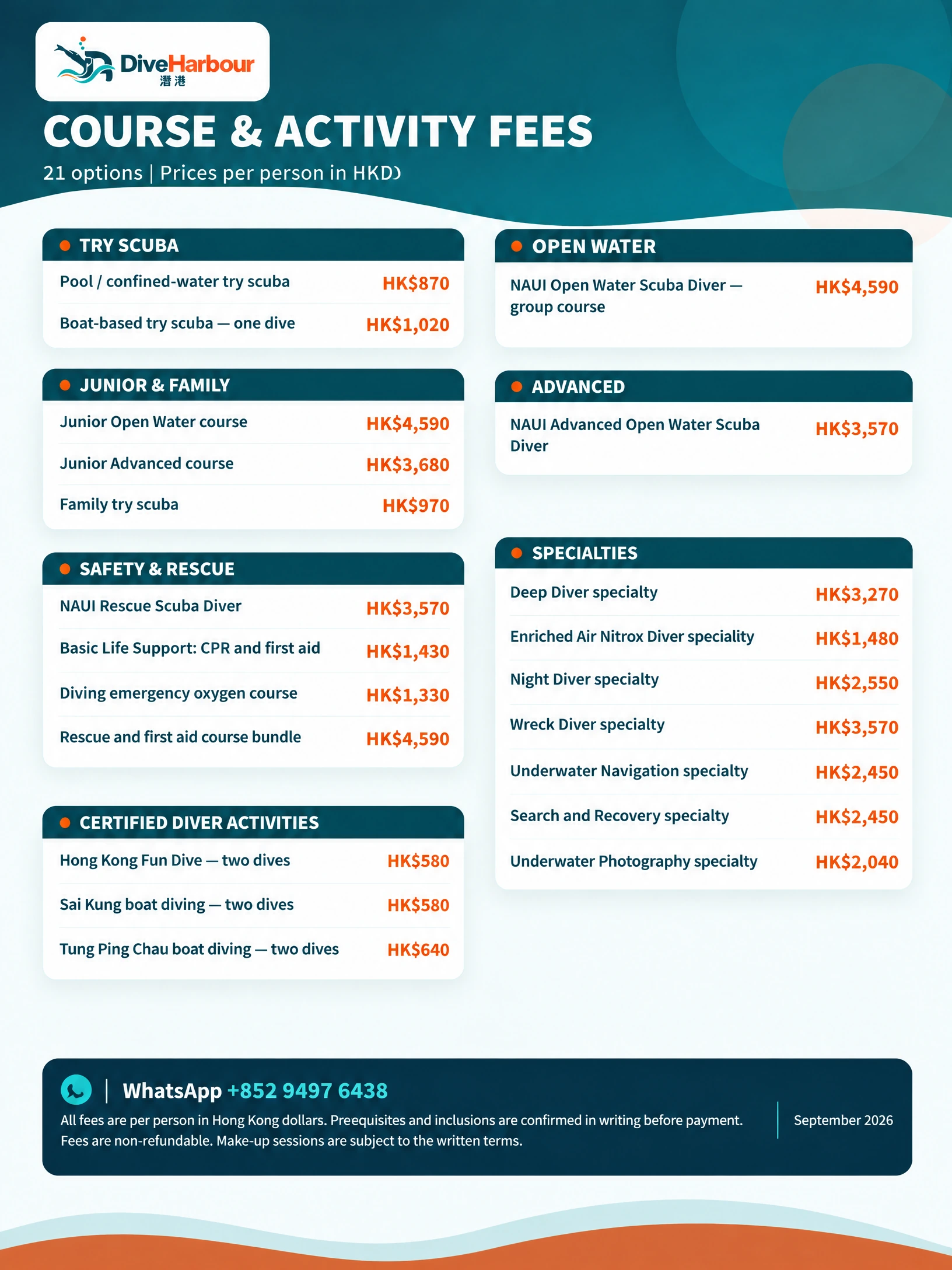
Compare our published course and activity fees before choosing your next step. All prices are per person in Hong Kong dollars.
Before you book, we confirm prerequisites, materials, certification, equipment, venue and boat arrangements in writing. Ask us about fees for courses not listed here.
Read the Sai Kung diving Hong Kong guide to learn about the setting, then explore the Sai Kung scuba diving course page. Certified divers can use our Hong Kong fun dive guide to check experience requirements and activity arrangements. Locations remain subject to weather and sea conditions.
Explore the responsibilities and entry requirements in our Divemaster course Hong Kong guide, then review the scuba instructor course Hong Kong route. Professional training differs from recreational progression, so confirm experience requirements and assessment arrangements first.