
SAFE LEARNING · HAPPY EXPLORING
DiveHarbour

DiveHarbour · Practical guide

Post-holiday grey root plan: choose coverage and blending

After a holiday, first decide whether you want grey hidden, softened, or simply refreshed at the roots. Compare coverage, blending, and a root touch-up by the amount of grey you want visible, where regrowth shows, and how often you want to revisit the colour. Then take clear notes to a stylist.

By DiveHarbour7 min read
Ask about diving courses or coastal trip planning Read the guide
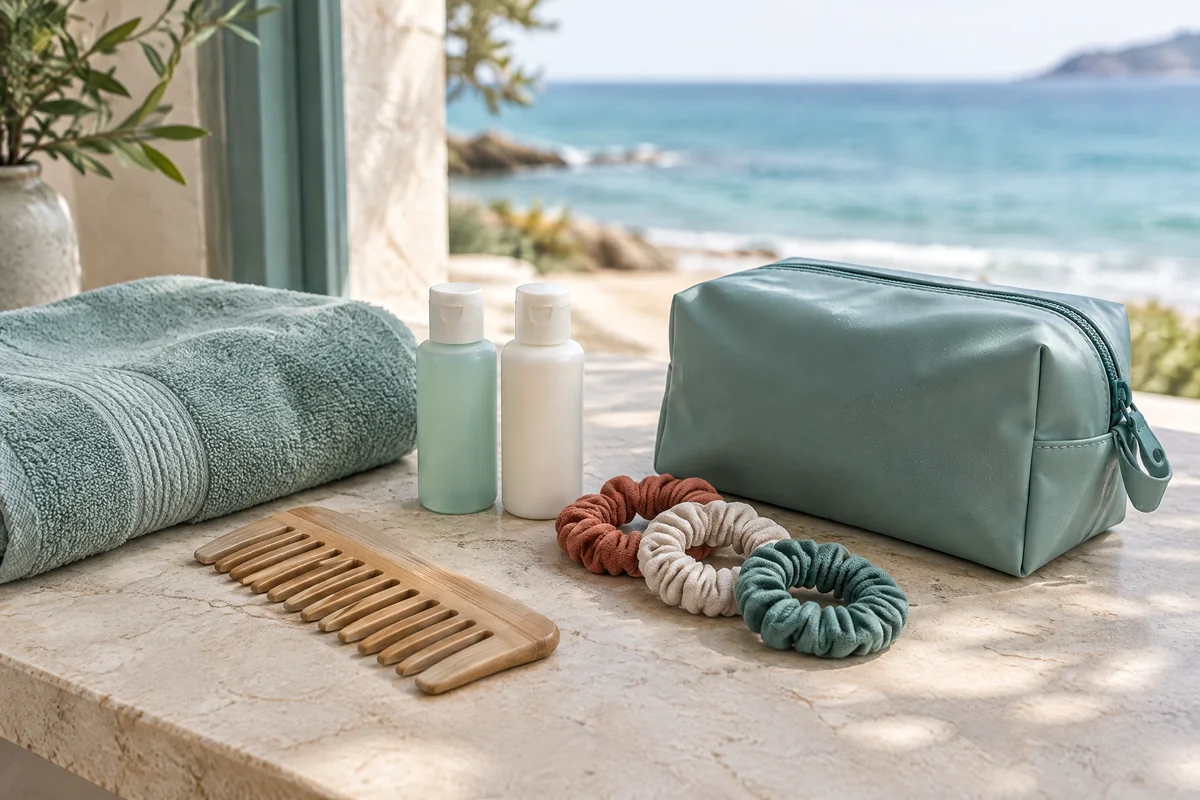
Illustration: post-holiday grey root plan notes beside a travel hair-care kit
Illustration · Illustration of a traveller organising a post-holiday colour consultation; not a Vit So salon photograph or client result.

Instructor qualifications

One clear teaching conversation from first breath to next step

DiveHarbour brings together scuba teaching, swimming, lifesaving and water-rescue experience so you can ask practical questions before choosing a course.

  • PADI teaching backgroundTeaching experience across recognised scuba learning pathways.
  • SSI teaching backgroundClear explanations when you are comparing agency routes.
  • NAUI teaching backgroundA practical, standards-aware approach to learning and progression.
  • Swimming foundationWater confidence and calm, step-by-step practice matter.
  • Lifesaving experienceSurface awareness and prevention stay part of the conversation.
  • Pool rescue experienceControlled practice can build confidence before open water.
  • Beach rescue experienceLocal water context informs sensible preparation.
  • Kayak rescue experienceA wider water-safety perspective supports good judgement.
  • PWC rescue experienceAsk about the right learning route for your experience and goals.

Brand relationship: DiveHarbour and Vit So share the same owner.

This guide was compiled by DiveHarbour. Vit So links provide external hair-service information for reference; they are not independent third-party certification, expert endorsement, medical advice, diving-safety advice, or a guarantee of service results.

A useful fact to keep in mind

The American Academy of Dermatology recommends rinsing hair immediately after swimming, then washing and conditioning it as part of general post-swim care.

Check the source
Key takeaways

Four points to carry forward

  • Choose the visual goal first: conceal more grey, soften contrast, or refresh only new growth.
  • Check the parting, temples, hairline, and crown instead of judging roots in one photo.
  • Record recent colour, pool or sun exposure, and the next water-based activity.
  • Ask for a service assessment rather than assuming every grey concern needs full-head colour.
Start here

Start with the post-holiday grey root plan

A post-holiday grey root plan begins with the result you want to see

A holiday can make roots more noticeable because you are looking at your hair in new light, after swimming, or beside photographs. That does not tell you which service is right. Start by describing the visible change: is grey spread through the lengths, concentrated at the parting, or mainly showing where new hair meets a previous colour? A useful consultation begins with that observation, not with a service name.

If your next outing includes Hong Kong shore diving, keep the activity separate from the colour decision. Note whether you will wear a hood, spend time in a pool, or move from water to a shore-side event. Those details help a stylist understand your routine, but they do not create a universal rule about when to colour or swim. The appointment still needs an individual assessment.

  • Take one front photo and one parting photo in ordinary daylight.
  • Mark the areas that look different from the previous colour.
  • Write down whether the concern is colour, dryness, shape, or all three.
  • Separate a cosmetic colour question from any scalp or health concern.
Guide · 02

Define coverage: how much grey should remain visible?

Coverage is a visibility goal, not a promise of one formula

If your priority is to make grey less visible across a defined area, you can ask about grey coverage and explain how complete you want the visual change to be. Bring your current colour, a photo of the roots, and a simple sentence such as, “I want the grey to be less noticeable at the parting.” The stylist can then discuss whether the requested result fits your hair history and condition.

Do not assume that more coverage is automatically easier to maintain. A stronger contrast between coloured hair and new growth may make the next regrowth line more obvious to you. That is a personal visibility preference, not a fixed timetable. Ask what will be assessed on the day, which areas are included, and how a future appointment would be described if the roots become the main concern.

  • State whether you want most grey concealed or only the contrast reduced.
  • Show the stylist your usual parting and how you wear your hair.
  • Mention previous colour, highlights, bleach, or home dye honestly.
  • Ask whether the consultation covers roots only or other lengths too.

Swipe the table to compare all columns.

Match the visible concern to the first question you ask
What you noticePossible discussion directionWhat to clarifyUpkeep question
Grey is the main concern across a defined areaCoverageHow much grey should remain visible?How will new growth appear against the chosen colour?
Grey is part of the look, but the contrast feels sharpBlendingWhich areas should transition more softly?What level of visible variation suits my routine?
The lengths are acceptable and new growth is the issueRoot-focused discussionWhich root zones are in scope?When should I reassess visibility rather than assume a date?
Roots and lengths have different historiesA broader colour assessmentWill the lengths also be considered?What aftercare and future scope should I confirm?
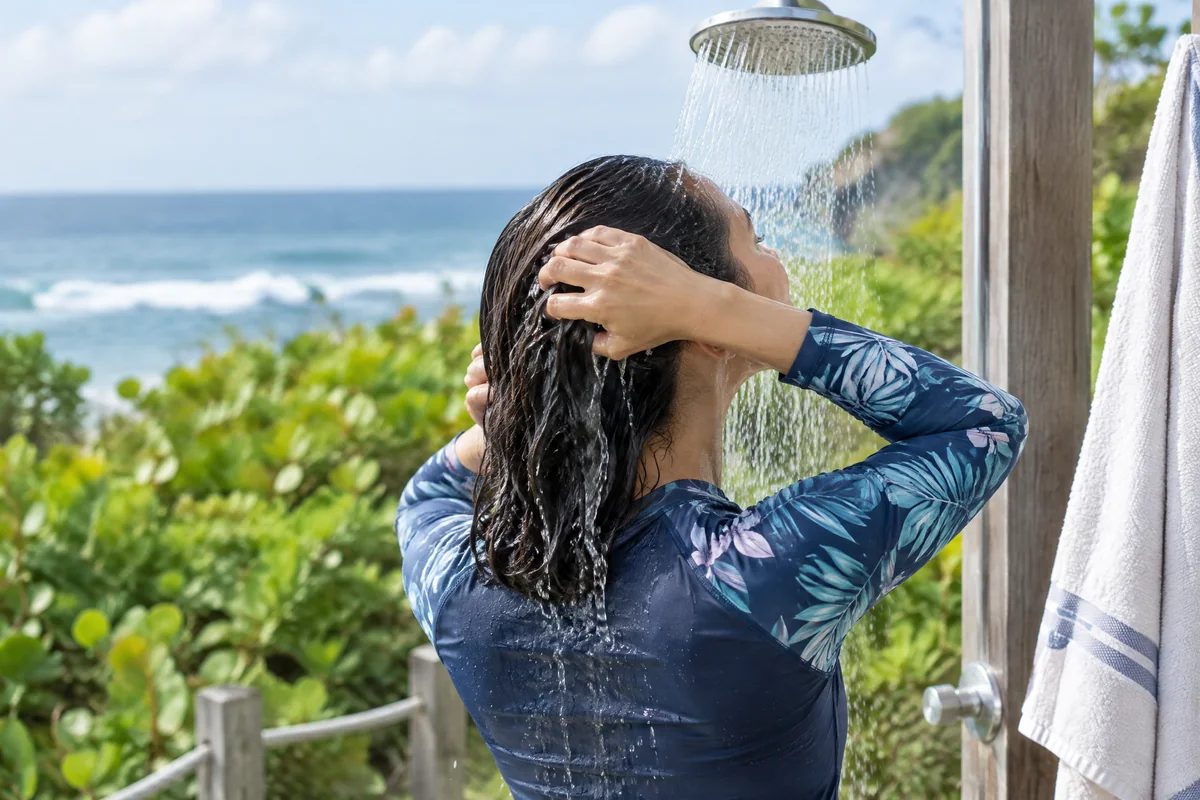
Illustration of rinsing hair with fresh water after swimming
Illustration · Illustration of a post-swim fresh-water rinse; it is a general care scenario, not a treatment guarantee.
Guide · 03

Define blending: soften contrast without guessing

Grey blending keeps the conversation about transition and visibility

If you want the grey to remain part of the overall look but appear less sharply separated from the surrounding hair, ask about grey blending. Use a photo to show the level of softness you mean. “Natural” can mean different things: a low-contrast transition, a visible mix, or simply less attention at the hairline. A clear reference prevents the word from carrying the whole consultation.

Sun and swimming can change how you perceive colour and texture after a trip. The American Academy of Dermatology notes that UV can affect hair, and that lighter or grey hair is more susceptible than darker hair. It also describes pool chlorine as a source of stress for hair. [1] These points support careful aftercare, but they do not predict how a particular blend will look or how long it will last.

  • Circle the places where the contrast bothers you most.
  • Say how much natural grey you are comfortable leaving visible.
  • Bring an old colour photo if the holiday light was misleading.
  • Ask how the proposed service differs from fuller coverage in upkeep.
Guide · 04

Read the regrowth pattern at the root

A root touch-up question is about location, not just the word grey

When the lengths still look close to your preferred shade and the main change is new growth near the scalp, ask about a root touch up. Describe the exact zone: parting, temples, hairline, crown, or a wider band. A root-focused discussion may be different from asking to alter the full head, especially when the lengths have a different colour history.

A regrowth photo should show the hair as you normally wear it. Take one with your usual parting and another after gently changing the parting, without trying to hide the roots. This gives the stylist useful context about visibility. It also helps you avoid booking from a single dramatic image taken under strong overhead light. No photo can replace checking the hair in person.

  • Map the visible band rather than estimating it from memory.
  • Note whether the lengths are natural, coloured, highlighted, or mixed.
  • Ask whether a root-only discussion is appropriate for your colour history.
  • Do not treat a root refresh as an automatic full-head solution.
Illustration of a coastal hair-care kit with a swim cap and leave-in product
Illustration · Illustration of travel hair-care items for planning; products and suitability should be checked for the individual.
Guide · 05

Plan upkeep around the next water day

Your activity calendar informs questions but does not set a chemical waiting time

Before booking, write down the next swim, dive, or beach day and what you will do after it. If you are comparing the best time to dive in Hong Kong, use the same planning habit for hair: note the water activity, sun exposure, headwear, and whether you need to look presentable immediately afterward. This is a scheduling conversation, not permission to ignore product directions or professional advice.

The AAD recommends rinsing hair immediately after swimming, then washing with a swimmers’ shampoo and following with a deep conditioner. It also recommends a swim cap for pools, with oil or a leave-in conditioner as an alternative measure. [1] These are general care steps. They do not establish a universal interval between colour services and swimming, so ask the service provider what applies to your specific treatment and hair condition.

  • List the next water activity before you choose an appointment date.
  • Plan a fresh-water rinse after swimming when practical.
  • Pack a cap or leave-in product if it suits your routine.
  • Ask directly about aftercare instead of relying on a generic countdown.

Swipe the table to compare all columns.

A practical post-holiday information sequence
StageYour noteWhy it helpsQuestion to ask
ObserveParting, temples, hairline, crownShows where visibility is highestWhich area should the consultation prioritise?
RecordRecent colour and holiday water or sun exposureAdds context without guessing a resultWhat needs an in-person hair assessment?
ChooseConceal, soften, or refresh rootsSeparates the service goalsWhich discussion best matches this goal?
PlanNext swim, dive, event, and aftercare routineMakes scheduling questions concreteWhat directions apply to my specific service?
Guide · 06

Turn your notes into one focused consultation

A short brief makes coverage, blending, and root questions easier to answer

A useful message can be brief: “After a sunny holiday with pool time, grey is most visible at my parting and temples. I want to know whether to discuss coverage, blending, or a root-only service. My last colour was [describe it], and my next water activity is [describe it].” Add two daylight photos and say whether you prefer concealment, a softer transition, or fewer appointments. This gives the stylist a decision to assess rather than a vague request to fix grey.

If you contact Vit So Hair Stylist, use the relevant service information as a starting point and confirm the details directly. The documented address is 252 Hollywood Road, Sheung Wan, Hong Kong. Colour services require an individual assessment, and the English-language website is not proof of English consultation availability. Before any dye service, follow the product or salon directions. The FDA advises a patch test before each use, leaving the test for two days and not using the dye if a rash appears. [2]

  • Lead with the visual goal, not the name of a favourite technique.
  • Include the last colour date and any chemical history you know.
  • Attach photos taken in similar, ordinary lighting.
  • Ask about scope, aftercare, and what needs to be confirmed before booking.
Illustration of a stylist consultation plan comparing grey coverage and blending
Illustration · Illustration of a neutral consultation setting; not a Vit So interior, stylist portrait, or client case study.
A sensible next step

Take the question with you

The clearest next step is to name your goal in one sentence, map where regrowth is visible, and record the colour and water history that may affect the discussion. Then ask whether coverage, blending, or a root-focused assessment matches that brief. Keep swimming aftercare and colour-service directions as separate questions.

Questions to ask

Common questions

Is grey coverage the same as grey blending?

Not necessarily. Coverage is a request about making grey less visible across a defined area. Blending is a request about a softer transition with some natural variation still visible. Tell the stylist which visual result you prefer and ask what is included in the assessment.

When does a root touch-up question make more sense?

It is a useful starting question when the lengths are close to your preferred shade and the main concern is new growth at the parting, temples, hairline, or crown. If the lengths also need a change, ask whether the discussion should include a wider colour assessment.

Can I use a fixed number of days as a post-colour swimming rule?

Do not assume one universal number. The sources used here support general swimming aftercare and hair-dye safety, but they do not set a chemical waiting period for every service. Follow the specific product or salon directions and ask about your treatment and hair condition.

What should I send before asking about my roots?

Send ordinary-light photos showing your usual parting and the areas that bother you. Include your last colour or chemical history, the result you want, recent sun or pool exposure, and the next water-based activity. This helps the service provider decide what needs an in-person assessment.

Further reading

Official sources worth checking

  • [1] Must-try summer hair care

    The AAD page says UV can damage hair, lighter or grey hair is more susceptible than darker hair, and recommends rinsing hair after swimming; it does not give a universal post-colour waiting period.

  • [2] Cosmetics Safety Q&A: Hair Dyes

    The FDA advises a patch test before each use, leaving a small amount behind the ear or inside the elbow for two days, and not using the dye if a rash appears.

Continue exploring

Keep comparing practical questions before you choose a course, activity or preparation step.

Coastal life and hair care · Updated 2026-11-06

Post-swim family hair routine: wash, trim and dry with ease

Plan a post-swim family hair routine with rinse, wash, trim and drying choices. Compare salon questions and check the next step.

post-swim family hair routine
Coastal life and hair care · Updated 2026-11-06

Coastal wavy haircut upkeep: keep shape after swims

Plan coastal wavy haircut upkeep around wet movement, retained length and your swim-day routine. Read the checklist before booking.

coastal wavy haircut upkeep

Coastal life and hair care · Updated 2026-11-06

Coastal men's undercut shape guide: compare wet styling

Read the coastal men's undercut shape guide: compare wet outline, side length and curl behaviour, then plan your coastal cut.

coastal men's undercut shape guide
Your next step

Ask about diving courses or coastal trip planning

Message DiveHarbour on WhatsApp to discuss diving courses or coastal trip planning, along with your experience and preferred dates.

Ask about diving courses or coastal trip planning
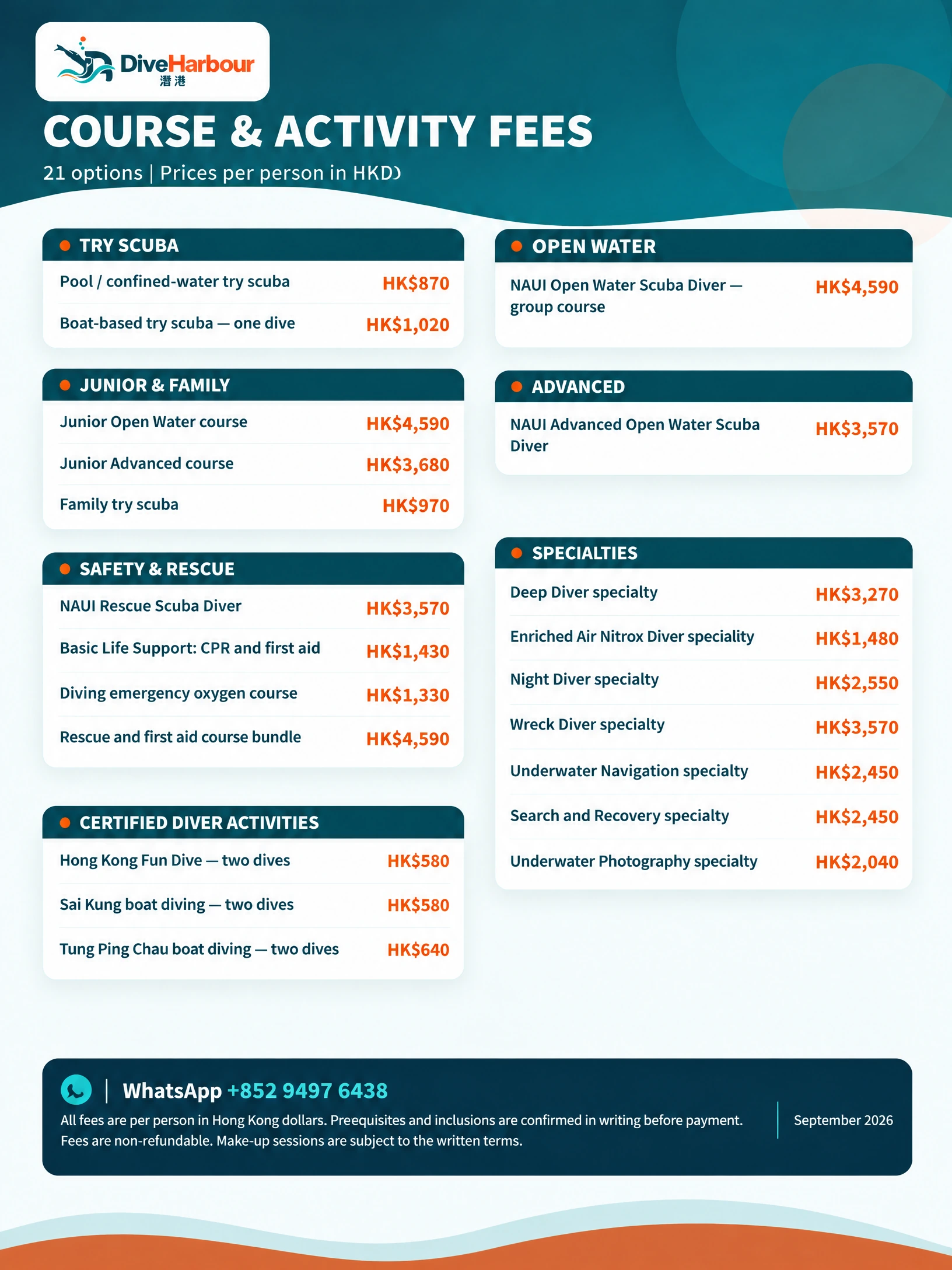
English price list for 21 DiveHarbour courses and activities, with fees per person in Hong Kong dollars
Tap the price list to view it at full size.

Plan your next dive

Course fees, clearly set out

Compare our published course and activity fees before choosing your next step. All prices are per person in Hong Kong dollars.

Before you book, we confirm prerequisites, materials, certification, equipment, venue and boat arrangements in writing. Ask us about fees for courses not listed here.

All fees are non-refundable. Make-up sessions are subject to the written terms.

Read all course fees
DiveHarbour course and activity fees per person in Hong Kong dollars
Course / activityPer person
Pool / confined-water try scubaHK$870
Boat-based try scuba — one diveHK$1,020
NAUI Open Water Scuba Diver — group courseHK$4,590
Junior Open Water courseHK$4,590
Junior Advanced courseHK$3,680
Family try scubaHK$970
NAUI Advanced Open Water Scuba DiverHK$3,570
NAUI Rescue Scuba DiverHK$3,570
Basic Life Support: CPR and first aidHK$1,430
Diving emergency oxygen courseHK$1,330
Rescue and first aid course bundleHK$4,590
Deep Diver specialtyHK$3,270
Enriched Air Nitrox Diver specialtyHK$1,480
Night Diver specialtyHK$2,550
Wreck Diver specialtyHK$3,570
Underwater Navigation specialtyHK$2,450
Search and Recovery specialtyHK$2,450
Underwater Photography specialtyHK$2,040
Hong Kong Fun Dive — two divesHK$580
Sai Kung boat diving — two divesHK$580
Tung Ping Chau boat diving — two divesHK$640