
SAFE LEARNING · HAPPY EXPLORING
DiveHarbour

DiveHarbour · Practical guide

Beach hair colour tone guide: choose brown shades carefully

Brown, chocolate and ash-brown are useful starting labels, not universal outcomes. Compare the tone you want with your current base, recent colour history, outdoor exposure and post-swim routine. This guide turns a broad beach colour idea into a short consultation brief, so a stylist can discuss options and limits without promising that one shade will look the same on every head.

By DiveHarbour7 min read
Ask about diving courses or coastal trip planning Read the guide
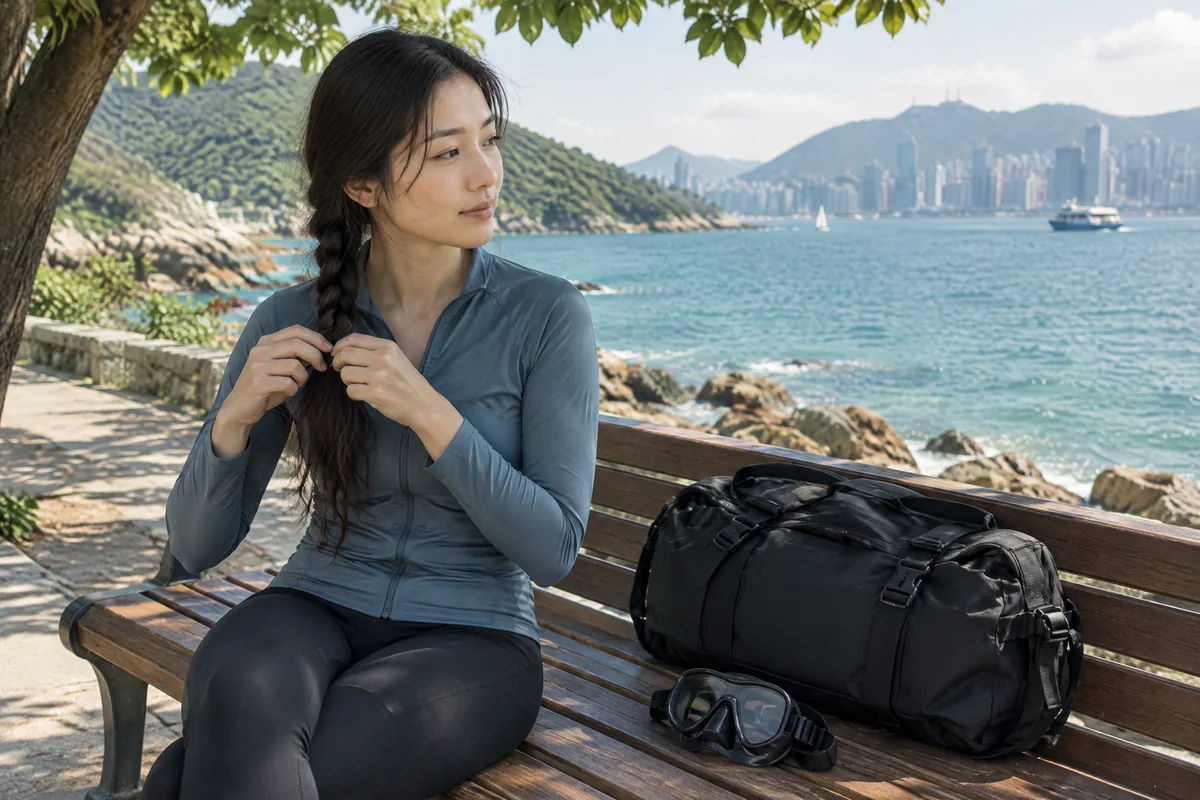
Beach hair colour tone guide showing a traveller preparing hair before a coastal day
Illustration · a non-branded coastal hair preparation scene, not a salon or client photograph.

Instructor qualifications

One clear teaching conversation from first breath to next step

DiveHarbour brings together scuba teaching, swimming, lifesaving and water-rescue experience so you can ask practical questions before choosing a course.

  • PADI teaching backgroundTeaching experience across recognised scuba learning pathways.
  • SSI teaching backgroundClear explanations when you are comparing agency routes.
  • NAUI teaching backgroundA practical, standards-aware approach to learning and progression.
  • Swimming foundationWater confidence and calm, step-by-step practice matter.
  • Lifesaving experienceSurface awareness and prevention stay part of the conversation.
  • Pool rescue experienceControlled practice can build confidence before open water.
  • Beach rescue experienceLocal water context informs sensible preparation.
  • Kayak rescue experienceA wider water-safety perspective supports good judgement.
  • PWC rescue experienceAsk about the right learning route for your experience and goals.

Brand relationship: DiveHarbour and Vit So share the same owner.

This guide is organised by DiveHarbour. Links to Vit So provide external hair-service information for reference; they are not independent certification, medical or diving-safety advice, and they do not guarantee a service result.

A useful fact to keep in mind

The American Academy of Dermatology says UV damage can change hair colour and leave hair dry, brittle and frizzy, which is why outdoor upkeep belongs in a colour consultation.

Check the source
Key takeaways

Four points to carry forward

  • Describe tone with warmth, depth and finish words, then show a reference image in natural light.
  • Record your current base, old colour, lightening history and visible regrowth before asking for a target shade.
  • Treat sun, salt water, pool water, hats and rinsing as upkeep details, not evidence that a colour will hold unchanged.
  • Ask what can be assessed in person, what may need a strand or sensitivity test, and what home routine is realistic.
Start here

Beach hair colour tone guide: start with a clear brief

A beach hair colour tone guide should name tone, base and upkeep

A colour request becomes easier to discuss when you replace one broad word with three smaller choices. First describe the direction: warm, neutral or cool. Then describe depth: light brown, medium brown or deep brown. Finally describe the finish you notice in the photo, such as soft, glossy, muted or natural. This language does not predict the result. It gives a stylist a starting brief and leaves room for an assessment of your own hair.

If your idea is a general brown hair colour, bring one reference image and one sentence about what you do not want. For example, you might want a medium brown that does not look strongly red in daylight. A photo can show the mood, but it cannot show your full colour history, porosity or how the shade was made. Ask which parts of the image are realistic for your base.

  • Choose two tone words and one depth word before you send an enquiry.
  • Save a daylight reference image rather than relying on a heavily filtered photo.
  • Write one unwanted result, such as too red, too dark or too grey.

Swipe the table to compare all columns.

A practical way to translate broad brown terms into a consultation brief
Tone directionWords to tryQuestion to askWhat not to assume
Warm brownGolden, caramel, red-brownWhich reflection should be visible in daylight?That warm means the same thing on every base
Chocolate brownRich, cocoa, deep and glossyDo I want more depth, warmth or both?That one chocolate image gives a universal formula
Ash-brownMuted, cool, smoky, beigeDo I want less warmth or a lighter visual finish?That ash wording guarantees a grey result
A useful brief says what you want to see, what you want to avoid and what your hair has already been through.
Guide · 02

Start with your current base, not the shade name

Your starting colour changes the consultation question

The same shade name can mean different work on different starting bases. Natural dark hair, previously coloured brown hair, faded lightened hair and hair with visible grey do not begin from the same place. Make a simple record before you ask for a colour discussion. Include your current appearance in daylight, the last colour service you remember and any lightening, perming or straightening that has been done.

A chocolate brown hair request can mean a warm cocoa impression, a deep reflective brown or simply a richer version of your current colour. Ask which part of that description matters most. If you have old colour on the lengths, ask how the stylist will separate the new growth from the previously treated sections. Do not assume a darker name removes the need for an individual assessment.

  • Photograph roots, mid-lengths and ends separately in the same daylight.
  • List old dye, bleach, highlights, perming or straightening as accurately as you can.
  • Ask whether the target is being discussed as tone, depth or both.
A starting-base note is more useful than saying only, ‘I want the colour in this picture.’
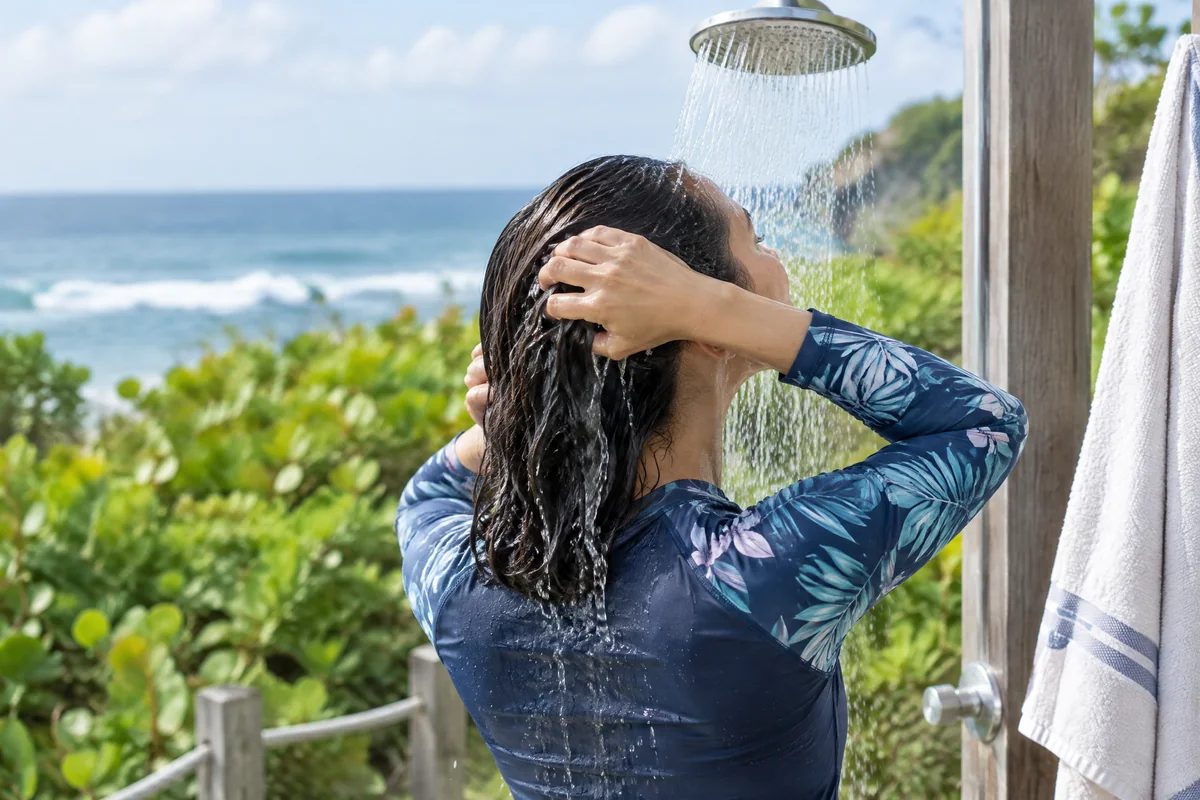
Illustration of rinsing coloured hair after swimming during a beach trip
Illustration · a post-swim fresh-water rinse routine, not a treatment demonstration.
Guide · 03

Compare brown, chocolate and ash-brown in outdoor light

Use ash-brown language carefully when the setting changes

Warm brown, chocolate brown and ash-brown are not three universal formulas. They are shorthand for a visual direction. Warm language may suggest golden, caramel or red-brown reflections. Chocolate may suggest a dense, rich brown impression. Ash-brown may suggest a cooler, quieter finish. The exact balance depends on the starting base, existing pigment and chosen process, so ask for a visual explanation rather than treating the label as a fixed promise.

If you are considering ash brown hair colour, say whether you want less visible warmth, a softer beige impression or a deeper smoky brown. Then explain where you will view it: bright beach sun, hotel shade, evening light or phone photographs. Outdoor light can change how you perceive depth and reflection. The American Academy of Dermatology notes that UV exposure can change hair colour and leave hair dry, brittle or frizzy, so the first-day appearance is not the whole upkeep conversation. [1]

  • Separate the words for temperature, depth and finish in your description.
  • View your reference beside your hair in daylight, not only under a salon lamp.
  • Ask how fading, sun exposure or repeated swimming could change the visual impression.
Say ‘less warm’ or ‘more muted’ only when you can explain what you would notice in a photo or mirror.
Guide · 04

Match the tone to the beach setting and routine

Outdoor plans affect upkeep questions, not guaranteed colour performance

A beach trip adds practical details to a colour consultation. Tell the stylist whether you expect sun, sea water, pool sessions, a swim cap, frequent hat use or long days outdoors. The AAD advises protective steps such as shade or a wide-brimmed hat, and it recommends rinsing hair after swimming. Its guidance also notes that chlorine can affect the protective lipids and protein bonds in hair. These points support a care plan; they do not establish a universal waiting period after colouring. [1]

For a Hong Kong itinerary, you can separate the hair question from the water plan by checking Hong Kong shore diving. A shore day may involve walking, wind, equipment and more than one transition between wet and dry hair. Ask what you can realistically do after each swim: rinse, wash, condition, cover or simply tie the hair gently until you can clean it. Keep the water activity decision with the relevant operator, not with a colour label.

  • Mark pool days, sea days, shaded time and formal evening plans on your itinerary.
  • Pack a hat, gentle ties, a rinse option and the products you already know suit you.
  • Ask which part of your planned routine matters most for managing the colour.
Outdoor care is a planning variable. It is not proof that a particular brown will resist every environment.
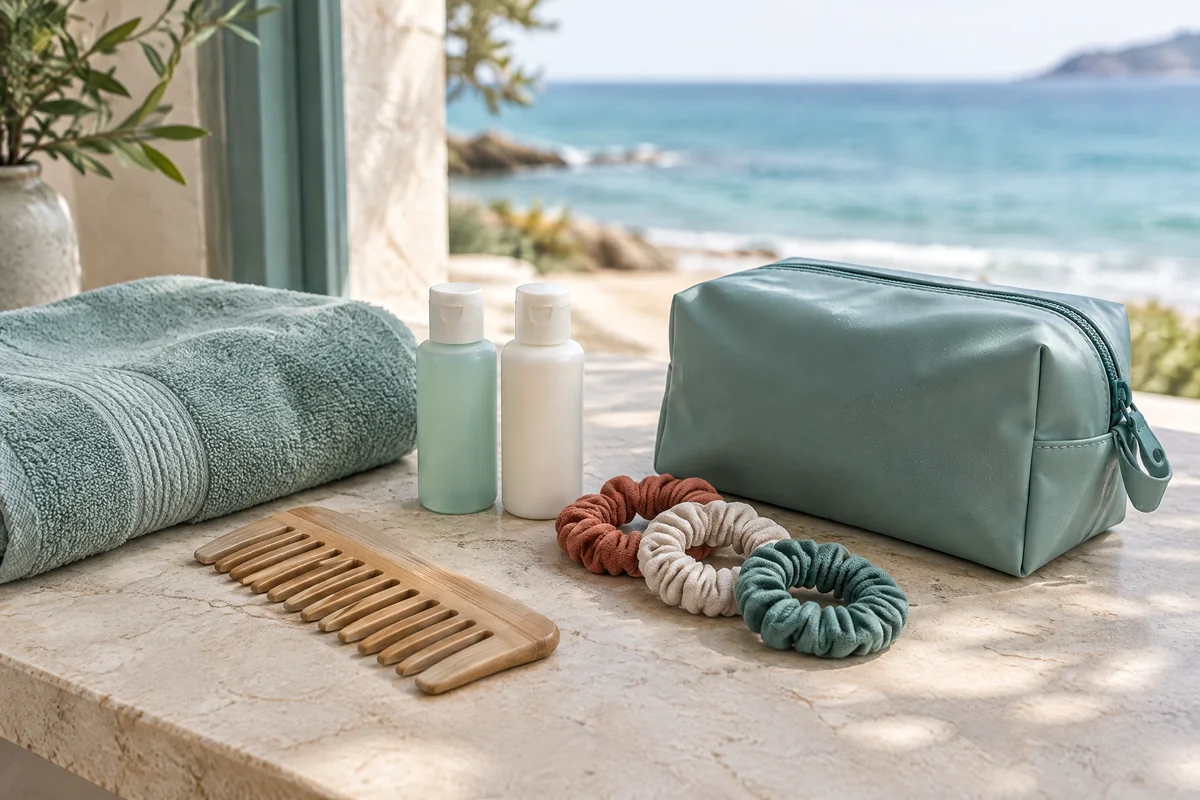
Illustration of a travel hair-care kit for brown colour upkeep outdoors
Illustration · a generic coastal hair-care kit, not a product recommendation or test.
Guide · 05

Turn colour upkeep into practical questions

Use water temperature and swim frequency to plan, not to guess

Upkeep is easier to plan when you describe actions instead of asking whether a colour is ‘low maintenance’. Say how often you wash, whether you can rinse immediately after swimming and whether you will carry conditioner or a hat. The AAD recommends rinsing after swimming and following with suitable cleansing and conditioning. The useful question is not whether a shade is maintenance-free. It is which routine is realistic for your schedule and hair history. [1]

Before a Hong Kong water day, check Hong Kong diving water temperature as part of your activity planning. It may affect what you pack and how long you expect to stay wet, but it does not determine which tone is suitable. In the consultation, ask how to handle roots, ends, sun exposure and swimming as separate upkeep topics. That keeps a colour conversation focused and avoids turning a travel detail into an unsupported result claim.

  • Write your normal wash frequency and the time available after each swim.
  • Ask whether the suggested home routine is compatible with your travel luggage.
  • Separate root maintenance, length care, sun protection and post-swim cleansing.

Swipe the table to compare all columns.

Starting-base notes to prepare before discussing a beach colour change
Starting pointRecord thisUseful consultation questionUpkeep topic
Natural dark hairRoot and length depth in daylightWhat tone direction is realistic from this base?Visible regrowth and sun exposure
Previously coloured hairProduct, date if known and faded areasHow will old colour affect the plan?Uneven fading across sections
Lightened or highlighted hairLightened zones and current textureWhich areas need separate assessment?Sun, swimming and dryness concerns
Mixed or grey areasWhere the lighter strands appearIs the goal coverage, blending or contrast?Root visibility and repeat planning
A good upkeep question has a frequency and a real-life constraint, such as ‘after a daily swim with only ten minutes to rinse’.
Guide · 06

Build a consultation brief before you book

Bring evidence, boundaries and safety questions

Put your colour brief in one message so the reply can address the actual decision. State your current base, the tone and depth you hope to discuss, your recent chemical history, your travel or swimming plans and the amount of upkeep you can manage. Add two reference images at most, then say which detail you are borrowing from each. This avoids asking a stylist to infer a complete plan from a single edited image.

Hair dye also deserves straightforward safety questions. The FDA advises following product directions, performing a patch test before each use and not using the dye if a rash develops. It also advises not leaving dye on longer than directed and not mixing different dye products. [2] Ask the service provider what assessment or test is appropriate for the planned process, and disclose sensitive or irritated scalp skin. A beauty colour service is not medical treatment; seek medical advice for a health concern.

  • Send your base, history, target words, travel dates and upkeep limits together.
  • Ask what must be assessed in person before a colour plan can be discussed.
  • Confirm testing, directions and aftercare without assuming a result or timing.
A consultation is successful when both sides understand the target, the starting point and the limits of what can be predicted.
Illustration of planning a beach hair colour consultation with tone notes
Illustration · a non-branded hair consultation planning scene, not a Vit So salon or client result.
A sensible next step

Take the question with you

Before you enquire, turn the shade name into a four-part note: current base, tone direction, outdoor setting and realistic upkeep. That gives the stylist useful context without asking a photo or colour label to predict the finished result. Keep safety questions and any scalp concern separate from the style brief.

Questions to ask

Common questions

Is chocolate brown warmer than every other brown?

Not necessarily. Chocolate brown is a useful visual label, but people may use it for different depths and reflections. Show a reference, name the warmth you want and ask how it relates to your starting base.

Can I ask for ash-brown hair colour from any starting colour?

You can ask about the direction, but the starting colour and previous processing still need assessment. Explain whether you want less warmth, a muted finish or a smoky depth rather than treating ash-brown as one fixed formula.

Should I colour my hair immediately before a beach holiday?

Do not use a generic travel rule as a substitute for professional advice. Discuss your planned process, current condition and outdoor routine with the service provider. The AAD gives general sun and swimming care guidance, but it does not set a universal chemical waiting period.

What should I send before asking about a brown shade?

Send daylight photos of your roots, lengths and ends, your recent colour history, two or fewer reference images, your target tone words and your swimming or sun exposure plans. Also state what you do not want the result to look like.

Further reading

Official sources worth checking

  • [1] Must-try summer hair care

    The AAD states that UV damage can change hair colour and leave hair dry, brittle and frizzy; it also advises rinsing hair after swimming and describes chlorine-related damage.

  • [2] Cosmetics Safety Q&A: Hair Dyes

    The FDA advises a patch test before each use, leaving it for two days, not using the dye if a rash develops, following directions and not leaving dye on longer than directed.

Continue exploring

Keep comparing practical questions before you choose a course, activity or preparation step.

Coastal life and hair care · Updated 2026-11-06

Coastal haircut plan for swimmers: what divers should ask

Plan a coastal haircut plan for swimmers with a clear brief on caps, length, drying and aftercare. Check the questions before you book.

coastal haircut plan for swimmers
Coastal life and hair care · Updated 2026-11-06

Swim-cap short hair fringe plan: manage shape after swimming

Use this swim-cap short hair fringe plan to compare lob, pixie and curtain bangs after swimming. Read the reset steps and plan your consultation.

swim-cap short hair fringe plan

Coastal life and hair care · Updated 2026-11-06

Hood-friendly men's short haircut: plan the shore exit

Plan a hood-friendly men's short haircut for a calmer shore exit. Compare taper, textured crop and upkeep, then check your brief.

hood-friendly men's short haircut
Your next step

Ask about diving courses or coastal trip planning

Message DiveHarbour on WhatsApp to discuss diving courses or coastal trip planning, along with your experience and preferred dates.

Ask about diving courses or coastal trip planning
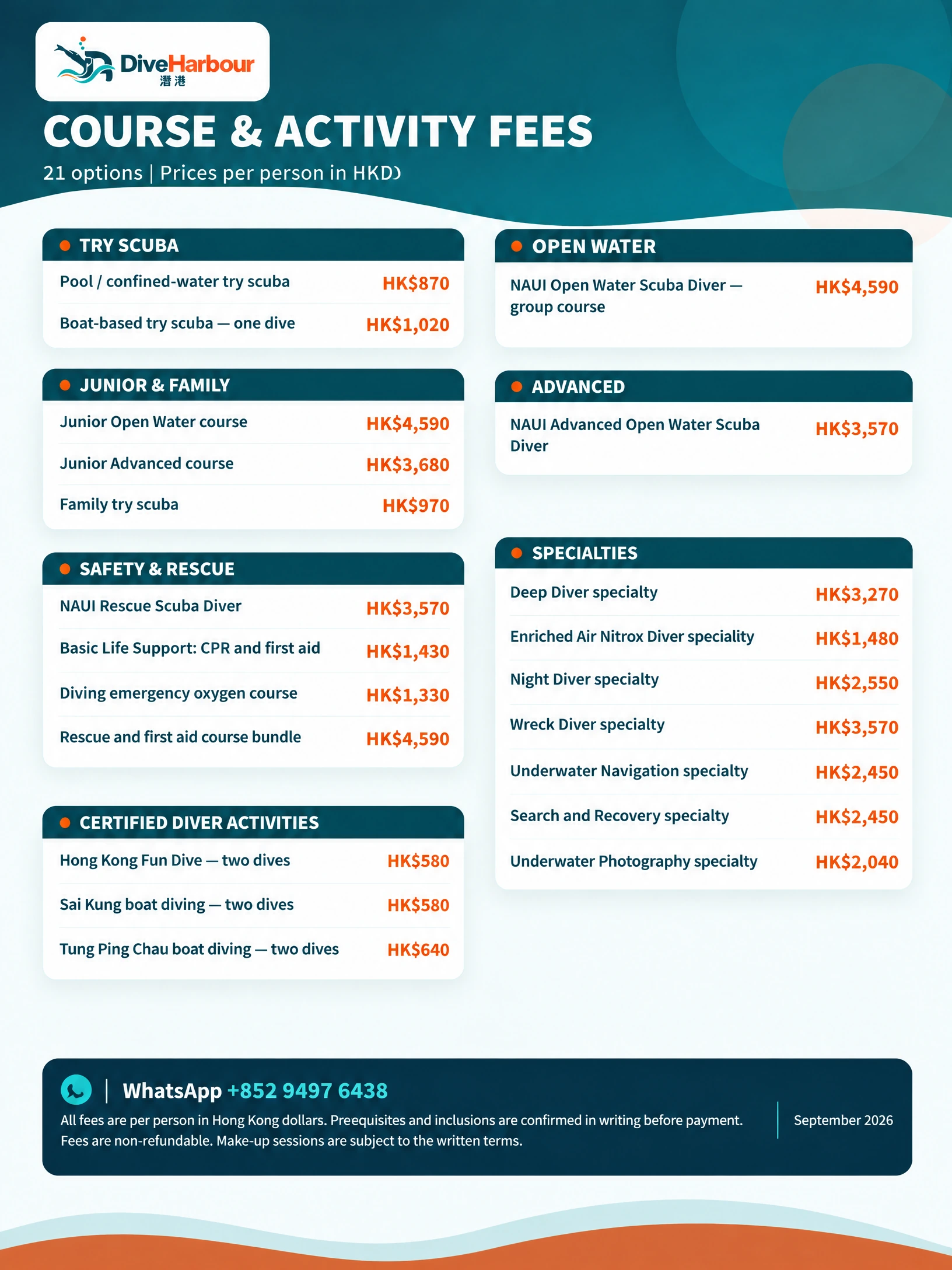
English price list for 21 DiveHarbour courses and activities, with fees per person in Hong Kong dollars
Tap the price list to view it at full size.

Plan your next dive

Course fees, clearly set out

Compare our published course and activity fees before choosing your next step. All prices are per person in Hong Kong dollars.

Before you book, we confirm prerequisites, materials, certification, equipment, venue and boat arrangements in writing. Ask us about fees for courses not listed here.

All fees are non-refundable. Make-up sessions are subject to the written terms.

Read all course fees
DiveHarbour course and activity fees per person in Hong Kong dollars
Course / activityPer person
Pool / confined-water try scubaHK$870
Boat-based try scuba — one diveHK$1,020
NAUI Open Water Scuba Diver — group courseHK$4,590
Junior Open Water courseHK$4,590
Junior Advanced courseHK$3,680
Family try scubaHK$970
NAUI Advanced Open Water Scuba DiverHK$3,570
NAUI Rescue Scuba DiverHK$3,570
Basic Life Support: CPR and first aidHK$1,430
Diving emergency oxygen courseHK$1,330
Rescue and first aid course bundleHK$4,590
Deep Diver specialtyHK$3,270
Enriched Air Nitrox Diver specialtyHK$1,480
Night Diver specialtyHK$2,550
Wreck Diver specialtyHK$3,570
Underwater Navigation specialtyHK$2,450
Search and Recovery specialtyHK$2,450
Underwater Photography specialtyHK$2,040
Hong Kong Fun Dive — two divesHK$580
Sai Kung boat diving — two divesHK$580
Tung Ping Chau boat diving — two divesHK$640