

A useful fact to keep in mind
PADI describes its Open Water course as combining knowledge development, a water-skills assessment, confined-water practice and 4 open-water dives.
Check the sourceHow to prepare for pool training after PADI eLearning
Bring your eRecord and course documents
Finishing the online knowledge development is an important milestone, but it is not the same as completing practical training. Before travelling to a Hong Kong pool, open your PADI account and check that your eLearning progress or completion record is visible. Save the eRecord confirmation where you can find it without relying on a weak mobile signal. If your instructor or dive centre has asked for a course confirmation, medical questionnaire or other form, keep the requested version ready and ask whether a digital copy is acceptable.
Use the day before training to make a short document check. Confirm your full name is consistent across the booking and eRecord, note the instructor's meeting instructions, and save the centre's contact number. If you have changed address, phone number or emergency contact since enrolling, mention it when asked. Do not assume that an online completion automatically transfers every detail to every provider: the practical session still needs a clear booking and an instructor who can verify what you have completed.
The PADI eLearning Open Water Hong Kong page is a useful place to review how online study fits into the wider course. If you are unsure whether your record is complete, send a screenshot or your eRecord reference to the centre before the session rather than trying to solve an administrative problem at the poolside. Keep the original login private; share only the information needed for verification.
- Save your eRecord confirmation and booking details offline.
- Check the meeting point, arrival time, emergency contact and document requirements.
- Write down two or three theory questions instead of attempting a last-minute re-read of every page.

Get ready for a focused pool session
Check comfort, kit and timing before you arrive
Pack for a training session rather than a beach day. Comfortable swimwear, a towel, water to drink, a change of clothes and any personal toiletries are practical basics. Bring prescription glasses or medication that you normally need, and tell the instructor where essential medication is stored. Avoid arriving dehydrated, overly tired or immediately after a heavy meal. A calm start gives you more attention for buoyancy, breathing and communication practice.
Confirm what the centre supplies and what you should bring yourself. The pool, mask, fins, exposure protection, regulator, BCD, cylinder and weights may be arranged by the provider, but equipment models and sizing can vary. If you use contact lenses, have a preferred mask or need a particular size, raise it before the day. Never borrow a piece of equipment without checking its fit and operation with the instructor. Your job is not to perform a pre-dive inspection from memory alone; it is to ask, listen and take part in the supervised checks.
Allow a buffer for Hong Kong traffic, changing and briefing. Arriving late can compress the explanation that makes the water work feel manageable. The PADI Open Water pool and sea dives Hong Kong information can help you understand how confined-water preparation connects to later dives, while the final timing, venue and equipment plan should come directly from your booking confirmation.
- Wear swimwear that stays secure under equipment and bring a warm layer for the journey home.
- Tell the instructor early about ear, sinus, skin, mobility, anxiety or previous-water concerns.
- Treat discomfort as information: pause and communicate rather than forcing a skill.

Connect online learning with practical skills
What to clarify with your instructor in Hong Kong
Online modules introduce concepts; the pool is where you learn how those concepts feel in real equipment under supervision. Before entering the water, ask how the session will be structured, which skills are planned, how signals will be used and when questions are welcome. You do not need to pretend that a diagram made perfect sense. Saying ‘I understand the idea but I am unsure how to recognise it in the water’ gives the instructor a useful starting point.
Expect repetition with a purpose. You may first watch a demonstration, then practise a skill in stages, receive feedback and try again. Mask and regulator exercises can feel unfamiliar, so agree on a clear pause signal and take a moment to settle your breathing. If you cannot equalise comfortably, stop and tell the instructor; do not force pressure changes. The instructor can adapt the explanation, position or pace and decide what is appropriate for the session.
PADI describes its Open Water course as combining knowledge development, a water-skills assessment, confined-water practice and 4 open-water dives. Its official overview says those 4 dives usually take place over at least two days. That is a course-structure reference, not a promise that every Hong Kong booking follows one timetable. Use it to ask better questions about what your own pool session covers and what remains.
- Ask which skills are demonstration-only, which you will practise, and how progress will be recorded.
- Agree on hand signals for stop, problem, okay and attention before descending below the surface.
- Request a break when concentration, temperature or comfort drops.

A practical preparation plan for the 24 hours before training
Use a simple sequence instead of cramming
The most useful preparation is boringly clear. First, check the booking message, venue, arrival time and transport route. Second, open the eRecord and revisit only the knowledge topics you marked as uncertain, such as buoyancy, hand signals, equipment roles or basic dive planning. Third, write questions in plain language. Fourth, pack your personal kit and charge your phone. Finally, sleep normally and leave enough travel time. This sequence prevents a common mistake: spending late-night energy memorising terminology while forgetting a towel, document or meeting detail.
If the session includes a swim or water-skills assessment, ask what is expected and how it will be conducted. Different agencies and course pathways can have different requirements, and the centre should explain the applicable standard rather than asking you to guess. Being comfortable in the water matters, but it does not mean you should train through illness or hide a concern. Tell the responsible instructor and follow the advice given for that booking.
Use the scuba diving course process Hong Kong guide to map your next administrative step. If you are still comparing providers, the article on how to choose a beginner scuba diving course can help you compare supervision, communication, equipment arrangements and the route from pool to open water—not just the headline price.

Choose the right follow-up after your pool practice
Compare what you need, not just what is available
After the pool session, ask what you completed, what needs more practice and what the next booking includes. Some learners need another explanation or a slower attempt; others are ready to progress but need to organise open-water dates. A constructive debrief should leave you with a clear next action and an honest understanding of any remaining skills. Do not treat a single difficult exercise as a verdict on your ability to learn. Practical training is designed to turn feedback into improvement.
The PADI vs SSI for learning to dive in Hong Kong comparison is relevant if your online learning and intended practical pathway do not appear to match. Ask whether the eLearning record is accepted for the planned course, which agency issues the certification, and whether the instructor can explain the transition before you pay for another product. A provider should be able to state inclusions and exclusions clearly, including pool time, equipment, open-water dives, certification processing and transport.

Questions to settle before you book
Make the next conversation specific
A short message can prevent most avoidable surprises: ‘I completed PADI eLearning on [date]. Is my eRecord sufficient for your pool session? What should I bring, what equipment is included, where do I meet you, and what happens if I am unwell or cannot complete a skill?’ Include your preferred dates and any relevant comfort or access consideration. Ask for the written terms before paying, and keep the reply with your booking record.
Prices, locations, equipment and dates can change, so do not infer a current quotation from a blog article. If you need help deciding whether your completed online module matches the practical session, contact DiveHarbour with the course name and eRecord details. The goal is a prepared, informed start—not rushing into the water with unanswered administrative or personal-safety questions.
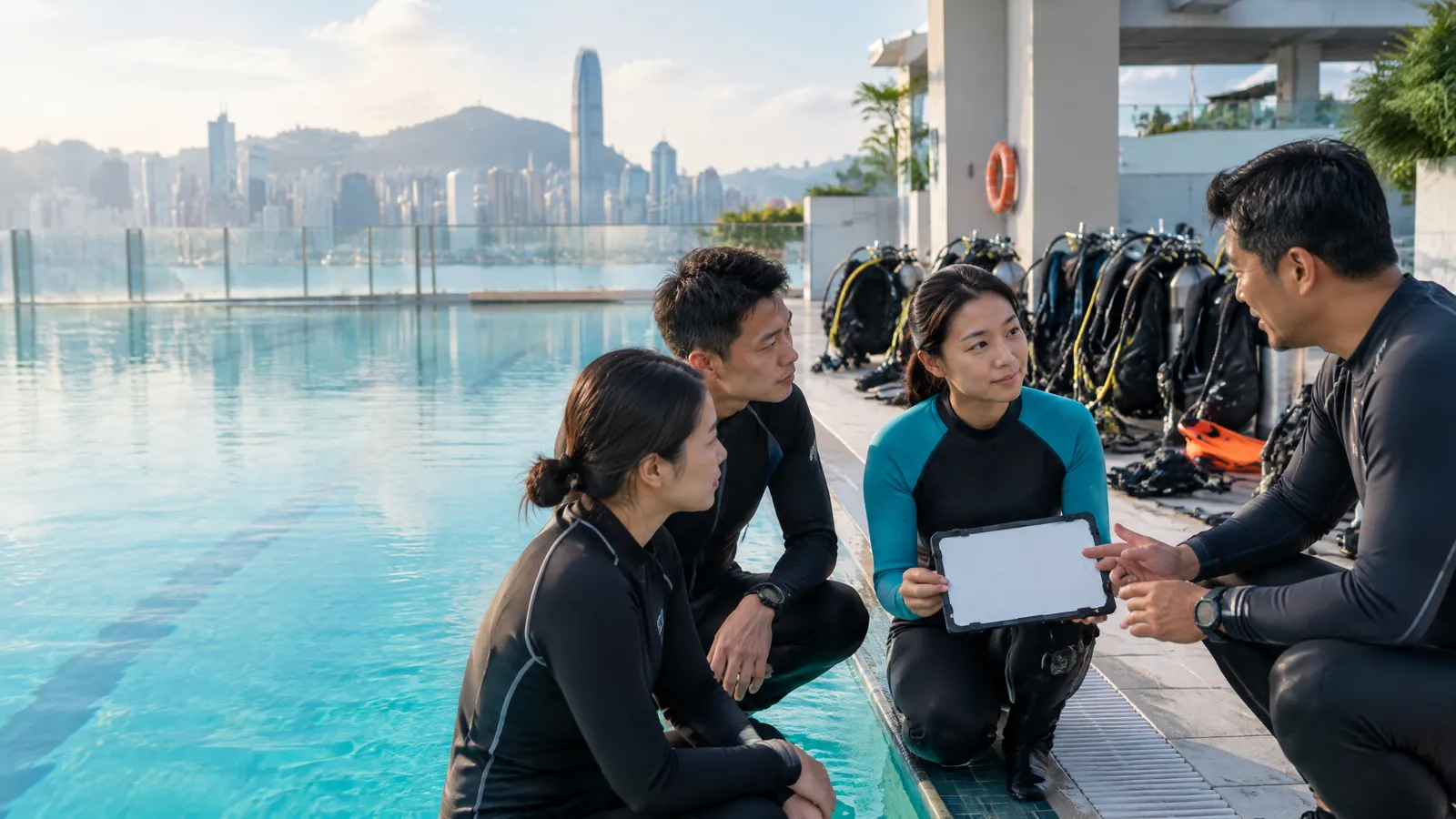
Pool-training preparation checklist
| Preparation area | Do before arrival | Confirm with the instructor |
|---|---|---|
| Record | Open eRecord, save confirmation and note questions | Whether the record matches this course pathway |
| Personal kit | Swimwear, towel, water, change of clothes and essentials | What equipment and sizes are supplied |
| Timing | Check venue, transport and a sensible arrival buffer | Briefing start, session length and meeting point |
| Comfort | Rest normally and disclose relevant concerns | Pause signals, adaptations and next steps |
How to prepare for pool training after PADI eLearning — common questions
What should I bring to pool training after completing PADI eLearning?Toggle answer
Keep your PADI eRecord or completion details and any requested documents accessible. Bring suitable swimwear, a towel and personal water essentials. Confirm equipment arrangements, meeting details and timing with DiveHarbour before the session, as these practical arrangements may vary.
Do I need to repeat all the PADI eLearning before pool training?Toggle answer
Usually, revisit the topics you found unclear and note questions for your instructor rather than repeating everything automatically. Pool training is supervised practical learning, so your instructor can connect the theory with the skills being introduced and clarify anything you do not understand.
What if I feel nervous or cannot complete a pool skill?Toggle answer
Tell the instructor promptly and use the agreed stop signal. The instructor can pause, explain, demonstrate or adapt the practice where appropriate. Do not force breathing, equalisation or mask skills, and do not hide illness or discomfort. Ask what needs more practice and what the written next-step arrangement is.
Are pool-training fees refundable, and can I automatically reschedule?Toggle answer
Fees are non-refundable unless the written booking terms say otherwise. Make-up sessions or date changes are available only where those written terms permit them; never assume a guaranteed reschedule. Ask about illness, lateness and incomplete-skill policies before payment.
Should I choose PADI or SSI after starting online learning?Toggle answer
First confirm which agency issued your eLearning record and whether the planned practical session accepts it. Compare the complete pathway, instructor communication, supervision, equipment and open-water arrangements rather than choosing from a label alone. Ask the provider to confirm the match in writing before booking.
Take the question with you
Your best next step is to check the eRecord, send the centre a focused list of questions, and pack for a calm, well-supported pool session. Arrive ready to communicate, not to prove anything. Once the instructor confirms your documents, equipment and pathway, you can concentrate on learning each skill carefully and deciding together what comes next.
Sources worth checking
- PADI: What are the 4 PADI Open Water Dives?
PADI states that the Open Water Diver course combines knowledge development, confined-water practice and four open-water dives, usually over at least two days.
- NAUI: Open Water Scuba Diver (Autonomous-ISO Level 2)
NAUI describes this entry-level course as teaching fundamental knowledge and skills for open-water scuba diving, with a minimum age of 15 by the water phase for the autonomous course.
Useful next reads for your plan
If you are still comparing routes, these related pages give you practical questions to bring into your next conversation with an instructor.
Put your plan into practice
Useful planning guides
PADI Open Water plan Hong Kong: a practical study route
Use this PADI Open Water plan Hong Kong worksheet to compare practical options, check key decision points, and confirm current details with DiveHarbour.
PADI Open Water plan Hong Kong
