SAFE LEARNING · HAPPY EXPLORING
DiveHarbour

DiveHarbour · Practical guide

Quote scope breakdown for a clearer coastal styling budget

A quote scope breakdown turns one coastal styling total into a set of checkable decisions. Separate the visible service from assumptions, timing, possible additions, and change or cancellation terms. Ask for the scope in writing, compare like with like, and keep appearance planning separate from medical questions, product handling, and any decision about entering the water.

By DiveHarbour9 min read
Ask about diving courses or coastal trip planning Read the guide
quote scope breakdown concept illustration for a coastal styling consultation
Illustration · Concept illustration: organising a coastal styling quote; not a DT HUB shop, medical setting, product, customer, student, or before-and-after result.

Instructor qualifications

One clear teaching conversation from first breath to next step

DiveHarbour brings together scuba teaching, swimming, lifesaving and water-rescue experience so you can ask practical questions before choosing a course.

  • PADI teaching backgroundTeaching experience across recognised scuba learning pathways.
  • SSI teaching backgroundClear explanations when you are comparing agency routes.
  • NAUI teaching backgroundA practical, standards-aware approach to learning and progression.
  • Swimming foundationWater confidence and calm, step-by-step practice matter.
  • Lifesaving experienceSurface awareness and prevention stay part of the conversation.
  • Pool rescue experienceControlled practice can build confidence before open water.
  • Beach rescue experienceLocal water context informs sensible preparation.
  • Kayak rescue experienceA wider water-safety perspective supports good judgement.
  • PWC rescue experienceAsk about the right learning route for your experience and goals.

Brand relationship: DiveHarbour and DT HUB share the same owner.

DiveHarbour and DT HUB are operated by the same owner. DT HUB links in this article are references to external service and product information, not independent third-party recommendations, medical claims, or endorsements of water-activity safety. DiveHarbour handles diving and coastal activities; DT HUB handles salon, hairpiece, academy, and hair-growth enquiries, which must be checked with the relevant provider.

A useful fact to keep in mind

Consumer Protection New Zealand distinguishes an estimate as a rough cost idea from a quote as an offer for a specified price, and says an accepted quote generally cannot be exceeded unless the customer agrees to extra work or the scope changes. [2]

Check the source
Key takeaways

Four points to carry forward

  • Ask whether the figure is a quote or an estimate, then request the scope and assumptions in writing.
  • Separate the core styling service from washing, preparation, trials, travel, extra length, products, and event-day adjustments.
  • Write down which changes need approval, how timing changes are handled, and what cancellation or rescheduling terms apply.
  • Treat hair-growth and scalp labels as enquiry starting points, not as diagnoses, treatment advice, results, or approval for water activity.
Start here

Quote scope breakdown: start with the total's meaning

Use a quote scope breakdown before comparing coastal styling totals

A large number at the bottom of a message is not yet a useful comparison. First identify whether the provider is offering a quote for a specified scope or an estimate based on limited information. Consumer Protection New Zealand describes an estimate as a rough cost idea and a quote as an offer for a specified price. [2] That distinction changes what you should ask next.

For a shore-day appointment, write the job in ordinary terms before looking at the total. State the event date, the setting, the number of people, the visible style you want to discuss, and the time by which everyone must be ready. Add what you already know about hair length, current condition, previous services, and whether a trial or a second look is being considered. This is a planning brief, not a promise about what can be done.

A general directory can be a starting point for questions, but it cannot decide your personal scope. For example, hair salon kwun tong is service information rather than an independent recommendation or a price promise. Ask the relevant provider to state what the figure covers, what it assumes, and which details could change it.

  • Name the occasion, date, location, people, and required ready time.
  • Describe the visible outcome and the parts of the outfit or photograph that must remain clear.
  • List known hair length, condition, previous services, and any trial or second-look request.
  • Mark every unknown that needs the provider's confirmation before acceptance.
Guide · 02

List the inclusions that make a styling quote comparable

Separate the core service from preparation, materials, and timing

The first pass should turn a vague service name into observable tasks. Ask whether the stated work includes washing, drying, detangling, preparation, styling, finishing, and removal or reset. If a cut, colour, extension, hairpiece, or makeup element is part of the conversation, ask whether each is included, optional, or handled by another provider. A quote can be easy to compare only when the same work appears in every version.

Consumer Affairs Victoria advises that a clear quote should say what it covers and identify items such as transport, materials, labour, call-out fees, and weekend or public-holiday rates. [1] A coastal appointment may use different labels, but the checking habit transfers well: ask who supplies products and tools, whether travel is included, and whether timing is a guide or a committed part of the arrangement.

If you are simply trying to understand how a listed service is described, hair growth center kwun tong should be treated as a service-information page only. It does not establish that a consultation, assessment, treatment, product, result, or event styling element is included. Put every inclusion and exclusion in the written reply you plan to compare.

Swipe the table to compare all columns.

A coastal styling quote: separate the price from its scope
Quote fieldWhat to recordQuestion to ask
Core serviceWashing, preparation, styling, finishing, reset, or another named taskWhich tasks are included, and which are separate?
Event conditionsDate, setting, people, required ready time, and visible outfit detailsWhich conditions did you use when preparing this figure?
Materials and travelProducts, tools, transport, call-out, and any outside-provider workWho supplies each item, and what is not covered?
Timing and trialsPreparation window, trial date, second look, and reset requestIs timing a guide, and what changes if the plan expands?
Coastal quote inclusions and assumptions planning concept illustration
Illustration · Concept illustration: separating inclusions and assumptions for a shore-day appointment; not a DT HUB shop, medical setting, product, customer, student, or before-and-after result.
Guide · 03

Make assumptions and possible additions visible

A fair quote comparison records the conditions behind the number

Two totals may differ because the providers are picturing different work. One may assume clean, dry hair and a straightforward appointment. Another may allow time for preparation, extra length, more people, a trial, or a requested change between photographs and dinner. Do not label the higher or lower figure as better until you know which assumptions produced it. Ask each provider to describe the starting condition they used.

Use a simple three-part note: included now, conditional later, and not offered. Conditional items might include unusually long or thick hair, a second styling change, additional people, travel outside the usual setting, special products, or a trial on another date. The point is not to predict an extra amount. It is to learn what event or request would require a fresh confirmation before work begins.

When a reader searches for hair loss hong kong, the label may help locate information, but it is not a diagnosis or a personal recommendation. Keep a quote conversation about its stated service scope. If you have a health concern, ask an appropriately qualified healthcare professional separately, and do not treat an appearance quote as evidence about cause, treatment, or outcome.

  • Included: write the exact preparation, service, finishing, people, and setting covered by the figure.
  • Conditional: list the hair, timing, travel, product, or additional-look conditions that need confirmation.
  • Excluded: record work that is not offered or must be arranged with another provider.
  • Trigger: note the event or request that would require a revised scope before proceeding.
Guide · 04

Ask how event-day changes will be handled

Treat timing, variations, and cancellation as separate quote questions

A coastal plan can change because the event schedule moves, the group size changes, or the requested look becomes more involved. Consumer Affairs Victoria recommends agreeing in advance how quote or timeframe changes, delays, late payment, and quality concerns will be handled, and documenting conversations about cost or quality. [1] Use that as a prompt for questions, not as a claim about the law governing a Hong Kong appointment.

Ask what must happen before a change becomes part of the booking. Is a written approval needed? Who confirms a new start time? If a trial becomes an event-day service, is the scope rewritten? If the provider cannot accommodate a late change, what alternative is available? The useful answer is a process you can understand before the day, not an informal assurance that everything will be sorted out later.

For a separate activity-budget comparison, what is included in a Hong Kong scuba course fee helps illustrate why inclusions and exclusions deserve their own questions. It does not define a styling quote, and it does not make a hair service part of a diving course. Keep the two decisions independent.

A page labelled hair loss treatment kwun tong is likewise only a provider-side information label. Do not read it as a promise of treatment, eligibility, timing, price, or hair regrowth. If a quote uses health-related language, ask what service is actually being offered and what qualifications, risks, alternatives, and follow-up questions should be addressed by the relevant professional.

Coastal event-day quote change questions concept illustration
Illustration · Concept illustration: recording timing and change questions for a coastal event; not a DT HUB shop, medical setting, product, customer, student, or before-and-after result.
Guide · 05

Keep appearance, health, and water decisions apart

Quote scope breakdown: know which question belongs to whom

A styling quote answers a commercial scope question: what service is proposed, under which assumptions, on what date, and with what possible changes. It does not determine whether a symptom needs medical assessment, whether a product is suitable for your skin or scalp, or whether a person is fit for a water activity. Pain, redness, sudden patchy hair loss, or another worrying change should be taken to a qualified medical professional rather than folded into a salon decision.

The same boundary applies to hairpieces and coastal activities. A hairpiece is an appearance choice, not a treatment, and a quote does not confirm water suitability, equipment compatibility, or secure wear in the water. Ask the product provider about handling and the activity provider about activity requirements. If those answers are missing, keep the plan on shore instead of filling the gap with an assumption.

A service label such as tcm hair loss treatment should therefore be read as a prompt to ask what is actually offered, who provides it, and what the written terms say. It is not independent medical evidence. Do not use a directory page to choose acupuncture, herbs, medication, scalp procedures, or any other intervention for yourself.

Swipe the table to compare all columns.

Questions to put beside any event-day change or cancellation term
Possible changeTrigger to identifyWritten confirmation to request
More workExtra length, people, products, preparation, or a second lookThe revised tasks and the new figure before approval
Time changeA later start, delayed arrival, or shortened preparation windowThe new sequence, finish limit, and who confirms it
Date or venue changeA moved event, different setting, or added travel requirementWhether the original scope still applies or must be reissued
Cancellation or reschedulingThe notice point, deposit language, and provider availabilityThe applicable written terms, without assuming a refund or fee
Guide · 06

Compare the written replies and choose the next question

Close your quote scope breakdown with evidence and a fallback

Once replies arrive, compare the scope before comparing totals. New Zealand Consumer Protection recommends requesting detailed written quotes or estimates, stating the dates needed, and checking what work, other costs, hourly rates, and timing are shown. It also says comparison should consider more than price. [2] For a coastal day, reliability of the proposed sequence and clarity about changes may matter more than a superficially lower number.

Save the original message, your brief, the provider's questions, the final scope, and any later variation. Circle every phrase that could be read two ways, such as ‘from,’ ‘standard,’ ‘as needed,’ ‘touch-up,’ ‘extra,’ or ‘subject to assessment.’ Ask for a plain-language explanation and a revised written scope when an answer changes the job. This record helps you remember what you accepted and what remained open.

If scalp or hair-loss wording leads you to tcm acupuncture kwun tong, keep your questions neutral. Ask about provider qualifications, the proposed service, foreseeable risks, alternatives, fees, and what information is needed before any decision. Do not infer efficacy, suitability, or a result from the page title, and do not treat it as approval for a coastal or water activity.

For the activity side of the day, Hong Kong scuba course cost breakdown is a separate budgeting reference. It can help you think in line items, but it does not combine with a styling quote or guarantee a date, place, equipment arrangement, or activity clearance. Finish with one fallback: a simpler shore-only look, a shorter service, or a schedule that leaves more time for questions.


Written quote comparison and fallback planning concept illustration
Illustration · Concept illustration: comparing written scope and a shore-only fallback; not a DT HUB shop, medical setting, product, customer, student, or before-and-after result.
A sensible next step

Take the question with you

Before accepting a coastal styling total, make a one-page record of the core service, starting assumptions, inclusions, exclusions, timing, possible additions, and change or cancellation questions. Ask for unclear points in writing. If an important answer remains open, choose a simpler shore plan or postpone the decision rather than relying on a price that does not describe its scope.

DiveHarbour can answer questions about diving and coastal activities. Styling, salon, hair-growth, hairpiece, academy, and related consultation questions belong to DT HUB and must be checked with the relevant provider. This article does not give medical advice, promise a result, or approve anyone for a water activity.

Questions to ask

Common questions

What is the difference between a quote and an estimate?

An estimate is a provider's rough cost idea based on the information available. A quote is an offer for a specified price and scope. Ask which one you received, then request the assumptions and work list in writing.

Which inclusions should I check for a coastal styling appointment?

Check the named preparation and styling tasks, washing or drying, products and tools, travel, the number of people, trials, timing, and any reset or second-look request. Ask what is excluded instead of treating a blank space as included.

What if the event date or styling request changes?

Ask what starts a variation, who must approve it, and when the provider will issue a revised scope. Keep the original reply and the change confirmation together. Do not assume a new date, extra work, refund, deposit treatment, or availability without written terms.

Can a styling quote confirm medical or water-activity suitability?

No. A quote covers commercial scope and timing. Health concerns require a qualified medical professional, while product handling and activity suitability require the relevant providers. A hairpiece or styling plan does not automatically become suitable for entering the water.

Further reading

Official sources worth checking

  • [1] Giving quotes - tradespeople and small works

    Consumer Affairs Victoria says a quote should be clear about what it covers, should give a careful estimate of timing, and should address how quote or timeframe changes, delays, late payments, and quality concerns will be handled.

  • [2] Quotes and estimates

    New Zealand Consumer Protection describes an estimate as a rough cost idea and a quote as an offer for a specified price; it says an accepted quote generally cannot be exceeded unless the customer agrees to extra work or the scope changes.

Continue exploring

Keep comparing practical questions before you choose a course, activity or preparation step.

Coastal life and image planning · Updated 2026-11-06

colour-perm order: Plan Coastal Hair Changes with Care

Use a colour-perm order to separate hair facts, provider scope, and event timing before a coastal day. Read the checklist and ask informed questions.

colour-perm order

Coastal life and image planning · Updated 2026-11-06

Outdoor-light reference brief for coastal photo planning

Use an outdoor-light reference brief to plan light, framing, neckline and styling limits for a coastal shoot. Read the checklist and ask better questions.

outdoor-light reference brief

Coastal life and image planning · Updated 2026-11-06

Multi-event style order for a coastal day | DiveHarbour

Plan a multi-event style order for swim, lunch, photos and dinner. Use reset windows, provider questions and weather backups before you book or ask.

multi-event style order
Your next step

Ask about diving courses or coastal trip planning

Message DiveHarbour on WhatsApp to discuss diving courses or coastal trip planning, along with your experience and preferred dates.

Ask about diving courses or coastal trip planning
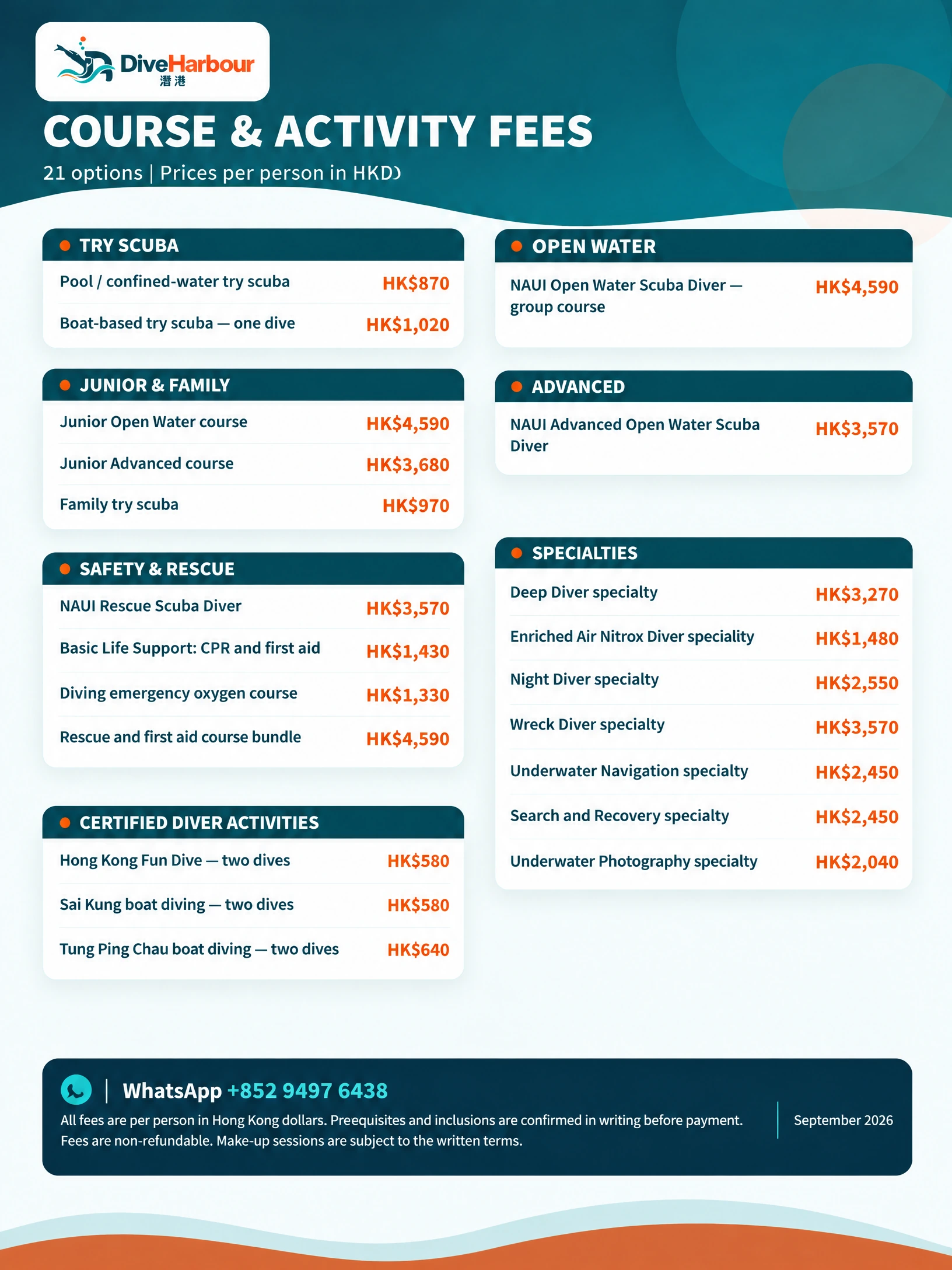
English price list for 21 DiveHarbour courses and activities, with fees per person in Hong Kong dollars
Tap the price list to view it at full size.

Plan your next dive

Course fees, clearly set out

Compare our published course and activity fees before choosing your next step. All prices are per person in Hong Kong dollars.

Before you book, we confirm prerequisites, materials, certification, equipment, venue and boat arrangements in writing. Ask us about fees for courses not listed here.

All fees are non-refundable. Make-up sessions are subject to the written terms.

Read all course fees
DiveHarbour course and activity fees per person in Hong Kong dollars
Course / activityPer person
Pool / confined-water try scubaHK$870
Boat-based try scuba — one diveHK$1,020
NAUI Open Water Scuba Diver — group courseHK$4,590
Junior Open Water courseHK$4,590
Junior Advanced courseHK$3,680
Family try scubaHK$970
NAUI Advanced Open Water Scuba DiverHK$3,570
NAUI Rescue Scuba DiverHK$3,570
Basic Life Support: CPR and first aidHK$1,430
Diving emergency oxygen courseHK$1,330
Rescue and first aid course bundleHK$4,590
Deep Diver specialtyHK$3,270
Enriched Air Nitrox Diver specialtyHK$1,480
Night Diver specialtyHK$2,550
Wreck Diver specialtyHK$3,570
Underwater Navigation specialtyHK$2,450
Search and Recovery specialtyHK$2,450
Underwater Photography specialtyHK$2,040
Hong Kong Fun Dive — two divesHK$580
Sai Kung boat diving — two divesHK$580
Tung Ping Chau boat diving — two divesHK$640