

A useful fact to keep in mind
NAUI's official page identifies 1 prerequisite pathway category: current full CPR training from an accepted provider.
Check the sourceEmergency Oxygen for Scuba Diving Injuries course Hong Kong: who it suits
Choose focused oxygen training for dive-safety responsibilities
An underwater incident can leave a diver, buddy, boat crew member or shore-side helper needing to make sensible decisions before professional medical care arrives. The Emergency Oxygen for Scuba Diving Injuries course Hong Kong is designed around that narrow but important responsibility: recognising possible diving-related illness, understanding the role of emergency oxygen and fitting an appropriate response into a wider emergency plan. It is useful for recreational divers, regular buddies, dive leaders, instructors, boat operators and family members who want a clearer safety role without pretending to be clinicians.
This is focused first-aid education, not a promise that every incident can be diagnosed at the scene. A participant learns to notice concerning signs, communicate useful information and support a diver while emergency services or medical professionals are contacted. The course does not grant permission to ignore local emergency procedures, delay evacuation or make a medical diagnosis. If you are asking about your own fitness to dive, discuss that question with a qualified physician rather than treating a training certificate as medical clearance.
The most useful starting point is to describe your real situation. Are you usually diving from a boat, helping family members at a beach, leading club outings, or maintaining safety readiness for a small team? Tell DiveHarbour whether you already hold CPR or first-aid training, what agency training you use and whether you want a standalone oxygen course or a broader plan. This makes the enquiry practical instead of assuming that one course suits every diver.
- Ask for the current learning outcomes, certificate or provider details before booking.
- Choose a course that reflects your likely role, available equipment and local emergency-contact plan.
- Keep physician advice and emergency-service decisions separate from course marketing or certification language.
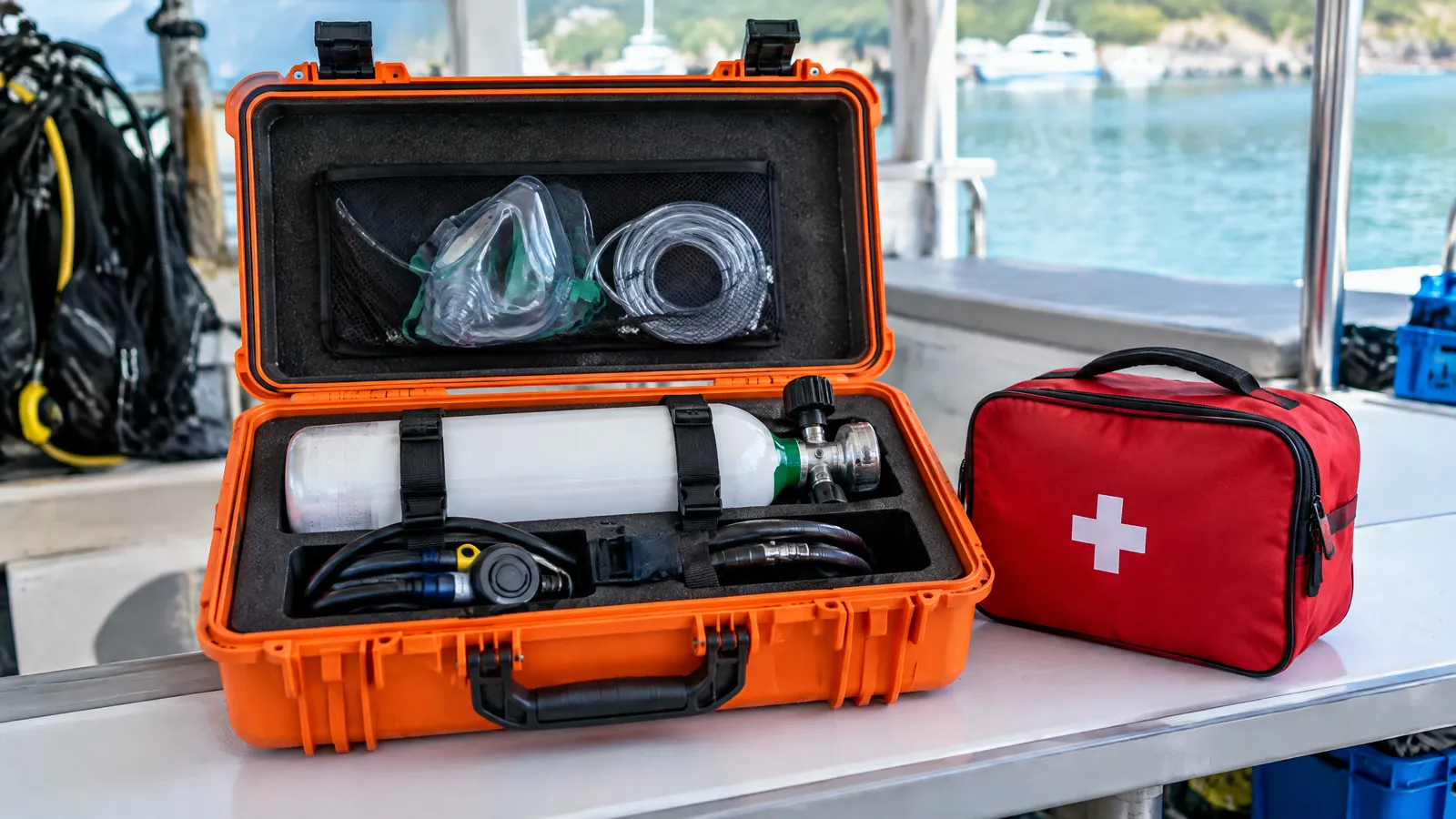
What emergency-oxygen training covers for diving incidents
Connect recognition, response and professional medical help
The learning journey normally begins with recognition. Rather than memorising a dramatic scenario, participants consider why an unusual symptom after diving deserves attention, what information a responder should record and how to communicate clearly with the person coordinating professional help. The official NAUI course description says the DAN-powered programme teaches recognition of signs and symptoms of decompression illness and appropriate response. That is a useful boundary: awareness and first aid support are central, while diagnosis and definitive treatment belong to medical professionals.
The next layer is oxygen awareness. Training can introduce the purpose of emergency oxygen, the parts of an oxygen-delivery system and supervised practice with the equipment included in the provider's curriculum. It should also explain that delivery choices depend on the casualty's condition and the equipment available. This page intentionally does not turn a short webpage into a substitute for hands-on instruction. In a real emergency, activate local emergency services, follow the trained protocol and seek professional guidance rather than relying on an online checklist.
Communication and handover are just as important as equipment familiarity. A good participant should be ready to pass on the dive profile and timeline as accurately as possible, describe observed changes, identify what first aid has been provided and keep the incident record organised. Emergency oxygen is part of a coordinated response, not an isolated trick. The course should therefore sit alongside appropriate CPR, first aid, buddy awareness, transport planning and contact details for local emergency support.
The course is relevant beyond one type of dive. The NAUI description notes that the response skills are applicable to other watersports and activities, but that does not mean every sport has identical hazards or emergency procedures. Ask how the instructor frames the content for Hong Kong conditions, your usual boat or shore setting and the resources you can realistically access.

Planning your DiveHarbour course enquiry
Clarify prerequisites, course scope and current arrangements
Before choosing a date, confirm the prerequisite. NAUI states that current DAN BLS: CPR & FA, CPR: HCP provider or other nationally recognised full CPR training is a prerequisite for its Emergency Oxygen for Scuba Diving Injuries course. In practical terms, NAUI's official page identifies 1 prerequisite pathway category: current full CPR training from an accepted provider. Provider policies can change, and local delivery may use a different published arrangement, so send a copy or description of your current CPR qualification for checking. If you need the foundation course first, compare it with EFR Primary and Secondary Care course Hong Kong rather than assuming oxygen training includes every first-aid skill.
You can also ask whether the intended course is the same provider pathway as the Emergency Oxygen Provider course Hong Kong, or whether the wording describes a separate course arrangement. Confirm what is taught, how practical equipment work is supervised, what learning materials are supplied, how assessment is handled and what certificate or card is issued. These details matter more than a broad label because oxygen education is only useful when participants understand the limits of their training and can access suitable equipment and help.
If your longer-term aim is broader diver-rescue capability, discuss progression to the Rescue Diver course Hong Kong. A rescue course and an oxygen course serve different purposes: one may develop a wider set of prevention, self-rescue and diver-assistance skills, while the other concentrates on oxygen first aid for diving injuries. The best sequence depends on your existing certification, confidence, fitness, schedule and the agency's current prerequisites.
- Share your current CPR/first-aid qualification and its expiry or renewal status.
- Ask what equipment, documents, language support and supervised practice are included.
- Request written confirmation of fee inclusions, cancellation terms and any required preparation.

Match oxygen training with the rest of your safety plan
Build capability in a sensible order
A focused oxygen class is strongest when it answers a real gap. Someone who has never taken CPR may need a foundation course before oxygen practice. A certified diver who regularly joins boat trips may value oxygen awareness but still need to review buddy procedures, surface communication, emergency contacts and how the operator manages an injured passenger. A dive leader may want to add rescue training and a simple equipment-readiness check. These are different needs, so ask for a pathway rather than automatically adding every available course.
For a wider plan, review Rescue Diver prerequisites and be candid about any concern affecting water participation. Prerequisites are not a test of personal worth; they help an instructor confirm that the course is suitable and that participants can engage safely. If you are returning after a long break or changing the kind of diving you do, Rescue Diver fitness preparation may help you think through preparation questions, but it cannot replace individual medical advice or an instructor's assessment.
Keep the practical plan visible: who calls emergency services, who meets responders, where the first-aid and oxygen equipment is kept, who records observations and how the group avoids crowding the casualty. Training should make those roles clearer, not encourage untrained people to improvise. In Hong Kong, also ask how local transport, vessel access and language needs are handled for your particular dive setting.

Compare course formats before you book
Use the enquiry to check fit, not just availability
There are three useful ways to frame your enquiry. A standalone oxygen course may be the right answer when your CPR qualification is current and your safety role is specific. A foundation-first route may be better when you need CPR and first aid before oxygen. A broader rescue pathway can make sense when you want to support divers in more situations. The table below is a conversation guide, not a promise that all formats, dates or certificates are available at every intake.

Safety boundaries, questions and next steps
Turn interest into a clear, responsible booking decision
Emergency oxygen training should increase confidence without creating false certainty. Symptoms after a dive deserve prompt professional attention, and a course does not authorise a participant to diagnose decompression illness, prescribe treatment or postpone evacuation. Follow the instructor's current protocol, local emergency guidance and the advice of medical professionals. Bring honest information about your previous training and ask questions whenever a boundary is unclear.
For an enquiry, send your preferred language, current CPR or first-aid qualification, number of learners, typical diving environment and any accessibility question. Ask whether the course is delivered in a classroom, pool or another setting, what hands-on practice is included and whether the schedule is confirmed. DiveHarbour can then explain current arrangements rather than offering a generic promise.
- Do not use this webpage as a treatment guide or delay emergency medical care.
- Confirm prerequisites and course provider before paying.
- Keep all fee, cancellation and make-up-session terms in writing.

Which emergency-training conversation fits your current need?
| Option | Best for | Check |
|---|---|---|
| Standalone emergency oxygen | Divers or safety helpers with current full CPR training | Provider, prerequisite, equipment practice and certificate |
| CPR/first-aid first, then oxygen | Learners who need the foundation before a focused oxygen course | Whether the foundation course is accepted and how the two courses are scheduled |
| Rescue plus emergency training | Divers seeking broader prevention, assistance and response capability | Rescue prerequisites, water skills, fitness expectations and separate oxygen scope |
Emergency Oxygen for Scuba Diving Injuries course Hong Kong — common questions
Is this course the same as an EFR CPR or first-aid refresher?Toggle answer
No. Emergency oxygen training has a different focus from CPR and first-aid refresher content. They may sit within a broader emergency-training plan, but an oxygen course should not be treated as an EFR refresher or a replacement for other relevant training. Confirm the current prerequisite and provider pathway before booking.
Who should ask about emergency oxygen training for diving?Toggle answer
Divers, dive leaders, boat crews, buddies and people involved in diving-safety planning may wish to ask whether this focused course matches their role. DiveHarbour can explain scope and arrangements; personal medical decisions and dive clearance remain matters for a qualified physician.
Do I need CPR or first-aid training first?Toggle answer
Often, yes. NAUI's official course page lists current DAN BLS: CPR & FA, CPR: HCP provider or another nationally recognised full CPR qualification as a prerequisite. Local delivery requirements should be confirmed in writing because agency and provider arrangements can change.
Is the course fee refundable, and can I automatically move to another date?Toggle answer
Ask for the written booking policy before payment. Course fees are non-refundable unless the stated terms say otherwise, and make-up sessions or date changes are available only where the written terms permit them; no automatic reschedule or guaranteed alternative date should be assumed.
Can this course diagnose or treat a diving injury?Toggle answer
No. It teaches recognition and emergency-oxygen first-aid skills within a trained response, not diagnosis or definitive treatment. Activate local emergency services, follow current course and professional guidance, and seek urgent medical assessment for a suspected diving injury.
Take the question with you
If you already hold suitable CPR training and want a focused role in diving emergency readiness, message DiveHarbour with your qualification details and typical Hong Kong diving setting. If you need a foundation or broader rescue skills, ask for the most sensible sequence instead of booking by title alone. Confirm the provider, scope, practical work, current fee and written policy before committing, then keep professional emergency help at the centre of every response.
Sources worth checking
- NAUI: Emergency Oxygen for Scuba Diving Injuries
NAUI says the DAN-powered course teaches recognition of decompression-illness signs and symptoms, emergency oxygen first aid and appropriate response; it lists current full CPR training as a prerequisite.
Useful next reads for your plan
If you are still comparing routes, these related pages give you practical questions to bring into your next conversation with an instructor.
Put your plan into practice
Useful planning guides
Emergency oxygen training path for Hong Kong divers
Use this emergency oxygen training path worksheet to compare practical options, check key decision points, and confirm current details with DiveHarbour.
emergency oxygen training path
