Scalp consult file: record coastal-day changes clearly
A scalp consult file turns a worrying coastal-day memory into a neutral record. Note the date, what you noticed, how quickly it changed, sensations, products, and photos taken in repeatable conditions. Use those observations to ask a qualified provider about assessment, scope, risks, alternatives, and referral. Do not treat the file as a diagnosis or as approval for any water activity.
Illustration · Concept illustration: neutral notes for a scalp consultation; not a DT HUB shop, medical setting, product, customer, student, or before-and-after result.
Instructor qualifications
One clear teaching conversation from first breath to next step
DiveHarbour brings together scuba teaching, swimming, lifesaving and water-rescue experience so you can ask practical questions before choosing a course.
PADI teaching backgroundTeaching experience across recognised scuba learning pathways.
SSI teaching backgroundClear explanations when you are comparing agency routes.
NAUI teaching backgroundA practical, standards-aware approach to learning and progression.
Swimming foundationWater confidence and calm, step-by-step practice matter.
Lifesaving experienceSurface awareness and prevention stay part of the conversation.
Pool rescue experienceControlled practice can build confidence before open water.
Beach rescue experienceLocal water context informs sensible preparation.
Kayak rescue experienceA wider water-safety perspective supports good judgement.
PWC rescue experienceAsk about the right learning route for your experience and goals.
Brand relationship: DiveHarbour and DT HUB share the same owner.
DiveHarbour and DT HUB are operated by the same owner. DT HUB links in this article are references to external service and product information, not independent third-party recommendations, medical claims, or endorsements of water-activity safety. DiveHarbour handles diving and coastal activities; DT HUB handles salon, hairpiece, academy, and hair-growth enquiries, which must be checked with the relevant provider.
A useful fact to keep in mind
The American Academy of Dermatology says hair loss may appear gradually or suddenly, and it lists intense itching, burning, tenderness, scaly patches, sores, redness, and swelling among signs that can accompany hair loss. [1]
Write the event date, first notice, and rate of change before adding any theory about what caused it.
Describe visible features and sensations separately, using repeatable photographs and plain words rather than a self-diagnosis.
List every relevant product or change in routine, but label coastal exposure as context rather than proof of cause.
Ask about qualifications, assessment scope, risks, alternatives, and referral; keep appearance choices and water-activity decisions separate.
Start here
Scalp consult file: start with a neutral timeline
Use a scalp consult file to separate timing from assumptions
Begin with the coastal day as a dated event, not as an explanation. Write the location or activity, approximate start and finish, weather as you remember it, when you first noticed a difference, and whether it was still present later. A gap between an event and an observation matters because memory tends to compress several changes into one story.
Next, record the change at three points: before the day, when you first noticed it, and when you made the record. Use words such as ‘more shedding while brushing,’ ‘a visible part,’ or ‘a small area looked different.’ The American Academy of Dermatology lists gradual thinning and widening parts as possible signs, but it also notes that hair loss can appear suddenly, including a bald patch or strip within one or two days. That range is a reason to record speed carefully, not to name a condition. [1]
If you need a separate appearance conversation while documenting the concern, glueless wig is a DT HUB product-information reference only. It does not assess a scalp, treat a medical problem, confirm comfort for water, or promise a particular look. Ask the relevant provider about materials, fitting, cleaning, and scope instead of allowing an appearance page to answer a health question.
Event: date, setting, activity, and approximate duration.
First notice: what you saw or felt, and when you noticed it.
Change rate: gradual, sudden, repeated, or still unclear.
Open question: what needs qualified assessment rather than your own conclusion.
Guide · 02
Describe the visible change before naming a cause
Separate what the mirror shows from what you think happened
A useful record has an observation column and an interpretation column, and the interpretation column may remain blank. Note whether you saw more loose hair, a widening part, a receding edge, a patch, flaking, redness, swelling, a sore, or no visible surface change. Avoid turning ‘after the beach’ into ‘because of the beach.’ Sun, wind, salt water, hats, sunscreen, and styling products may belong in the context log, but neither source used here establishes which factor caused an individual concern.
Take photographs only to improve comparison, not to prove an outcome. Use the same room, distance, camera angle, hair state, and approximate lighting when possible. Add the date and a short note about whether hair was dry, damp, brushed, tied, or covered. A single close photograph can exaggerate a part or hide a broader pattern, so include a consistent wider view only if it can be taken comfortably and privately.
A page labelled synthetic wig hong kong is still appearance and product information. Confirm its current scope, care instructions, and any charges directly with the provider; this article makes no promise about price, availability, comfort, heat, or use around water. If the record describes an active scalp symptom, keep that question with a qualified healthcare professional.
Swipe the table to compare all columns.
Timeline fields for a coastal-day scalp record
Record field
Neutral entry
Why it helps
Event window
Date, setting, activity, and approximate start and finish
Separates the event from later recall
First notice
What you saw or felt and the approximate time
Shows whether the change seemed gradual or sudden
Visible feature
Loose hair, widening part, patch, scale, redness, or none noticed
Gives a provider an observable starting point
Products and routine
Product name, date used, washing, drying, or headwear change
Makes the sequence easier to discuss without assigning blame
Illustration · Concept illustration: recording timing and product context; not a DT HUB shop, medical setting, product, customer, student, or before-and-after result.
Guide · 03
Record sensations, scalp surface, and pattern
Scalp consult file fields for observations you can repeat
Visible change and sensation are different fields. Write ‘itching at the crown,’ ‘burning after washing,’ ‘tender when touched,’ or ‘no sensation noticed’ only if that is what you experienced. Also note whether the feeling is constant, comes and goes, follows a product, or is difficult to locate. Do not use a sensation to infer an infection, allergy, inflammation, or another cause.
The AAD lists intense itching, burning, tenderness, scaly bald patches, sores or blisters that may ooze, and redness or swelling among signs that can accompany hair loss. It also describes burning or stinging before sudden loss. These observations do not diagnose a reader, but they make the handoff more useful and may justify seeking qualified medical assessment rather than starting with a cosmetic service. [1]
A free wig consultation page can be a starting point for appearance questions only. The word ‘free’ does not make a no-cost promise in this article: confirm eligibility, scope, appointment conditions, and any charges with the provider. A wig consultation cannot decide whether a scalp symptom needs medical evaluation, whether a product should be used, or whether a person may enter the water.
Guide · 04
Build a product and activity context log
Scalp consult file notes should distinguish exposure from evidence
List what changed in the week around the event. Include shampoo, conditioner, styling product, dye, treatment product, sunscreen near the hairline, headwear, adhesives, and any new washing or drying habit if relevant. Record when each item was used and whether the concern appeared before or after it. This is not a product blacklist. It is a way to prevent a provider from having to reconstruct the sequence from a vague sentence.
Keep the water-activity record separate from the scalp record. Write what activity was planned or completed, but do not use a scalp note to approve diving, swimming, or another coastal activity. The NHS says hair loss can have different explanations and advises seeing a GP if you are worried, including before considering a commercial hair clinic. That supports a calm clinical handoff, not a conclusion that a coastal exposure caused the change. [2]
For appearance planning, hair integration hong kong is a DT HUB service-information reference, not independent medical evidence. It cannot establish a diagnosis, replace clinical advice, or confirm that a hairpiece is suitable for water, equipment, adhesives, or a sensitive scalp. Ask separately about appearance options, product handling, and personal activity suitability; if any answer is missing, keep the plan on shore.
Swipe the table to compare all columns.
Questions to sort before contacting a provider
Question area
Write down
Ask the provider
Qualifications
Name, role, and relevant scope if available
What can you assess, and when do you refer?
Evidence
Timeline, repeatable photos, sensations, and product list
What additional information or examination is needed?
Risks and alternatives
What you are not willing to assume or purchase yet
What are the risks, limits, alternatives, and no-action option?
Activity boundary
Any planned coastal activity kept as a separate record
Who must confirm participation, if that question applies?
Illustration · Concept illustration: separating observations from assumptions; not a DT HUB shop, medical setting, product, customer, student, or before-and-after result.
Guide · 05
Turn the record into provider questions
Ask what can be observed, assessed, or referred
Bring the record as a short handoff rather than a long explanation. Put the timeline first, then the visible change, sensations, product list, photographs, and the one decision you need help making. A provider should be able to tell you what kind of assessment they offer, what they can and cannot comment on, and when they would refer you elsewhere. You can ask for the answer in writing if the plan involves more than one appointment or provider.
DiveHarbour’s diver medical questionnaire vs physician clearance form explains a different kind of information boundary. Use it only as a reminder that an activity questionnaire is not the same document as a physician’s assessment. It does not assess scalp symptoms, and a scalp consultation does not clear anyone for diving. Keep the two records separate so neither is mistaken for the other.
Use questions that invite assessment rather than a sales answer. Ask about the provider’s relevant qualifications, what the appointment includes, what observations would change the next step, known risks or irritations, alternatives, follow-up, and when medical referral is appropriate. If you are asked to purchase a product before your concern is understood, pause and ask what information supports that suggestion and what the non-purchase option is.
Guide · 06
Decide the next step without forcing a conclusion
Close the scalp consult file with a safe handoff
The final page of the file should say what is known, what is uncertain, and who needs to answer the open question. ‘Observed more loose hair after the event; cause unknown; no pain noticed; seeking assessment’ is stronger than a confident label. If the concern is worrying you, the NHS advises seeing a GP. If you notice sudden patchy loss, intense itching, burning, tenderness, redness, swelling, sores, blisters, or drainage, seek qualified medical assessment rather than relying on cosmetic care. [1] [2]
If your activity plans change while you are waiting for an answer, record the change instead of treating it as medical clearance. DiveHarbour’s when to update a diver medical questionnaire is an activity-information reference, not a scalp-care pathway. Any question about participation during illness, treatment, recovery, or a new symptom belongs with the appropriate personal healthcare and activity professionals, using their own requirements.
Close with a practical handoff date, the provider you intend to contact, and the questions you still need answered. Do not promise yourself that a salon service, hairpiece, supplement, or home routine will fix the issue. An appearance choice can help you plan how you want to present yourself, while a qualified healthcare assessment addresses a health concern. Keeping those jobs separate is the most useful result of the file.
Illustration · Concept illustration: preparing questions and a separate activity record; not a DT HUB shop, medical setting, product, customer, student, or before-and-after result.
A sensible next step
Take the question with you
Before contacting anyone, reduce the file to one dated timeline, one observation-and-sensation note, one product and routine list, repeatable photographs, and five questions about qualifications, assessment scope, risks, alternatives, and referral. Keep any coastal activity record separate. If the evidence is incomplete, say so plainly rather than filling the gap with a treatment guess or an activity assumption.
DiveHarbour can handle questions about diving and coastal activities. Scalp concerns, medical assessment, wigs, hair integration, appearance services, and hair-growth enquiries belong to the relevant qualified or DT HUB provider and must be checked separately. This article does not give medical advice, recommend a treatment, promise regrowth, or approve anyone for a water activity.
Questions to ask
Common questions
Is a scalp consult file a diagnosis?
No. It is an organised record of timing, observations, sensations, products, photographs, and questions. A qualified healthcare professional must assess a health concern; the record only makes that conversation clearer.
Should I assume the sea, sun, wind, or a product caused the change?
No. Put those details in the context log and keep the cause open. The sources support recording what happened and seeking assessment when worried, not assigning an individual cause from timing alone.
What should I do if I notice sudden patchy loss or a painful, red, or swollen scalp?
Record what you can without repeatedly irritating the area, and seek qualified medical assessment. Sudden change and symptoms such as pain, burning, tenderness, redness, swelling, sores, or drainage should not be handled as a purely cosmetic question.
Can a wig consultation answer my scalp or diving question?
No. A wig consultation can address appearance or product questions within the provider’s scope. It does not diagnose a scalp concern, prescribe care, or clear anyone for swimming, diving, or another water activity.
The American Academy of Dermatology page lists gradual thinning, widening parts, sudden bald patches or strips, and several scalp symptoms that may accompany hair loss.
The NHS says losing 50 to 100 hairs a day can be normal, advises seeing a GP if worried about hair loss, and says to get an idea of the cause before considering a commercial hair clinic.
Continue exploring
Three useful next reads
Keep comparing practical questions before you choose a course, activity or preparation step.
Coastal life and image planning · Updated 2026-11-06
Pre-event hair record: a clear brief for coastal events
Use a pre-event hair record to compare photos, note dates and limits, then ask better questions before a coastal event. Read the checklist.
Coastal life and image planning · Updated 2026-11-06
Hair-Loss Timeline for Coastal Plans and Better Consultations
Build a hair-loss timeline with dated notes, consistent photos, and clear questions before a consultation. Keep appearance plans and dive choices separate.
Coastal life and image planning · Updated 2026-11-06
Medical-salon boundary: a coastal hair decision guide
Read this medical-salon boundary guide to separate appearance choices, neutral consultation notes, and medical or diving clearance before a coastal day.
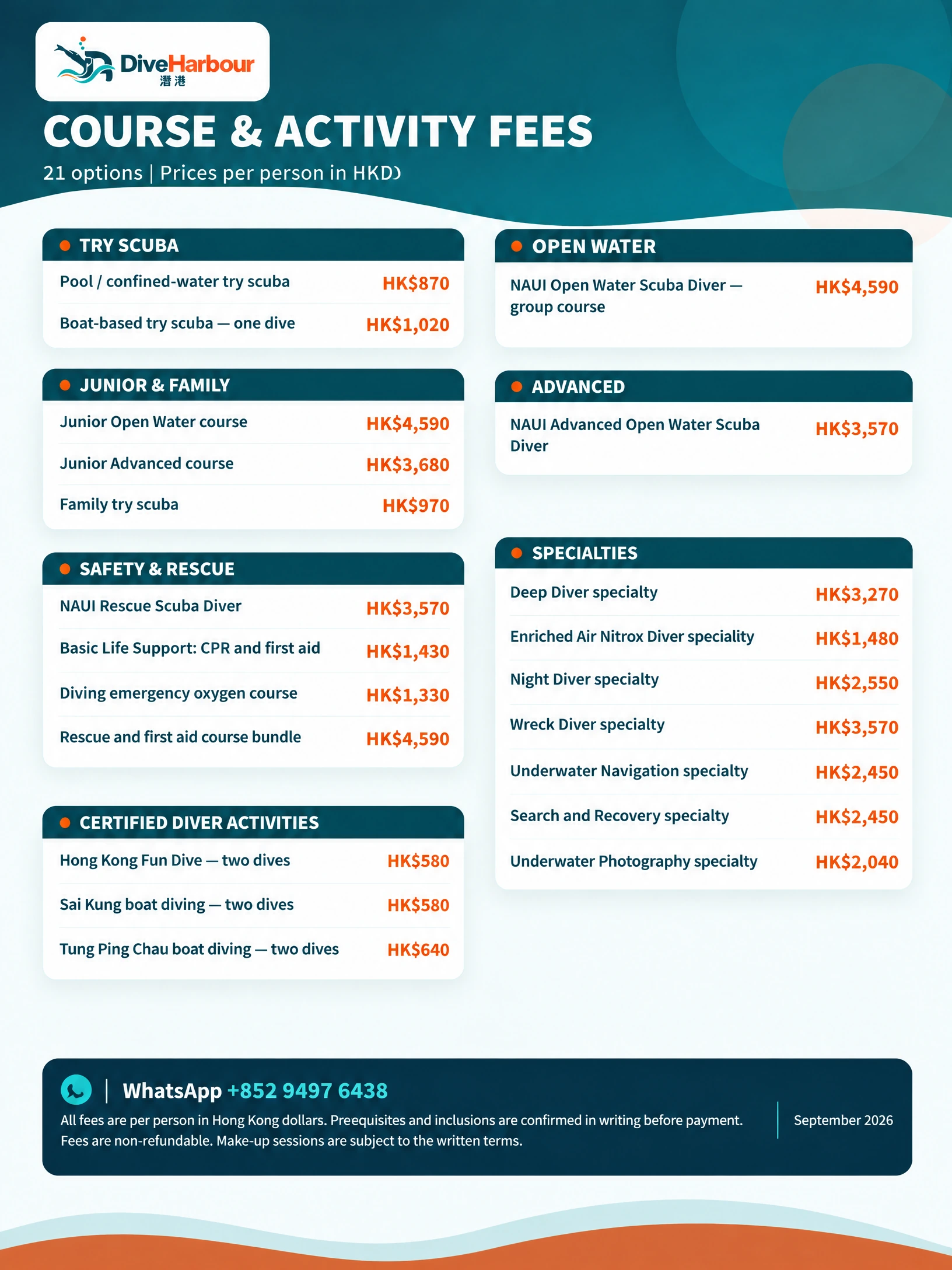
Compare our published course and activity fees before choosing your next step. All prices are per person in Hong Kong dollars.
Before you book, we confirm prerequisites, materials, certification, equipment, venue and boat arrangements in writing. Ask us about fees for courses not listed here.
Read the Sai Kung diving Hong Kong guide to learn about the setting, then explore the Sai Kung scuba diving course page. Certified divers can use our Hong Kong fun dive guide to check experience requirements and activity arrangements. Locations remain subject to weather and sea conditions.
Explore the responsibilities and entry requirements in our Divemaster course Hong Kong guide, then review the scuba instructor course Hong Kong route. Professional training differs from recreational progression, so confirm experience requirements and assessment arrangements first.