SAFE LEARNING · HAPPY EXPLORING
DiveHarbour

DiveHarbour · Practical guide

Hair course scorecard for shore-ready learning | DiveHarbour

A useful hair course scorecard asks what you will learn, practise, use, be assessed on, and receive afterward. Compare written outcomes with the actual lesson format, supervision, equipment rules, feedback process, and provider terms. For a shore event, add questions about humidity, wind, changing arrangements, and how the skill fits your own routine without assuming a course grants a qualification or activity clearance.

By DiveHarbour10 min read
Ask about diving courses or coastal trip planning Read the guide
Hair course scorecard and shore learning toolkit on a planning table
Illustration · Concept illustration: a learner organising questions before a coastal course decision.

Instructor qualifications

One clear teaching conversation from first breath to next step

DiveHarbour brings together scuba teaching, swimming, lifesaving and water-rescue experience so you can ask practical questions before choosing a course.

  • PADI teaching backgroundTeaching experience across recognised scuba learning pathways.
  • SSI teaching backgroundClear explanations when you are comparing agency routes.
  • NAUI teaching backgroundA practical, standards-aware approach to learning and progression.
  • Swimming foundationWater confidence and calm, step-by-step practice matter.
  • Lifesaving experienceSurface awareness and prevention stay part of the conversation.
  • Pool rescue experienceControlled practice can build confidence before open water.
  • Beach rescue experienceLocal water context informs sensible preparation.
  • Kayak rescue experienceA wider water-safety perspective supports good judgement.
  • PWC rescue experienceAsk about the right learning route for your experience and goals.

Brand relationship: DiveHarbour and DT HUB share the same owner.

DiveHarbour and DT HUB are operated by the same owner. DT HUB links in this article are references to external service and product information, not independent third-party recommendations, medical-effect claims, or endorsements of water-activity safety. DiveHarbour handles diving and shore activities; DT HUB salon, hairpiece, academy, and hair-growth services require separate enquiries.

A useful fact to keep in mind

The Hong Kong Qualifications Framework hairdressing education unit describes staged progress checks, a theory-and-skills balance, feedback, records, and fair assessment as parts of evaluating training performance.

Check the source
Key takeaways

Four points to carry forward

  • Ask for observable learning outcomes instead of relying on a course title or a polished gallery.
  • Separate demonstrations from supervised practice, and confirm who supplies tools, products, models, or alternatives.
  • Check how progress is assessed, recorded, reviewed, and explained before the final lesson.
  • Treat a course, a product consultation, medical care, and scuba certification as separate decisions.
Start here

Build a hair course scorecard before you compare schools

Use the hair course scorecard to turn a shore goal into questions

A course title rarely tells you how the learning feels on an ordinary week. You may want a tidy style for a windy pier, a colour-planning skill for a family photo day, or confidence handling your own hair after a humid commute. Write the occasion, the skill you want to repeat, and the setting where you will use it. Then score the course against evidence rather than its name, model photos, or a promise of transformation.

The first row should ask for learning outcomes in observable language. Can the provider show what a learner will explain, demonstrate, practise, or evaluate? An official UK hairdressing training listing separates knowledge from skills and includes consultation, safe working, tools, service techniques, and evaluation. It is a comparison habit, not a local promise or required Hong Kong curriculum. [1] Ask the provider to mark which outcomes are taught, practised, and assessed.

If your shore objective involves a hairpiece rather than a class, keep that decision separate. A reference such as hair topper hong kong can help you frame product questions, but it is not evidence that a course teaches fitting, maintenance, or activity use. For a hypothetical beach portrait, score the class on repeatable technique and score the product conversation on fit, care, storage, and return terms. Do not combine the two into one assumed result.

  • Write the shore occasion and the repeatable skill in one sentence.
  • Request the syllabus, lesson format, practice ratio, and assessment method in writing.
  • Mark every claim as confirmed, unclear, or outside the course scope.
  • Leave room for weather, travel, changing, and maintenance questions.
A strong scorecard rewards clarity. It does not reward the longest list of techniques.
Guide · 02

Score the syllabus, practice ratio, and teaching setting

Ask where theory ends and supervised practice begins

Next, map the lesson from arrival to finish. A useful outline names the explanation, demonstration, learner practice, correction, clean-up, and reflection. It also says whether practice is on a mannequin, a model, yourself, or another arrangement. Those choices change what you can realistically learn. If the description only says “hands-on” or “professional technique”, ask for an example of one complete exercise and the time reserved to repeat it.

The Hong Kong Qualifications Framework unit on hairdressing education and training treats course goals, stage-by-stage progress, theory and skills balance, assessment methods, feedback, and records as matters to evaluate. [2] Use that structure when comparing providers. You are checking whether the teaching design matches your goal and whether the provider can explain how a learner gets from watching to doing.

A personal styling aim may include a separate product choice. For example, women's wig hong kong is a product-information reference, not a syllabus and not proof of training quality. Ask a course provider whether hairpieces appear in the lesson, whether a learner may bring one, and how practice is supervised. If the answer is no, that is not automatically a weakness. It simply tells you that a product consultation and a learning course belong on different lines of your plan.

Keep the activity boundary clear when a coastal itinerary includes diving. A hair lesson is not a prerequisite for a dive lesson, and a dive course does not validate a hair qualification. If you are also arranging your first underwater experience, the beginner scuba diving training pathway Hong Kong explains a different learning decision. Compare each course by its own outcomes, instructor information, safety process, and terms.

Swipe the table to compare all columns.

Course evidence to record before comparing providers
Scorecard rowQuestion to askEvidence to saveWhy it matters for a shore plan
Learning outcomesWhat can a learner explain or demonstrate by the end?Syllabus wording or lesson outlineShows whether the class matches the skill you actually need.
Practice formatWho practises, on what, and under whose supervision?Model, mannequin, self-practice, or demonstration detailsPrevents a hands-on label from hiding limited repetition.
Tools and materialsWhat is supplied, shared, consumed, or taken home?Written equipment and product listHelps you plan travel, cost questions, and a small follow-up kit.
AssessmentHow is progress checked and explained?Criteria, feedback method, and completion wordingSeparates participation from demonstrated learning.
Concept illustration of coastal appointment notes for a hair course
Illustration · Concept illustration: appointment notes and practical questions for a shore-day plan.
Guide · 03

Check tools, materials, and the real practice conditions

A scorecard should reveal what you can actually handle

Tools are part of the learning decision, not a footnote. Ask whether the fee includes ordinary equipment, consumable products, a practice head, a model arrangement, or only classroom access. Then ask what you may take home, what must remain on site, and what happens if a tool is unavailable. A learner who wants a reliable shore routine needs to know whether the skill transfers to a small travel kit, a shared bathroom, or a humid changing room.

Use the provider's answers to separate demonstration from independent repetition. “You will see colouring” is different from “you will practise a named consultation and record your choices.” “Tools provided” is different from “you will learn safe use, cleaning, storage, and limits.” An official training standard lists safe working, equipment use, client records, consultation, and evaluation as distinct knowledge or skill areas. [1] You can use those categories to ask precise questions without assuming that every short course covers all of them.

If your questions arise from a medical hair-loss journey, keep the educational and healthcare decisions apart. A page such as medical wig hong kong may be a separate product reference, but it is not a diagnosis, treatment recommendation, or proof that a class is clinically suitable. Ask the relevant healthcare team about personal care boundaries, and ask the course provider only about its teaching scope, adaptations, privacy, and cancellation terms.

For a shore day, add practical conditions that are easy to overlook. Ask how the room handles ventilation, wet coats, product storage, and clean-up. Ask whether a learner can pause, observe, or reschedule if the planned model or equipment is not available. These questions do not predict a final look. They show whether the class has a process that you can understand before committing time and belongings.


Guide · 04

Evaluate assessment, feedback, and the end point

Do not confuse attendance with demonstrated learning

A scorecard should identify the moment when learning is checked. Is there a short demonstration, a practical task, a written reflection, a tutor conversation, or only attendance? Ask what the assessor observes, whether the criteria are shared beforehand, and whether a learner can try again after feedback. A completion note may confirm participation. It does not automatically describe a regulated qualification, credit, employment readiness, or a particular standard of work.

The Hong Kong competency unit says progress can be assessed at different stages, course content can be adjusted to actual needs, performance information can be recorded, and assessment should be fair and just. [2] For a small course, translate those ideas into plain questions: When will I receive feedback? Who gives it? What is written down? What happens if I miss a skill? Which parts are demonstration only? Clear answers make the course easier to compare with another provider.

A medical context needs extra restraint. A chemo wig hong kong page is not evidence about treatment, recovery, regrowth, or a person's readiness for a class or a water activity. If you are receiving medical care, ask your own qualified treatment team about participation and timing. Ask the course provider about learning access and privacy. Neither a styling lesson nor a product page replaces individual medical confirmation.

For a coastal event, define success before you book. You might want to repeat one tidy finish at home, explain your product choices, or judge whether a technique suits wind and humidity. You might not need a formal assessment at all. Writing the endpoint prevents a provider's certificate language from becoming the main reason you choose a class.

Concept illustration of coastal colour planning and course practice notes
Illustration · Concept illustration: colour-planning notes beside a practice checklist.
Guide · 05

Test post-course support against a real shore scenario

Plan the week after class, not only the lesson day

Learning often becomes useful after the classroom ends. Ask whether the provider offers a written routine, a practice checklist, a way to submit a question, or a date for follow-up. Ask how long that support lasts and whether it is included or separately arranged. Also ask what the provider will not do. Honest boundaries are valuable when you are packing for a trip, preparing for a family photograph, or deciding whether a technique deserves more practice.

Product information can be a separate input to that plan. A lace front wig hong kong reference may help you list questions about appearance, storage, maintenance, or a private consultation. It does not establish that a course covers lace work, that a product is suitable for swimming or diving, or that any fit will stay secure in changing conditions. For shore use, ask product and activity questions independently, and choose a land-based arrangement if suitability remains unconfirmed.

Make the provider answer in the context of your actual day. If you will leave a lesson for a ferry, ask how much clean-up and packing time is realistic. If you will be outdoors, ask what practice is needed for wind, heat, or a hat. If you will photograph the result, ask whether the class teaches repeatable preparation rather than promising a particular camera outcome. These are planning questions, not requests for a guaranteed look.

A useful boundary also applies to DiveHarbour. Its activity information concerns diving and shore activities, while a hair academy or product provider has its own scope and terms. If you are comparing the learning steps for a separate underwater plan, the scuba diving course process Hong Kong is the relevant course-process reference. Do not treat either site as proof about the other service.

Swipe the table to compare all columns.

A practical decision check for a coastal learning plan
Decision pointAsk before bookingGreen signalPause signal
Time and travelWhat happens if the lesson, model, or transport plan changes?Clear start, finish, preparation, and cancellation termsOnly verbal timing or pressure to book immediately
Practice transferWhat can I repeat at home or on a trip?Named routine, feedback, and realistic practice materialsA promised look with no repeatable method
Privacy and boundariesWhat is taught, and what is outside the provider's scope?Plain answers and a route for separate medical questionsTreatment language or activity-safety assumptions
Next stepWho answers questions after the lesson and for how long?Named support channel and written support periodNo contact point or unclear extra charges
Guide · 06

Use the completed hair course scorecard to decide

Choose the clearest fit, then confirm the terms in writing

Total the evidence by category instead of averaging away a serious gap. A course with a modest syllabus may fit a one-skill shore goal if it gives supervised repetition and clear feedback. A longer programme may be a poor fit if practice conditions, tools, assessment, or follow-up remain vague. Send the same short list to each provider. Comparable answers are more useful than a polished sales conversation.

Before paying or travelling, confirm the course name, learning outcomes, lesson format, practice arrangement, tool responsibility, assessment, records, support period, cancellation terms, and any certificate wording. Check whether a model, mannequin, products, or equipment are actually supplied. Do not infer fixed hours, recognition, employment outcomes, or a credential from a title. The official sources used here describe specific education frameworks, not every academy or private class. [1] [2]

Use a final traffic-light decision: green means the answer is written and matches your goal; amber means the provider can clarify before booking; red means a key term is missing or conflicts with your boundary. For a hypothetical humid shore portrait, a green choice might be a short styling class with repeatable practice and a clear take-home routine. It would not require a promise that hair will behave perfectly outdoors.

The best next step is a short, factual enquiry. State the occasion, the skill, your available dates, and the questions that affect your decision. Ask the provider to identify what is included, what is optional, and what sits outside its scope. Keep any medical question with your healthcare team and any diving question with the activity provider. A scorecard is useful because it leaves you with a decision you can explain, not because it guarantees an outcome.

Concept illustration of a shore-change hair routine after course practice
Illustration · Concept illustration: a simple change-and-pack routine for a shore event.
A sensible next step

Take the question with you

Complete the scorecard with the same questions for every provider, save the written answers, and book only when the learning format, practice conditions, assessment, support, and boundaries fit your real shore plan. If a key answer remains vague, pause rather than filling the gap with a course title or a product photograph.

For DiveHarbour, enquire separately about diving or shore-activity planning and its own participation process. For DT HUB salon, academy, hairpiece, or hair-growth consultation information, contact DT HUB through its own service channel and confirm scope, terms, and suitability directly. This article does not sell a treatment, promise a result, or make a medical or water-activity decision for you.

Questions to ask

Common questions

What is the first question on a hair course scorecard?

Ask what a learner will be able to explain, demonstrate, practise, or evaluate by the end. Then ask which of those outcomes are actually assessed. This turns a broad course title into a checkable promise without assuming a qualification.

Should a course include all tools and products?

Not necessarily. The important point is that the provider states what is supplied, shared, consumed, borrowed, or expected from you. Compare that list with your travel plan and with the routine you want to repeat after class.

Does completing a hair class prove I am qualified to work professionally?

No. Attendance, a provider-issued completion note, a regulated qualification, and workplace readiness are different claims. Ask what the wording means, who recognises it, and what assessment took place. Do not infer employment or certification from a course title.

Can a hair course confirm whether I can take part in diving or another water activity?

No. Hair education and activity suitability are separate decisions. Ask the relevant activity provider about its own requirements, and ask your qualified healthcare team about personal medical questions. A styling course or product consultation is not activity clearance.

Further reading

Official sources worth checking

Continue exploring

Keep comparing practical questions before you choose a course, activity or preparation step.

Coastal life and image planning · Updated 2026-11-06

colour-perm order: Plan Coastal Hair Changes with Care

Use a colour-perm order to separate hair facts, provider scope, and event timing before a coastal day. Read the checklist and ask informed questions.

colour-perm order

Coastal life and image planning · Updated 2026-11-06

Styling learning route: a practical plan for shore days

Plan a styling learning route for shore events: choose practice, tools and help with clear limits. Read the guide and ask better questions.

styling learning route

Coastal life and image planning · Updated 2026-11-06

Outdoor-light reference brief for coastal photo planning

Use an outdoor-light reference brief to plan light, framing, neckline and styling limits for a coastal shoot. Read the checklist and ask better questions.

outdoor-light reference brief
Your next step

Ask about diving courses or coastal trip planning

Message DiveHarbour on WhatsApp to discuss diving courses or coastal trip planning, along with your experience and preferred dates.

Ask about diving courses or coastal trip planning
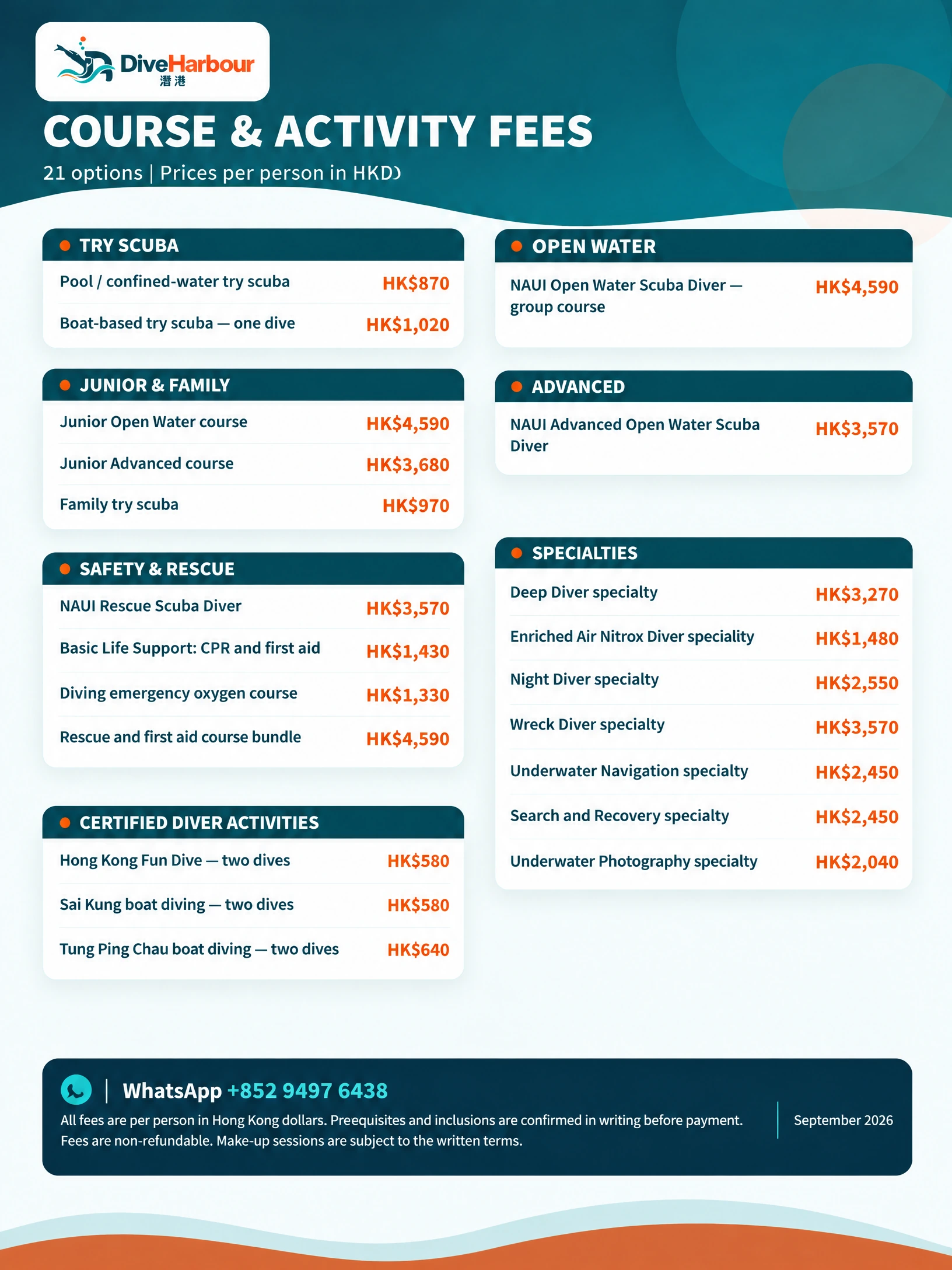
English price list for 21 DiveHarbour courses and activities, with fees per person in Hong Kong dollars
Tap the price list to view it at full size.

Plan your next dive

Course fees, clearly set out

Compare our published course and activity fees before choosing your next step. All prices are per person in Hong Kong dollars.

Before you book, we confirm prerequisites, materials, certification, equipment, venue and boat arrangements in writing. Ask us about fees for courses not listed here.

All fees are non-refundable. Make-up sessions are subject to the written terms.

Read all course fees
DiveHarbour course and activity fees per person in Hong Kong dollars
Course / activityPer person
Pool / confined-water try scubaHK$870
Boat-based try scuba — one diveHK$1,020
NAUI Open Water Scuba Diver — group courseHK$4,590
Junior Open Water courseHK$4,590
Junior Advanced courseHK$3,680
Family try scubaHK$970
NAUI Advanced Open Water Scuba DiverHK$3,570
NAUI Rescue Scuba DiverHK$3,570
Basic Life Support: CPR and first aidHK$1,430
Diving emergency oxygen courseHK$1,330
Rescue and first aid course bundleHK$4,590
Deep Diver specialtyHK$3,270
Enriched Air Nitrox Diver specialtyHK$1,480
Night Diver specialtyHK$2,550
Wreck Diver specialtyHK$3,570
Underwater Navigation specialtyHK$2,450
Search and Recovery specialtyHK$2,450
Underwater Photography specialtyHK$2,040
Hong Kong Fun Dive — two divesHK$580
Sai Kung boat diving — two divesHK$580
Tung Ping Chau boat diving — two divesHK$640