

A useful fact to keep in mind
In the PADI course structure, 2 required dives plus 3 selected specialty dives make 5 dives in total.
Check the sourceChoose an Advanced Open Water Diver course Hong Kong divers can build on
Skills, supervision and comfortable progression
An Advanced Open Water course should feel like a useful next chapter, not a race to a deeper number. It is for a certified diver who wants structured practice, thoughtful feedback and a chance to discover which type of diving is genuinely enjoyable. Before booking, share your certification agency, logged experience, last dive, comfort with mask and buoyancy skills, and any planned travel. A good instructor can then discuss whether the selected dives fit your current ability and the conditions likely to be encountered.
A well-designed Advanced Open Water Diver course Hong Kong programme balances challenge with calm decision-making. You might practise navigation, observe how weighting affects trim, or learn how a low-light environment changes communication and equipment checks. The aim is not to make every dive dramatic. It is to build repeatable habits: a clear briefing, a buddy plan, controlled descents and ascents, regular gas and comfort checks, and an honest decision to pause when conditions or concentration are not right.
DiveHarbour's lead coach has confirmed teaching experience with PADI, SSI and NAUI, alongside swimming, lifesaving, pool, beach, kayak and personal-watercraft rescue qualifications. That background supports practical risk conversations, but it does not replace your agency's standards or a medical professional's advice. If health, medication, recent illness, ear trouble or anxiety is relevant, discuss it early and seek clinician guidance where appropriate. No course should pressure you to continue a dive that feels unsuitable.
For a wider view of learning routes, compare advanced diver training Hong Kong with the specific course format described here. The useful question is not simply which card sounds most advanced; it is which sequence gives you enough repetition, supervision and honest feedback to become a more self-reliant buddy.
- Bring your certification card or digital record, logbook, recent-dive details and any questions about equipment.
- Ask how the instructor will adapt the plan for visibility, current, temperature, boat logistics and your actual experience.
- Treat comfort, communication and stable buoyancy as progress measures alongside depth or specialty names.

What a five-dive Advanced Open Water course Hong Kong programme involves
Specialty dives matched to your goals and conditions
The phrase five-dive Advanced Open Water course Hong Kong usually describes a planned set of five training dives, but the exact curriculum depends on the agency and provider. In the PADI course description, two dives are required—deep diving and underwater navigation—and the diver chooses three additional specialty dives from available options. That is a useful framework, not a promise that every local programme uses identical sites, depths, equipment or elective choices. Confirm the current plan in writing before paying.
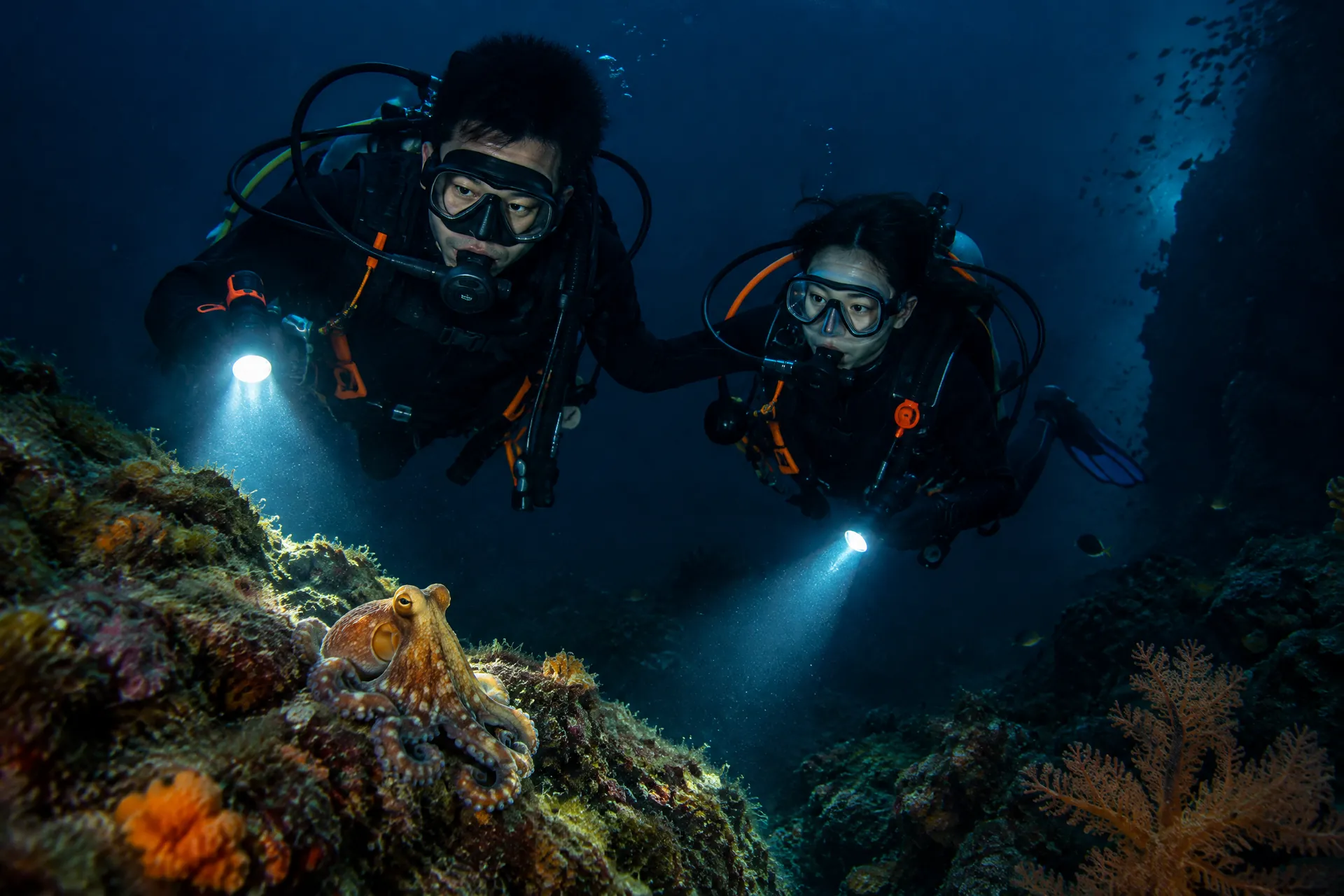
Electives should answer a real question about your diving. Peak performance buoyancy can help if you want less effort, better trim and fewer accidental contacts with the bottom. Navigation is valuable for divers who want a stronger mental map of a site. Night or limited-visibility training explores lighting, signals and pacing. Search and recovery introduces planning and teamwork. Photography can be rewarding when you are ready to keep the camera secondary to depth, position and your buddy. For a dedicated skills focus, see the buoyancy control course Hong Kong option.
Deep-diving content needs especially careful explanation. A training depth is not a personal target and does not authorise you to exceed the limits of your certification, equipment, gas plan or local conditions. The instructor should explain the intended profile, task loading, gas management, turn points, ascent plan and emergency response at a level appropriate to the agency. If deep diving is your main reason for enrolling, read the Deep Diver specialty course Hong Kong information as a separate comparison rather than assuming an Advanced course is the same qualification.
PADI's official course page states that its five dives include the two required components plus three selected specialty dives. In the PADI course structure, 2 required dives plus 3 selected specialty dives make 5 dives in total. This concrete structure makes it easier to compare quotes: ask whether the price includes eLearning or materials, certification processing, tanks, weights, other equipment, boat fees, site charges, instructor time, and any required surface intervals. DiveHarbour currently lists the approved NAUI Advanced Open Water Scuba Diver price as HK$3,570 per person; confirm inclusions, available dates and the agency issued before making a booking.
- Choose electives for a purpose: confidence, navigation, photography, low-light skills, buoyancy or a future specialty pathway.
- Ask what happens if weather, sea state, visibility or your readiness makes one planned dive unsuitable.
- Keep an equipment checklist separate from the course outline so you know what is supplied and what you must bring.

Planning PADI Advanced Open Water Diver Hong Kong training
Prerequisites, safety questions and the next enquiry
When comparing PADI Advanced Open Water Diver Hong Kong options, first confirm that your existing certification and recent experience meet the current PADI requirements. Agency rules can change, and other agencies use different course names, minimum ages or dive counts. A provider should check your certification history and explain any minimum age, medical declaration, prerequisite training, equipment and supervision requirements before accepting your enrolment. Do not treat another diver's eligibility as your own.
The strongest enquiry is specific. Include your agency and level, approximate number of logged dives, most recent dive date, whether you are comfortable in a boat and open-water setting, the three skills or environments you want to explore, and your preferred dates. Ask whether the course is private or group-based, how many students are with one instructor, where briefings happen, and how a missed or unsuitable dive is handled. This turns a vague price request into a sensible fit conversation.
Consider the weather window and your own recovery time. Hong Kong conditions can vary, so a plan may need flexibility rather than a rigid promise of a particular site. Eat and hydrate normally, arrive rested, and tell the instructor promptly if you feel unwell. A buddy system is an important part of recreational scuba, but it is not a substitute for training, supervision or conservative judgement. If you are not ready for a particular skill on the day, asking for a pause is responsible diving.
Divers who prefer a different agency can review NAUI Advanced Open Water course Hong Kong and SSI Advanced Open Water Diver Hong Kong. Compare learning outcomes, assessment style, included services and what the resulting certification allows within that agency's system. The best choice is transparent and suitable, not whichever title appears most impressive.
- Request the course outline, prerequisites, inclusions, cancellation terms and likely additional costs before confirming.
- Ask whether any online theory must be completed before the first water session and how knowledge is checked.
- Keep a realistic alternative date in mind without assuming a weather change guarantees a make-up session.

Compare course formats before you reserve
A practical checklist for value and fit
Two courses with the same title can feel very different because of group size, briefing quality, equipment condition, travel time and how calmly the instructor adapts a dive. Use the comparison below when messaging a provider. Look for a clear answer rather than a sales phrase. In particular, confirm whether boat and site charges are included, whether a certification fee is separate, and whether you can choose electives that are actually available in the season and conditions.
Ask to see the cancellation and attendance policy in plain language. Fees are not automatically refundable simply because plans change. A provider may permit a make-up session only where its written terms allow it, and a make-up date is not guaranteed. If you have a flight, hotel or other fixed commitment, leave sensible time between course completion and travel rather than relying on a best-case schedule.

Equipment, preparation and in-water habits
Small checks that make advanced learning easier
Advanced training is a good time to become more systematic about your kit. Before entering the water, check cylinder pressure, regulator routing, inflator connection, alternate air source, weights, exposure protection, mask seal and computer settings with your buddy and instructor. Use equipment you understand; unfamiliar accessories can add task loading. If rental sizing is needed, mention it before the session so time is not taken from the briefing or relaxed skill practice.
During each dive, keep the plan simple enough to remember. Agree on entry and exit, maximum planned depth, direction, hand signals, separation response, gas checks and turn point. Notice breathing effort, position and the effect of trim changes. If visibility drops or a current makes the planned exercise awkward, return to the agreed team response instead of improvising. Good advanced diving looks measured: communicate early, protect the environment and finish with enough capacity for a calm ascent and exit.
A refresher may be more appropriate than an Advanced course if your entry-level skills are rusty. Be candid about a long gap, difficult prior dive or lost confidence. The instructor can discuss a short practice session, simpler elective or different timeline. Building readiness first often makes the five-dive experience more enjoyable and gives the feedback a better foundation.
After the course: turn five dives into lasting experience
A sensible next step after certification
The card is a milestone, not the end of learning. After the course, review your logbook while the details are fresh: what task felt easy, what created stress, how did your buoyancy change, and what would you practise before the next boat trip? A guided fun dive, a buoyancy-focused session or a navigation practice can reinforce the skills without piling on a new level immediately. Keep a short personal checklist and share it with your next buddy or instructor.
If you enjoyed a particular elective, ask about its dedicated specialty pathway and the experience it expects. If you want to support other divers in an emergency context, choose a recognised first-aid or rescue programme separately and check its prerequisites. Advanced certification does not make a diver a professional, guarantee access to every site, or remove the need to follow local operator and agency rules.
Your next enquiry can be brief: send your certification, recent-dive history, goals, preferred training dates and any health or equipment questions. DiveHarbour can then explain the current agency route, practical options, inclusions and policy before you decide. That conversation is the right place to resolve uncertainty—not underwater and not after a payment has been made.

Compare common Advanced Open Water planning choices
| Option | Best for | Check before booking |
|---|---|---|
| Deep plus navigation focus | Divers wanting a structured foundation for depth awareness and route-finding | Agency limits, intended profile, equipment, gas planning and conditions |
| Buoyancy and photography focus | Divers who want better trim and careful camera habits | Whether camera equipment is supplied, group size and task-loading support |
| Night or limited-visibility focus | Divers curious about communication and pacing in reduced light | Lighting requirements, weather flexibility, buddy plan and exit arrangements |
| Search and recovery focus | Divers interested in planning, patterns and team problem-solving | Local site suitability, lift equipment, supervision and environmental limits |
Advanced Open Water Diver Course in Hong Kong — common questions
Who is an Advanced Open Water course for?Toggle answer
It is intended for certified divers who want structured experience beyond entry-level training. The appropriate course and dive choices depend on your certification history, recent experience, comfort in the water and the planned conditions, so discuss these details with a qualified instructor before enrolling.
Does the course always use the same five specialty dives?Toggle answer
Not necessarily. The five-dive format combines required elements with specialty-dive choices that should suit the diver, conditions and instructor plan. Ask DiveHarbour which options are currently practical, what each involves and how scheduling is arranged before making a decision.
Is the HK$3,570 NAUI Advanced Open Water price all-inclusive?Toggle answer
The published listing is HK$3,570 per person, but training dives, boat fees, equipment, certification and other arrangements should be confirmed before enrolment. Ask for a written inclusion list rather than assuming that every course-related cost is bundled.
What if I need to cancel or miss a session?Toggle answer
Course fees are non-refundable unless the provider's written terms say otherwise. A make-up session is available only where those written terms permit it, and no replacement date is guaranteed. Ask about the policy and weather contingencies before paying, especially if you are travelling.
Should I take a refresher instead of Advanced Open Water?Toggle answer
If your entry-level skills are rusty, you have not dived recently, or you feel uncertain with basic equipment and buoyancy, a refresher may be the more comfortable next step. Share your logbook and concerns with a qualified instructor so the plan matches your readiness.
Take the question with you
To choose well, send DiveHarbour your certification agency and level, recent dive history, goals, preferred dates and questions about equipment or health. Ask for the current five-dive outline, inclusions, prerequisites and written cancellation terms. Once the plan fits your ability and the conditions, book with enough flexibility to learn calmly—and treat each new skill as a reason to become a more thoughtful buddy, not simply a reason to go deeper.
Sources worth checking
- PADI Advanced Open Water Diver eLearning Course
PADI states that its course includes two required dives—deep diving and underwater navigation—plus three chosen specialty dives, for a total of five dives.
- NAUI Advanced Open Water Scuba Diver - Continuing Education
NAUI describes a distinct Advanced Open Water Scuba Diver programme with its own dive requirements and prerequisite information, illustrating that agency structures differ.
Useful next reads for your plan
If you are still comparing routes, these related pages give you practical questions to bring into your next conversation with an instructor.
Put your plan into practice
Useful planning guides
Advanced diver route planner for Hong Kong
Use this advanced diver route planner worksheet to compare practical options, check key decision points, and confirm current details with DiveHarbour.
advanced diver route planner
