

SAFE LEARNING · HAPPY EXPLORING
DiveHarbour

DiveHarbour · Practical guide

Coastal straightening goal guide: compare the finish you want

Start with the result you want: a visibly straighter outline, less bulk, a smoother feel, or an easier curly routine. Then compare service names, your past chemical history, daily styling time, and the aftercare questions that matter for swimming and coastal weather. A consultation can clarify fit, but no salon term should be treated as a promise of weatherproof hair.

By DiveHarbour9 min read
Ask about diving courses or coastal trip planning Read the guide
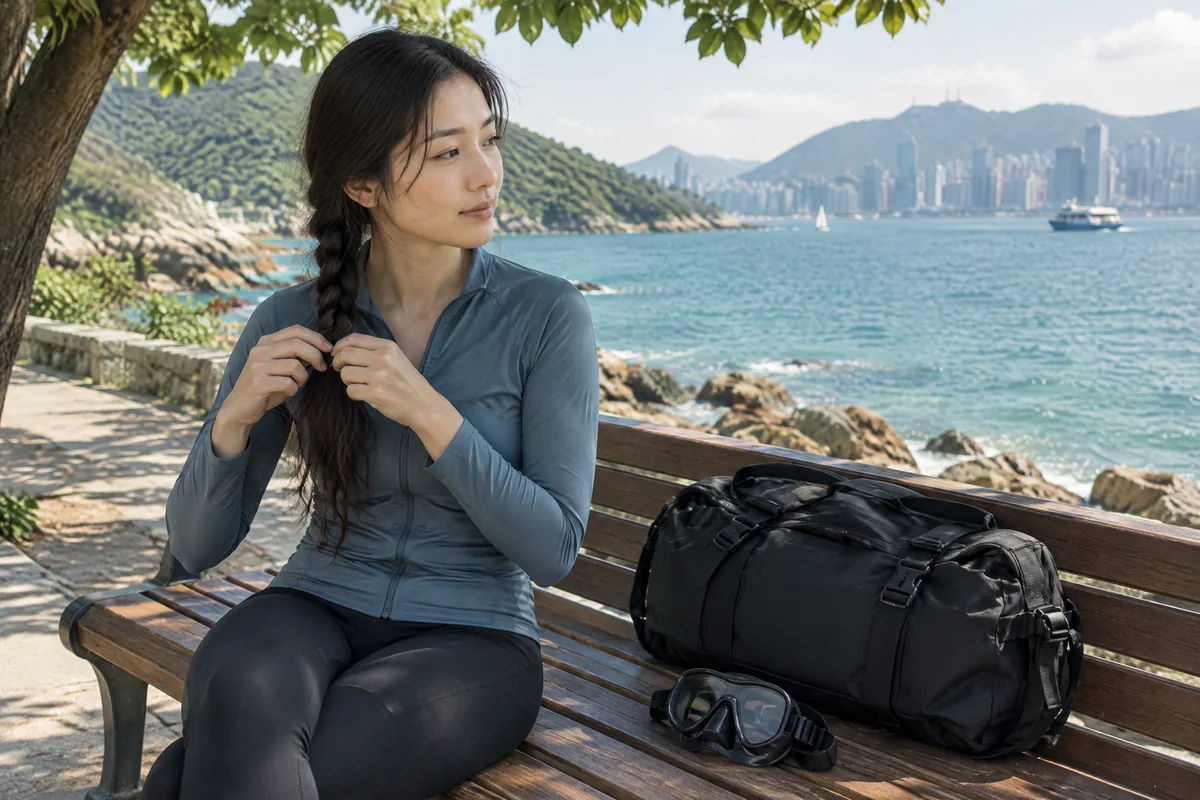
Coastal straightening goal guide illustration showing hair preparation before a shore day
Illustration · preparing a hair goal before a coastal activity.

Instructor qualifications

One clear teaching conversation from first breath to next step

DiveHarbour brings together scuba teaching, swimming, lifesaving and water-rescue experience so you can ask practical questions before choosing a course.

  • PADI teaching backgroundTeaching experience across recognised scuba learning pathways.
  • SSI teaching backgroundClear explanations when you are comparing agency routes.
  • NAUI teaching backgroundA practical, standards-aware approach to learning and progression.
  • Swimming foundationWater confidence and calm, step-by-step practice matter.
  • Lifesaving experienceSurface awareness and prevention stay part of the conversation.
  • Pool rescue experienceControlled practice can build confidence before open water.
  • Beach rescue experienceLocal water context informs sensible preparation.
  • Kayak rescue experienceA wider water-safety perspective supports good judgement.
  • PWC rescue experienceAsk about the right learning route for your experience and goals.

Brand relationship: DiveHarbour and Vit So share the same owner.

This guide is compiled by DiveHarbour. The Vit So links provide external hair-service information for reference; they are not a diving-safety, medical, expert-endorsement or service-results guarantee.

A useful fact to keep in mind

A practical post-swim step supported by dermatology guidance is to rinse and wash the hair after swimming, then follow with deep conditioner.

Check the source
Key takeaways

Four points to carry forward

  • Describe your target shape, texture and morning routine before naming a treatment.
  • Use service labels as prompts for questions, not as proof that two methods give the same finish.
  • Bring your chemical history, curl pattern, swim routine and realistic styling time to an assessment.
  • Plan rinsing, sun protection and post-water care separately from any salon decision.
Start here

Coastal straightening goal guide: name the finish first

A coastal straightening goal guide starts with shape, feel and routine

Humidity and sea air can make an already full or wavy head of hair feel larger, rougher or harder to place. That observation is a starting point, not a diagnosis. Before you compare salon labels, decide whether you want a visibly straighter outline, less expansion at the sides, a smoother surface, or a routine that lets your natural bend stay visible.

Your coastal schedule matters because the same finish can feel practical for one person and demanding for another. Someone who rinses after a short swim and air-dries may value movement. Someone who goes from a shore day to dinner may want a predictable parting and a quick reset. If the day includes Hong Kong shore diving, describe the hood, water exposure and shore-to-evening transition rather than saying only that your hair is frizzy.

Temperature and wind also change the routine around the hair. The Hong Kong diving water temperature guide is useful for planning the water part of a day, but it cannot decide which cosmetic service suits your hair. Keep the diving plan and the salon assessment as two separate conversations.

  • Write one sentence describing the outline you want from the front and sides.
  • Note whether you prefer a flat, natural, soft or visibly polished finish.
  • Record how long you normally spend drying and styling after water exposure.
  • List the next coastal activities that may change your hair routine.
A useful brief is specific: “I want less expansion and a soft bend, and I have ten minutes to style after a swim.”
Guide · 02

Separate straightness from manageability

Compare the look you see with the work you want to remove

“Straighter” can describe several different goals. You may want the hair to sit closer to the head, the ends to point in one direction, or the surface to feel less rough when you run your fingers through it. Those are not interchangeable requests. A shape change focuses on the outline; a manageability request focuses on how much effort is needed to reach that outline at home.

If your main question is hair straightening, ask what level of change the service is intended to discuss, which parts of the head would be assessed, and how your existing colour or chemical history affects the conversation. Vit So’s published service information should be treated as a starting point for those questions, not as a promise that the same finish is suitable for every head of hair.

A comparison becomes clearer when you describe what you do not want. “I do not want a rigid-looking result,” “I still want movement,” or “I cannot use heat every morning” gives a service provider better information than a single trend photograph. A reference image can show direction, but it cannot show your hair’s response, density or past processing.

  • Choose whether outline, surface feel or styling time is your first priority.
  • Say how much natural movement you want to keep at the ends.
  • Bring a photo of your usual air-dried hair, not only a finished salon image.
  • Ask which parts of the service are assessed before any treatment is selected.

Swipe the table to compare all columns.

Translate the desired finish into a useful consultation question
Your priorityWhat you may notice nowQuestion to askRoutine check
Straighter outlineSides or ends expand from the intended shapeHow would you describe the target outline?Can I maintain the outline with my usual drying method?
Smoother feelThe surface feels rough or catches when handledIs the goal surface feel, shape, or both?What conditioning and detangling steps remain?
Less visible volumeHair looks wider in damp or humid conditionsWhich areas need assessment for bulk or movement?How much daily styling time is realistic?
Keep natural curlCurl loses definition when brushed or dried differentlyWhich movement should remain visible?What is my normal wet-to-dry method?
Illustration of a consultation plan for a coastal straightening goal guide
Illustration · a neutral consultation-planning scene, not a Vit So salon or client result.
Guide · 03

Treat ionic straightening as a term to clarify

Ask what ionic straightening means in this consultation

Ionic straightening may sound like a complete answer to static, puffiness or humidity, but a name alone does not tell you the intended shape, process or maintenance. Ask the provider to explain the desired finish in ordinary words. Is the aim a straighter silhouette, reduced volume, a smoother hand-feel, or a change to how the hair behaves when dried?

When you look up ionic straightening, use the page as external service information and prepare follow-up questions. Confirm how the consultation considers hair density, elasticity, previous colour, bleach, perm or earlier straightening. Do not infer a price, appointment length, language arrangement or suitability from an English service page alone.

The most useful comparison is often between your current routine and the routine you are willing to keep. If you already need a careful rinse, detangle and dry after every swim, a service that changes the shape may not remove every step. Conversely, a person who wants to preserve a visible curl may find that “less puff” is a better goal than “straight.”

  • Ask the provider to define the finish without relying on the word ionic.
  • State which chemical services your hair has had and approximately when.
  • Ask how new growth, roots and previously treated lengths are considered.
  • Confirm what home styling and maintenance the proposed finish still requires.
A service name can open the discussion. Your hair history and the finish you can maintain should guide the assessment.
Guide · 04

Compare smoothing with a curl-friendly plan

Use the coastal straightening goal guide to keep movement intentional

A reader who says “I want smoother hair” may be asking for less tangling, a softer surface, less visible expansion or a straighter outline. Those are different endpoints. The comparison in hair smoothing vs hair straightening can help you build a question list, but it should not be read as a universal result guide. Ask which aspect of your current hair the consultation is actually addressing.

Naturally curly or wavy hair needs an especially clear brief. With hair straightening for naturally curly hair, explain whether you want to keep curl at the ends, reduce uneven volume, change the overall outline, or make wash days easier. Include how you usually part the hair and whether you style it wet, diffuse it, air-dry it or brush it out.

Coastal activity can make this choice feel urgent, but urgency can hide the trade-off. If you like your curl when it is defined, a smoother surface may be enough for the visual goal. If you want a consistently straighter outline, ask how the provider distinguishes that objective from a softer, more manageable finish. A consultation should make the trade-off visible before you decide.

  • Mark the curl pattern or wave movement you want to retain, if any.
  • Describe your wet-to-dry routine and the tools you realistically use.
  • Separate reduced bulk, reduced frizz and a straighter outline as three requests.
  • Ask what result would require the least daily intervention for your lifestyle.
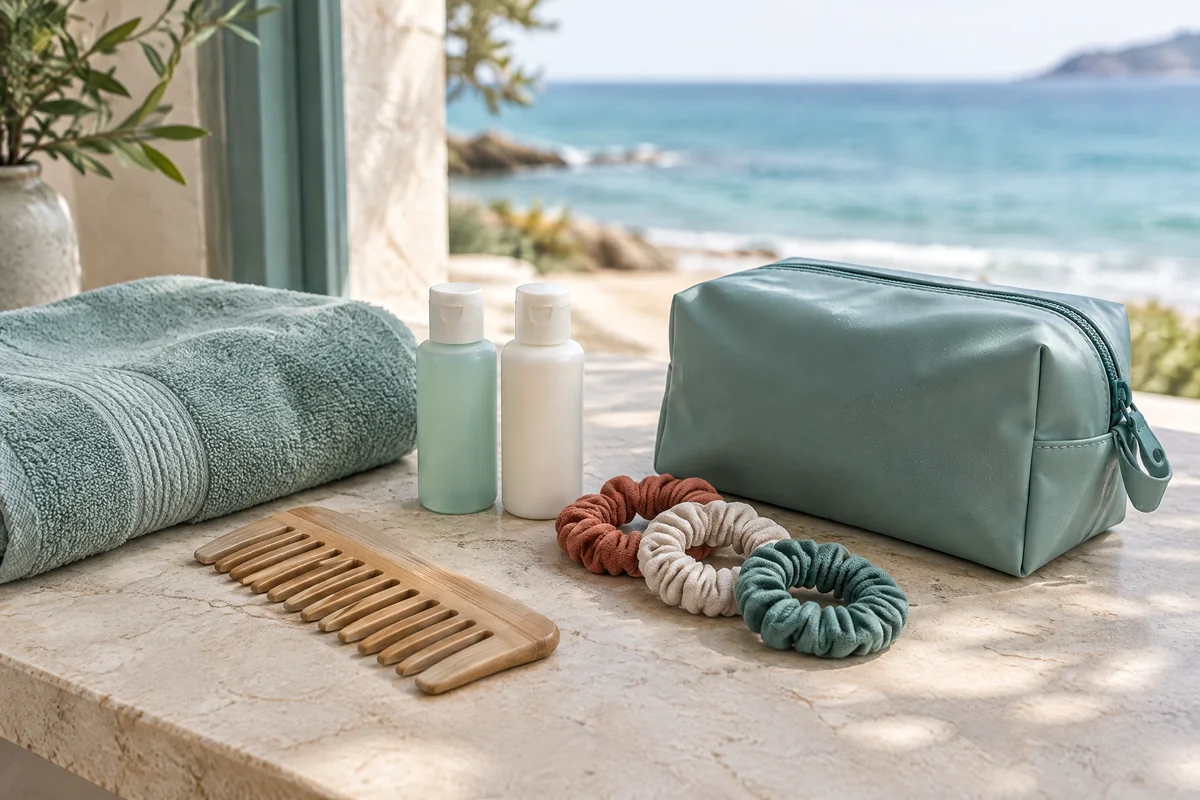
Illustration of a coastal hair-care kit for rinsing and routine planning
Illustration · a travel hair-care kit for a repeatable post-water routine.
Guide · 05

Build the coastal routine around the service

Swimming, sun and rinsing remain separate care decisions

No salon label replaces basic care after water exposure. The American Academy of Dermatology notes that sun UV can affect hair and may show up as dry, brittle or frizzy hair. It also recommends rinsing and washing hair after swimming, then using deep conditioner as part of a swim-season routine.[1] That advice supports a practical reset; it does not establish that any straightening or smoothing service makes hair resistant to the coast.

Make the post-water routine easy enough to repeat. Rinse when you can, detangle gently from the ends, and use the products that are appropriate for your own hair and scalp. If your hair has been coloured or chemically processed, ask the provider how your normal shampooing, conditioning and drying habits should be discussed at the assessment rather than guessing from a treatment name.

Protect exposed skin as well as the hair. NHS guidance says to cover exposed skin, including the head when hair is thinning or absent, and notes that a wide-brimmed hat is better protection for the head.[2] In a coastal itinerary, shade, suitable headwear and water-related sun protection belong in the activity plan, while the salon decision belongs in the hair consultation.

  • Pack a simple rinse and detangling routine for the journey home or next activity.
  • Use shade and suitable headwear when your coastal plan keeps you outdoors.
  • Ask how your existing wash and dry routine fits the proposed service.
  • Do not use a cosmetic treatment as a substitute for sun or water precautions.
Guide · 06

Turn the comparison into an assessment brief

Choose the question you want answered before you contact a salon

A useful enquiry can be short, but it should contain enough information for a meaningful reply. State your preferred finish, natural texture, current length, recent chemical history, usual drying method and the coastal routine that prompted the question. Add reference photos taken in ordinary light, including one after air-drying if that reflects your normal day.

Vit So Hair Stylist lists one documented address at 252 Hollywood Road, Sheung Wan, Hong Kong. Use the external service pages for reference and contact the provider directly to confirm the current service scope, assessment process and practical arrangements. Do not assume a branch, price, same-day availability or English consultation simply from the wording of a webpage.

Before you commit, ask what the consultation can and cannot determine. You can ask how the provider will review your hair history, what finish language they use, which home routine remains necessary, and what information they need before discussing a service. If the proposed answer does not match your goal, pause and restate the goal instead of choosing a label by default.

  • Send your goal, texture, length, chemical history and ordinary styling routine.
  • Ask what assessment is needed before a colour, perm or straightening decision.
  • Confirm the address, service scope, current terms and appointment arrangements directly.
  • Keep the choice open until the proposed finish matches your daily routine.

Swipe the table to compare all columns.

Prepare the information that helps an assessment stay specific
Bring or recordWhy it mattersQuestion for the provider
Current and air-dried photosShows your ordinary shape, volume and movementWhich finish is realistic from this starting point?
Colour, bleach, perm and straightening historyPast processing can change the assessment conversationWhat history do you need before discussing a service?
Swim, rinse and drying routineShows the care you can repeat after coastal activitiesWhich steps would still be part of my routine?
Next coastal event and desired lookConnects the goal to a real day rather than a vague promiseWhat should I clarify before deciding?
The next step is not “book the strongest option.” It is “ask which finish fits my hair, my routine and my coastal plans.”
Illustration of shore-side event hair after a coastal activity
Illustration · a shore-side styling situation, not a guaranteed treatment result.
A sensible next step

Take the question with you

Write your goal in one sentence, gather ordinary-light photos and record your recent hair history. Then ask a provider to compare the intended shape, feel, maintenance and assessment needs. Keep the coastal rinse, shade and sun-protection routine in place regardless of the service label.

Questions to ask

Common questions

Is hair straightening the same as hair smoothing?

Not necessarily. The words can point to different goals, such as a changed outline, less visible expansion or a softer surface feel. Ask the provider to define the intended finish and the home routine rather than choosing by label alone.

Does ionic straightening make hair suitable for swimming or sea air?

Do not treat the name as a water or weather guarantee. Swimming, sun and rinsing still need their own care plan, and your hair history should be assessed before a service decision.

What should someone with naturally curly hair ask first?

Say which movement you want to keep and which problem you want to reduce. Explain your wet-to-dry routine, parting, recent chemical history and whether the real goal is curl definition, less bulk, a smoother feel or a straighter outline.

What should I send before asking about a coastal hair service?

Send ordinary-light photos, your current length and texture, recent colour or chemical history, the finish you want, and the routine you can maintain after swimming or outdoor activity. Confirm current terms and arrangements directly with the service provider.

Further reading

Official sources worth checking

  • [1] Must-try summer hair care

    The American Academy of Dermatology says UV can affect hair and recommends rinsing and washing hair after swimming, followed by deep conditioner.

  • [2] Sunscreen and sun safety

    The NHS says to protect exposed skin, including the head when hair is thinning or absent, and notes that a wide-brimmed hat is better protection for the head.

Continue exploring

Keep comparing practical questions before you choose a course, activity or preparation step.

Coastal life and hair care · Updated 2026-11-06

Coastal haircut plan for swimmers: what divers should ask

Plan a coastal haircut plan for swimmers with a clear brief on caps, length, drying and aftercare. Check the questions before you book.

coastal haircut plan for swimmers
Coastal life and hair care · Updated 2026-11-06

Swim-cap short hair fringe plan: manage shape after swimming

Use this swim-cap short hair fringe plan to compare lob, pixie and curtain bangs after swimming. Read the reset steps and plan your consultation.

swim-cap short hair fringe plan

Coastal life and hair care · Updated 2026-11-06

Hood-friendly men's short haircut: plan the shore exit

Plan a hood-friendly men's short haircut for a calmer shore exit. Compare taper, textured crop and upkeep, then check your brief.

hood-friendly men's short haircut
Your next step

Ask about diving courses or coastal trip planning

Message DiveHarbour on WhatsApp to discuss diving courses or coastal trip planning, along with your experience and preferred dates.

Ask about diving courses or coastal trip planning
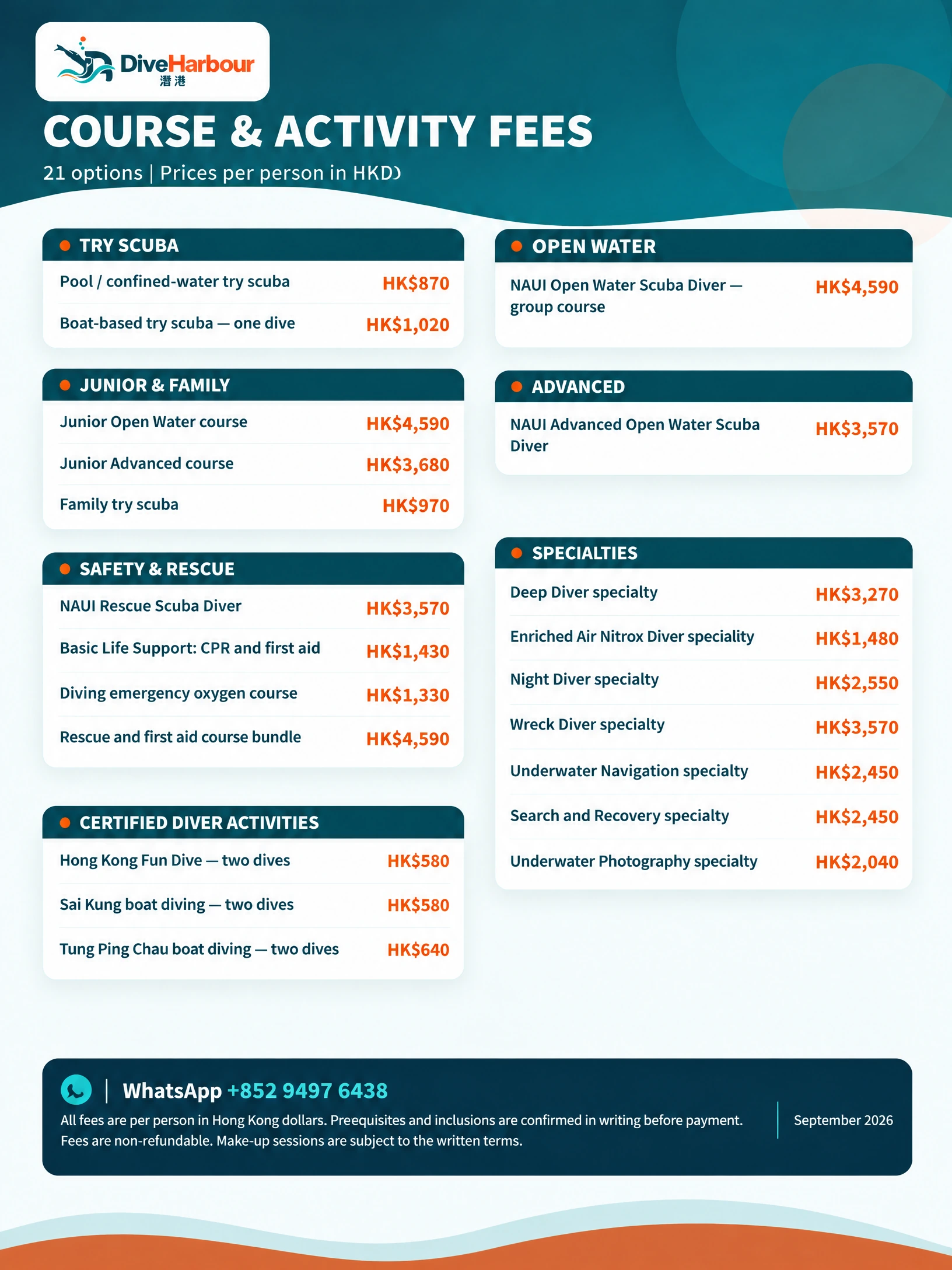
English price list for 21 DiveHarbour courses and activities, with fees per person in Hong Kong dollars
Tap the price list to view it at full size.

Plan your next dive

Course fees, clearly set out

Compare our published course and activity fees before choosing your next step. All prices are per person in Hong Kong dollars.

Before you book, we confirm prerequisites, materials, certification, equipment, venue and boat arrangements in writing. Ask us about fees for courses not listed here.

All fees are non-refundable. Make-up sessions are subject to the written terms.

Read all course fees
DiveHarbour course and activity fees per person in Hong Kong dollars
Course / activityPer person
Pool / confined-water try scubaHK$870
Boat-based try scuba — one diveHK$1,020
NAUI Open Water Scuba Diver — group courseHK$4,590
Junior Open Water courseHK$4,590
Junior Advanced courseHK$3,680
Family try scubaHK$970
NAUI Advanced Open Water Scuba DiverHK$3,570
NAUI Rescue Scuba DiverHK$3,570
Basic Life Support: CPR and first aidHK$1,430
Diving emergency oxygen courseHK$1,330
Rescue and first aid course bundleHK$4,590
Deep Diver specialtyHK$3,270
Enriched Air Nitrox Diver specialtyHK$1,480
Night Diver specialtyHK$2,550
Wreck Diver specialtyHK$3,570
Underwater Navigation specialtyHK$2,450
Search and Recovery specialtyHK$2,450
Underwater Photography specialtyHK$2,040
Hong Kong Fun Dive — two divesHK$580
Sai Kung boat diving — two divesHK$580
Tung Ping Chau boat diving — two divesHK$640