Colour Timing Boundary for Coastal Events | DiveHarbour
A colour timing boundary keeps three decisions separate: when the coastal event happens, what the colour provider and product instructions require, and whether your own health and activity checks support entering the water. Work backwards from the event, write questions before booking, and never treat a salon appointment as water-activity clearance.
Illustration · Concept illustration: a coastal colour-planning calendar, not a real salon, product, client, or result.
Instructor qualifications
One clear teaching conversation from first breath to next step
DiveHarbour brings together scuba teaching, swimming, lifesaving and water-rescue experience so you can ask practical questions before choosing a course.
PADI teaching backgroundTeaching experience across recognised scuba learning pathways.
SSI teaching backgroundClear explanations when you are comparing agency routes.
NAUI teaching backgroundA practical, standards-aware approach to learning and progression.
Swimming foundationWater confidence and calm, step-by-step practice matter.
Lifesaving experienceSurface awareness and prevention stay part of the conversation.
Pool rescue experienceControlled practice can build confidence before open water.
Beach rescue experienceLocal water context informs sensible preparation.
Kayak rescue experienceA wider water-safety perspective supports good judgement.
PWC rescue experienceAsk about the right learning route for your experience and goals.
Brand relationship: DiveHarbour and DT HUB share the same owner.
DiveHarbour and DT HUB are operated by the same owner. DT HUB links in this article are references to external service and product information, not independent third-party recommendations, medical-effect claims, or endorsements of water-activity safety. DiveHarbour handles diving and coastal activities; ask DT HUB separately about its salon, hairpiece, academy, or hair-growth services.
A useful fact to keep in mind
The FDA advises following hair-dye package directions and warnings, doing a patch test before each use, and not using the dye if the test produces a rash. [1]
Start with the coastal event, the photographs that matter, and the point at which you need to be ready; only then discuss an appointment.
Ask the provider which product directions, patch-test steps, processing limits, rinsing steps, and aftercare instructions apply to your situation.
Keep colour handling separate from water-activity suitability; neither a salon nor a service directory can personally clear you to dive or swim.
Keep a shore-based alternative ready, and confirm any health, medication, illness, or post-dive question with the appropriate qualified professional.
Start here
Colour timing boundary: begin with the coastal event
The colour timing boundary is a planning line, not a promise
A coastal event may combine a boat transfer, lunch, photographs, a shore walk, and an evening meal. Those moments do not all place the same demand on your appearance or your time. Write the event date, the first photograph, the last point at which you can change plans, and whether your colour appointment would be before or after the water portion. That simple timeline prevents a styling question from quietly becoming an assumption about swimming, diving, sweat, sun, salt water, or chlorine.
Next, separate the questions you want answered. One question is scheduling: what appointment window could fit without rushing? A second is product handling: what instructions, preparation, processing limits, rinsing, or follow-up does the provider require? The third is personal activity: are you currently fit and cleared for the planned water activity under the rules that apply to you? A useful service directory can help you identify a provider to ask, such as a hair salon kowloon bay, but its listing cannot answer the third question.
Event track: record the date, photographs, travel legs, and the latest time you can arrive without pressure.
Styling track: describe the colour goal, current hair condition, previous colour work, and what you need the provider to explain.
Activity track: check the operator's requirements and your own health status separately; ask a qualified medical professional when indicated.
Fallback track: decide what you will do if the appointment, product instructions, weather, or activity decision changes.
Guide · 02
Work backwards from the day you need to look ready
Use a date-led record instead of a guessed waiting period
Begin with the fixed moment that matters most. It might be a family photograph at the waterfront, a dinner reservation after a shore excursion, or a meeting point before a boat leaves. Then mark the latest realistic time for the colour appointment, allowing space for consultation, the provider's process, travel, food, and an unhurried change of plan. Do not turn this exercise into a universal rule such as “colour on this day means water is fine on that day.” The schedule is yours; activity suitability is a separate decision.
When you contact a provider, send a compact brief rather than only saying that you have a beach event. State the event date, when you need to be camera-ready, whether the water activity is optional, and what you want to understand about the process. Ask which steps are part of the appointment and which instructions you must follow at home. If you are comparing area information, best hair salon kowloon bay is a starting point for questions, not a verdict on quality, availability, or results.
Swipe the table to compare all columns.
A three-track record for planning colour around a coastal event
Track
Write down
Who answers the question
Event
Date, photographs, travel legs, and latest comfortable arrival time
You and the event organiser
Styling
Colour goal, current condition, product instructions, processing and aftercare questions
The actual colour provider
Activity
Planned water activity, operator requirements, health changes, and professional advice
The activity operator and, when needed, a qualified medical professional
Illustration · Concept illustration: appointment notes for a hypothetical shore event, not a real provider or booking.
Guide · 03
Treat product handling as its own conversation
A label instruction is not an activity clearance
The FDA says to follow the package directions and all caution or warning statements for hair dye. It also advises a patch test before each use, not using the dye if the test produces a rash, and not leaving the product on longer than directed. The same guidance includes rinsing the scalp well afterward, wearing gloves, and never mixing different hair-dye products. [1] For a salon appointment, use those points as prompts: ask which instructions apply, who performs any required test, and what you should do if your skin or scalp reacts.
This conversation should stay practical and specific. Tell the provider about previous colour, known sensitivities, recent scalp changes, or any instruction you already received from a health professional. Ask for the product name or label directions when relevant, the expected processing sequence, and what “finished” means for the appointment. Do not ask a colour provider to certify that a product is waterproof, chlorine-resistant, or suitable for diving. A listing such as hair salon lam tin can help you locate information to query, but it is not product evidence.
Guide · 04
Plan the appearance you can actually maintain
Colour timing boundary questions for a coastal itinerary
A useful brief describes the day you are trying to support, not an imagined result. Say whether the important view is daylight, indoor dinner light, or a photograph from a distance. Note whether you can return to a provider after the event, whether you need a low-effort shore look between activities, and which changes would be unacceptable. That gives the provider a clearer basis for discussing scope. It still does not guarantee a particular shade, lasting finish, or response to sea water, pool water, weather, or friction.
If a plan involves several people, assign one person to keep the timeline and one person to keep the activity questions. This avoids a group treating the most confident voice as the person who has made a health decision for everyone. Ask the provider about appointment scope and ask the activity operator about its own requirements. When comparing where to begin an enquiry, hair salon yau tong is external service information; it does not represent a Yau Tong branch, a confirmed appointment, or a promise about your event outcome.
Illustration · Concept illustration: a hypothetical change-of-plan routine, not a real activity clearance or hair result.
Guide · 05
Keep personal water-activity checks separate
Colour timing boundary decisions cannot replace medical or operator confirmation
Whether you can personally take part in a water activity depends on the activity, the operator's process, and your current circumstances. A colour appointment does not clear you for scuba, snorkelling, or swimming. If you have an acute illness, symptoms, a recent injury, a medication question, or another health concern, pause the activity decision and seek the appropriate qualified advice. Divers Alert Network says acute illness is not compatible with safe diving and notes that some people need medical evaluation rather than self-evaluation alone. [2] That is a health boundary, not a hair-care rule.
Keep the activity record factual: note the planned activity, the operator's questions, relevant changes in your health, and what professional advice you were told to follow. Do not infer that feeling well after an appointment equals fitness to dive, or that a colour-related inconvenience requires cancelling a medically approved activity. For travel planning, read flying after repetitive scuba dives surface interval as a separate dive-and-flight planning topic; it does not set a colour-processing interval.
Swipe the table to compare all columns.
What to confirm before treating the plan as settled
Area
Useful question
Do not infer
Appointment
What is included, what preparation is required, and what timing is realistic?
That an advertised service guarantees a date, shade, or finish
Product
Which label directions, patch-test steps, processing limits, rinsing, and reaction instructions apply?
That colour is waterproof or chlorine-resistant
Water activity
What does the operator require, and do I need qualified medical confirmation?
That a salon appointment approves diving, swimming, or snorkelling
Guide · 06
Build a shore-based fallback before you book
A good plan still works when one track changes
The safest practical fallback is not a product claim. It is a change in sequence. You might keep the colour consultation while moving photographs to a shore-only segment, postpone an optional water activity, or leave the appearance decision open until the provider answers your questions. If the event involves diving, keep the dive operator's process, health screening, and equipment requirements in their own record. If you are preparing for a course or trip, dive trip preparation in Hong Kong can sit beside the styling plan without becoming part of it.
Before confirming anything, read your notes aloud as three separate sentences: “This is when I need to be ready.” “These are the product and appointment questions I still have.” “This is what the operator or qualified professional has confirmed about my activity.” If one sentence contains an answer borrowed from another, stop and ask again. That habit protects your decision from marketing language, group pressure, and the tempting but unsupported idea that a hairstyle or colour process makes water activity suitable.
Illustration · Concept illustration: a planning toolkit for a hypothetical coastal day, not a real classroom, client, or product.
A sensible next step
Take the question with you
A colour timing boundary gives your coastal plan a clean stopping point: the event timeline tells you when you need to be ready, the provider tells you how to handle the product, and the operator or qualified professional addresses your personal activity question. Record each answer beside the right track. If any track remains uncertain, keep the shore-based option instead of filling the gap with a waterproof, chlorine, or safety assumption.
For diving or coastal activities, ask DiveHarbour about the activity format, operator requirements, and planning information. For colour, hairpieces, academy services, or hair-growth enquiries, contact DT HUB separately to confirm scope, product instructions, qualifications, risks, alternatives, and current arrangements. Neither this article nor a linked directory promises an appointment, price, colour result, treatment, or activity approval.
Questions to ask
Common questions
How long should I wait between colouring my hair and swimming or diving?
There is no universal interval in this article because the answer depends on the product instructions, the provider's process, the activity, and your own circumstances. Ask the colour provider about its instructions and ask the activity operator or a qualified medical professional about your activity. Do not turn a guessed number into clearance.
Does a patch test mean I am cleared for a coastal water activity?
No. A patch test is a product-safety step. The FDA advises following the label and repeating the test before each use; it does not make a statement that a product is waterproof, chlorine-resistant, or suitable for water activity.
Can a salon tell me whether I am fit to scuba dive?
No. A salon can explain its appointment scope and product instructions. It cannot replace the activity operator's requirements or qualified medical advice. If illness, symptoms, medication, injury, or another health issue affects the question, seek the appropriate professional confirmation.
What should I do if the colour appointment and coastal activity plan conflict?
Keep the tracks separate and change the sequence rather than inventing a product promise. You could move photographs to a shore-only part of the day, leave an optional activity undecided, or postpone the styling choice until your questions are answered. Keep any confirmed activity requirements in their own record.
DAN says acute illness is not compatible with safe diving and that people kept away by illness or with certain risk factors may need medical evaluation rather than self-evaluation alone.
Continue exploring
Three useful next reads
Keep comparing practical questions before you choose a course, activity or preparation step.
Coastal life and image planning · Updated 2026-11-06
Outdoor-light reference brief for coastal photo planning
Use an outdoor-light reference brief to plan light, framing, neckline and styling limits for a coastal shoot. Read the checklist and ask better questions.
Coastal life and image planning · Updated 2026-11-06
Shore styling tool choice: build a compact shore-day kit
Use shore styling tool choice to sort essential tools, power limits, cleaning needs, and backup options before a coastal day. Read the practical guide.
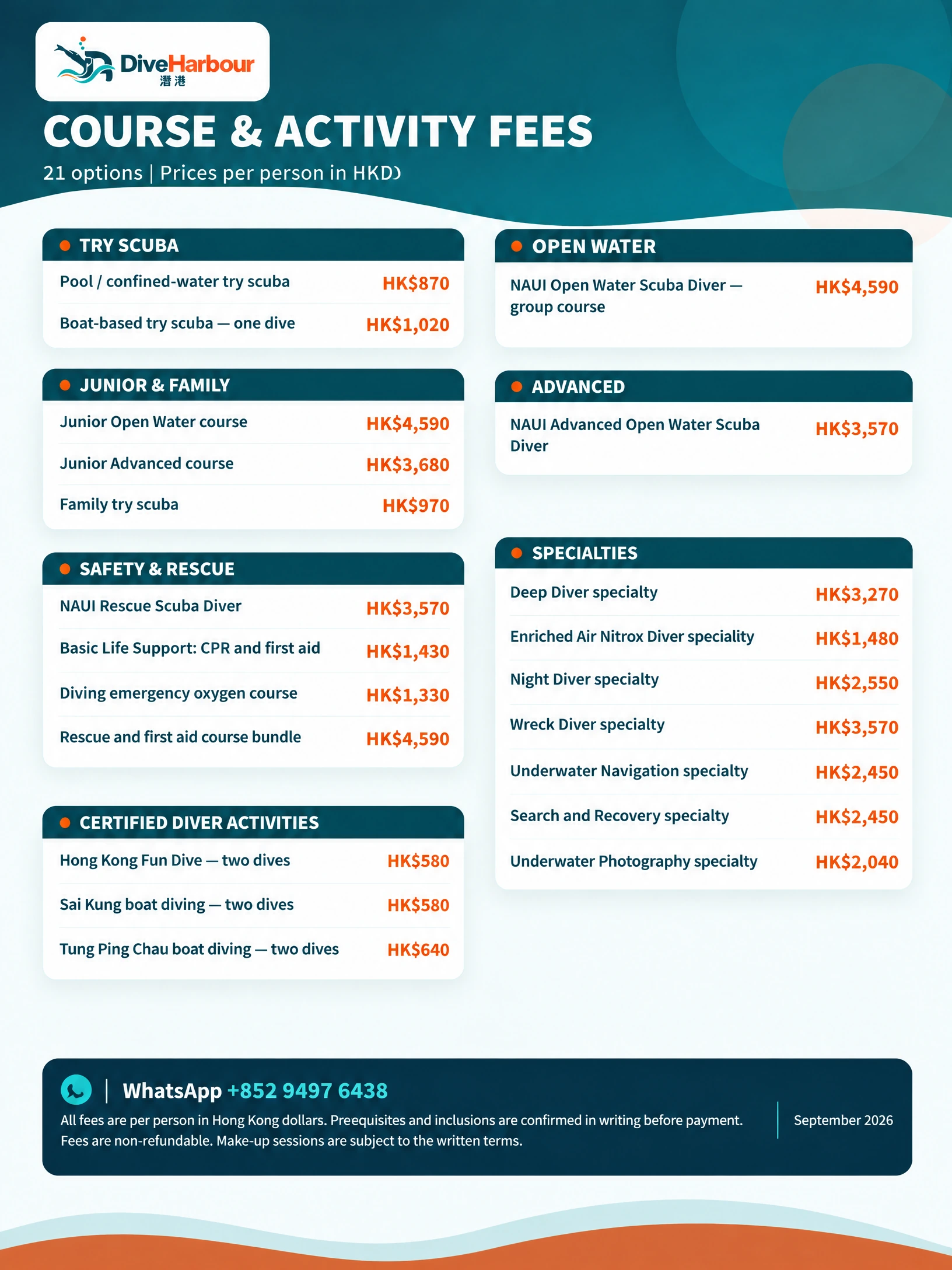
Compare our published course and activity fees before choosing your next step. All prices are per person in Hong Kong dollars.
Before you book, we confirm prerequisites, materials, certification, equipment, venue and boat arrangements in writing. Ask us about fees for courses not listed here.
Read the Sai Kung diving Hong Kong guide to learn about the setting, then explore the Sai Kung scuba diving course page. Certified divers can use our Hong Kong fun dive guide to check experience requirements and activity arrangements. Locations remain subject to weather and sea conditions.
Explore the responsibilities and entry requirements in our Divemaster course Hong Kong guide, then review the scuba instructor course Hong Kong route. Professional training differs from recreational progression, so confirm experience requirements and assessment arrangements first.