

SAFE LEARNING · HAPPY EXPLORING
DiveHarbour

DiveHarbour · Practical guide

Short-hair beach highlight plan: compare placement and upkeep

A short-hair beach highlight plan should compare cut length, colour contrast, starting base, placement, and post-swim upkeep. Fine highlights can read clearly on a short crop, while balayage may need enough length for a visible transition. Use the event setting and your darker base to choose the question to ask, not a universal lightening rule.

By DiveHarbour9 min read
Ask about diving courses or coastal trip planning Read the guide
Short-hair beach highlight plan showing coastal hair preparation before an outdoor event (Illustration)
Illustration · coastal preparation for a short-hair colour discussion; not a real client result.

Instructor qualifications

One clear teaching conversation from first breath to next step

DiveHarbour brings together scuba teaching, swimming, lifesaving and water-rescue experience so you can ask practical questions before choosing a course.

  • PADI teaching backgroundTeaching experience across recognised scuba learning pathways.
  • SSI teaching backgroundClear explanations when you are comparing agency routes.
  • NAUI teaching backgroundA practical, standards-aware approach to learning and progression.
  • Swimming foundationWater confidence and calm, step-by-step practice matter.
  • Lifesaving experienceSurface awareness and prevention stay part of the conversation.
  • Pool rescue experienceControlled practice can build confidence before open water.
  • Beach rescue experienceLocal water context informs sensible preparation.
  • Kayak rescue experienceA wider water-safety perspective supports good judgement.
  • PWC rescue experienceAsk about the right learning route for your experience and goals.

Brand relationship: DiveHarbour and Vit So share the same owner.

This guide was prepared by DiveHarbour. Vit So links provide external hair-service information for reference; they are not a diving-safety, medical, or service-results guarantee.

A useful fact to keep in mind

WHO recommends sun protection when the UV index reaches 3 or above, and says reflective surfaces such as water and sand increase UV levels.

Check the source
Key takeaways

Four points to carry forward

  • Decide where colour must be visible when the hair is dry, wet, tucked behind the ear, or covered by a hat.
  • Use haircut length and the darker starting base to set a realistic contrast conversation rather than copying a long-hair reference photo.
  • Treat highlights and balayage as placement choices, then ask about the likely upkeep after rinsing, sun exposure, and repeated swims.
  • Keep any perm discussion separate from colour planning and ask the service provider to assess your current hair and chemical history.
Start here

Start with the short-hair beach highlight plan, not a trend name

A short-hair beach highlight plan begins with the event and the way you actually swim

Before choosing a colour technique, describe the day after the appointment. A short-haired swimmer may move from a pool or boat to a shore event, wear a cap or hat, and need the hair to look deliberate after a quick rinse. Note the cut length at the sides, crown, fringe, and nape. A cropped style exposes more of the surface, while a short bob or grown-out pixie gives colour a little more room to overlap and blend.

The event also changes what counts as visible. A side part may show one bright panel, but wind can move it away from the face. Tucking the hair behind one ear can reveal a stronger accent than leaving it loose. If the day includes diving, check the practical route in Hong Kong diving water temperature and plan your hair brief separately from water-safety decisions. The goal is a shared description, not a promise that colour will stay unchanged in water or sun.

  • Write down the shortest and longest parts of the haircut, including fringe and side length.
  • Take one dry photo from the front and both sides in your usual parting.
  • Mark whether the colour must show loose, tucked behind the ear, or under a hat.
  • Describe the swim, rinse, travel, and event sequence in the order it will happen.
Guide · 02

Highlights on short hair: make placement do the work

Ask whether the line, panel, or fine pieces will still read after the next trim

On short hair, placement can matter more than the number of light pieces. Fine highlights through the top may create a small, even change, while a few face-framing or side pieces make the event result more directional. A very short crop can lose a planned line when the cut is reshaped. A short bob can retain a more obvious face or perimeter placement. Ask which sections will be cut, exposed, or hidden by your normal styling before discussing brightness.

Contrast should be judged against your actual starting base, not a studio image with different lighting. Dark brown hair may make a light piece look graphic, while a closer shade can read as texture. If you also want a change in movement, treat it as a separate consultation: a hair perm is a service question, not evidence that a colour pattern will suit wet hair. Ask what can be assessed in person and what would change if the cut is shortened.

  • Choose a placement zone: fringe, face frame, crown, side, nape, or a mix.
  • Ask how much of each piece remains after the next planned trim.
  • Compare a subtle contrast with a clearly visible contrast under outdoor light.
  • Bring a photo of your current base in daylight, without a beauty filter.

Swipe the table to compare all columns.

Highlights and balayage questions for short hair
Decision pointHighlights on short hairBalayage on a darker baseQuestion to ask
PlacementFine pieces, panels, or face-framing sections can be positioned preciselyA softer transition needs enough visible length to read clearlyWhere does the lighter area begin on my current cut?
ContrastA small light piece can look graphic against a dark baseThe darker root or base can remain part of the designDo I want soft, noticeable, or graphic contrast?
UpkeepA trimmed section may remove a planned lineThe transition may need to be reconsidered as short ends changeWhat will still show after my next trim and swim reset?
Fresh-water rinse as part of a short-hair beach highlight plan after swimming (Illustration)
Illustration · a post-swim fresh-water rinse routine; not a treatment guarantee.
Guide · 03

Balayage on a darker base: check the length of the transition

A darker base needs a conversation about where the lighter area begins and ends

Balayage is often discussed as a painted, softer transition, but the visible result still depends on space. On a short crop, there may be too little length for a long gradient to read as a gradient. The design may instead rely on selected surface pieces or a stronger contrast near the top. On a short bob, the lower edge can offer more room, but a blunt line may make the light area look more deliberate than soft. Ask to see the proposed start point on your own cut.

A darker starting base is not a small detail. It affects how much contrast you notice, how the natural root is used in the design, and how quickly a new line may attract your eye as the hair grows. The American Academy of Dermatology advises staying close to the natural shade when dyeing and notes that lightening more than three shades requires higher peroxide volumes and can cause more hair damage. [1] Use that as a reason to discuss the base and condition, not as a fixed colour limit.

  • Ask where the lighter transition begins on the front, side, and back of your haircut.
  • Check whether the darker base remains visible by design or is meant to be changed.
  • Describe your acceptable contrast in words such as soft, noticeable, or graphic.
  • Ask how the design will be handled if the short ends are trimmed before the event.
Guide · 04

Use length, contrast, and upkeep as the tie-breakers

The best match is the one that fits your cut and your tolerance for visible regrowth

There is no universal winner between highlights and balayage for a swimmer with short hair. Start with the silhouette you want to preserve. If the cut is tight and the event look depends on a few visible pieces, ask about precise placement and how the colour will be seen from each angle. If the cut has a longer top or bob perimeter, ask whether a gradual transition has enough room to look intentional. Then compare contrast: a darker base can make even a small light area stand out.

Upkeep is part of the design, not an afterthought. A high-contrast piece may be easy to notice after a rinse but also more noticeable when the cut shifts. A lower-contrast plan may be less visually demanding, yet it may not deliver the event change you want. If you are considering a women's perm as well, ask for the colour and movement decisions to be assessed together, without assuming that either service makes the hair resistant to water, sun, or friction.

  • Rank your priorities: visible event change, soft grow-out, easy reset, or preserving length.
  • Ask for the same placement to be shown on your current haircut rather than only on long hair.
  • Decide how much contrast you can maintain when the colour is no longer freshly styled.
  • Record which parts of the plan are essential and which can be adjusted after assessment.
Consultation notes for a short-hair beach highlight plan on a darker base (Illustration)
Illustration · planning placement and starting base with reference notes; not a real salon consultation.
Guide · 05

Plan post-swim and outdoor-event upkeep

Protect the look by planning the route from water to dry hair and sun

Build a simple reset into the day. If you swim before the event, carry a clean towel, a wide-tooth comb or soft brush suited to your hair, and the products you already know your scalp tolerates. Rinse when fresh water is available, blot rather than rough-drying, and decide whether the event look is loose, tucked, or lightly shaped. Do not invent a chemical waiting period from a calendar. Instead, ask the service provider how your own colour plan and recent treatments should be managed.

Outdoor exposure matters even when the water is not the main activity. The AAD says sun can make dyed, bleached, or permed hair weak, dry, rough, faded, and brittle, and suggests a wide-brimmed hat. [1] WHO also says water and sand reflect UV and recommends sun protection when the UV index is 3 or above. [2] Shade, a hat, and skin protection can therefore be part of the event kit, while hair upkeep remains a practical care plan rather than a guarantee of colour durability.

  • Pack the rinse, drying, and detangling items you can use without changing your whole routine.
  • Choose a hat that does not flatten the exact area you want the event colour to show.
  • Check the UV index and include shade or protective clothing for long outdoor periods.
  • Ask what to do if the hair feels unusually irritated, brittle, or uncomfortable after a service.

Swipe the table to compare all columns.

A practical pre-event colour brief
What to recordWhy it affects the comparisonUseful wordingBring or ask
Haircut lengthShort sections determine how much room a line or gradient hasMy sides are short; my top reaches this pointDaylight photos from front and both sides
Starting baseDark hair changes how strongly a light area readsI want a soft, noticeable, or graphic changeCurrent colour history and natural-base notes
After-swim routineRinsing, drying, hats, and wind affect the event planI have this much time before the eventA simple reset kit and care questions
Guide · 06

Turn the comparison into a clear consultation

Bring a short brief so a stylist can discuss colour, length, and movement separately

A useful consultation brief can fit on one phone note. Start with the event date and setting, then record your current haircut, natural or current colour, recent colour or perm history, swim frequency, headwear, and the amount of time available after swimming. Add two reference images only if they show a similar length and starting base. If you are asking about a full head perm, label that as a separate movement goal instead of using it as a substitute for a highlight or balayage decision.

Ask for the decision in plain terms: where will the colour sit, how strong will the contrast look against my darker base, what happens when the short sections are trimmed, and what will I need to do after a swim? A provider can then explain what needs individual assessment. For a diving plan, the seasonal context may also be useful; read best time to dive in Hong Kong for trip planning, while the hair consultation remains a separate service conversation.

  • Share current-hair photos in daylight and state whether they were taken before or after swimming.
  • List every recent chemical service you remember, even if the colour has faded.
  • Ask which option is easier to adjust if the haircut changes before the event.
  • Confirm what the service includes and which questions require an in-person hair assessment.
Shore-side event styling after a short-hair beach highlight plan (Illustration)
Illustration · shore-side event hair after practical planning; not a real client result.
A sensible next step

Take the question with you

Choose the option that matches the shape of your haircut and the amount of contrast you can live with after the swim, not the name that sounds most beach-like. Before booking, send daylight photos, describe the darker base and recent services, mark the placement you want visible, and write down the reset you can manage before the event.

Questions to ask

Common questions

Are highlights or balayage better for short hair before a beach event?

Neither is automatically better. Compare the haircut length, the visibility you want, the darker starting base, the placement, and the upkeep you can manage after swimming. Highlights may suit a precise visible piece, while balayage needs enough length for its transition to read as intended.

Can a darker base still work with a soft beach colour plan?

It can be discussed, but the starting base affects perceived contrast and the amount of lightening involved. Bring daylight photos and ask where the lighter area begins and ends. A stylist should assess the current colour, previous treatments, and hair condition rather than promise a fixed result.

Should I add a perm to my short-hair highlight plan?

Treat movement and colour as separate decisions that may need to be assessed together. A perm changes the shape brief, while highlights or balayage change the colour brief. Ask the service provider to review your hair history and event routine. Do not assume a perm protects colour from water, sun, or friction.

How should I prepare highlighted short hair for an outdoor swim day?

Plan a practical reset rather than a claimed waiting time: rinse when fresh water is available, blot gently, use familiar detangling tools, and protect yourself from sun with shade, clothing, or a hat. WHO recommends sun protection when the UV index is 3 or above, and water and sand can reflect UV.

Further reading

Official sources worth checking

  • [1] Coloring and perming tips for healthier-looking hair

    The American Academy of Dermatology says lightening more than three shades requires higher peroxide volumes and can cause more hair damage; it also says sun can make dyed, bleached, or permed hair weak, dry, rough, faded, and brittle.

  • [2] Ultraviolet radiation

    WHO recommends sun protection when the UV index reaches 3 or above and notes that reflective surfaces such as water and sand increase UV levels.

Continue exploring

Keep comparing practical questions before you choose a course, activity or preparation step.

Coastal life and hair care · Updated 2026-11-06

Women's post-swim haircut shape: choose the right length

Compare a trim, layers and a bob after swimming. Use this women's post-swim haircut shape guide, then ask the right salon questions before booking.

women's post-swim haircut shape
Coastal life and hair care · Updated 2026-11-06

Men's shore-day haircut routine: reset after a swim

Plan a men's shore-day haircut routine after swimming. Read the wash, dry and restyle brief, then ask your salon the right questions.

men's shore-day haircut routine

Coastal life and hair care · Updated 2026-11-06

Men's swim-after colour plan: schedule a clear consult

Use this men's swim-after colour plan to record swim exposure, past treatments and travel dates. Read the checklist and plan a clear consult.

men's swim-after colour plan
Your next step

Ask about diving courses or coastal trip planning

Message DiveHarbour on WhatsApp to discuss diving courses or coastal trip planning, along with your experience and preferred dates.

Ask about diving courses or coastal trip planning
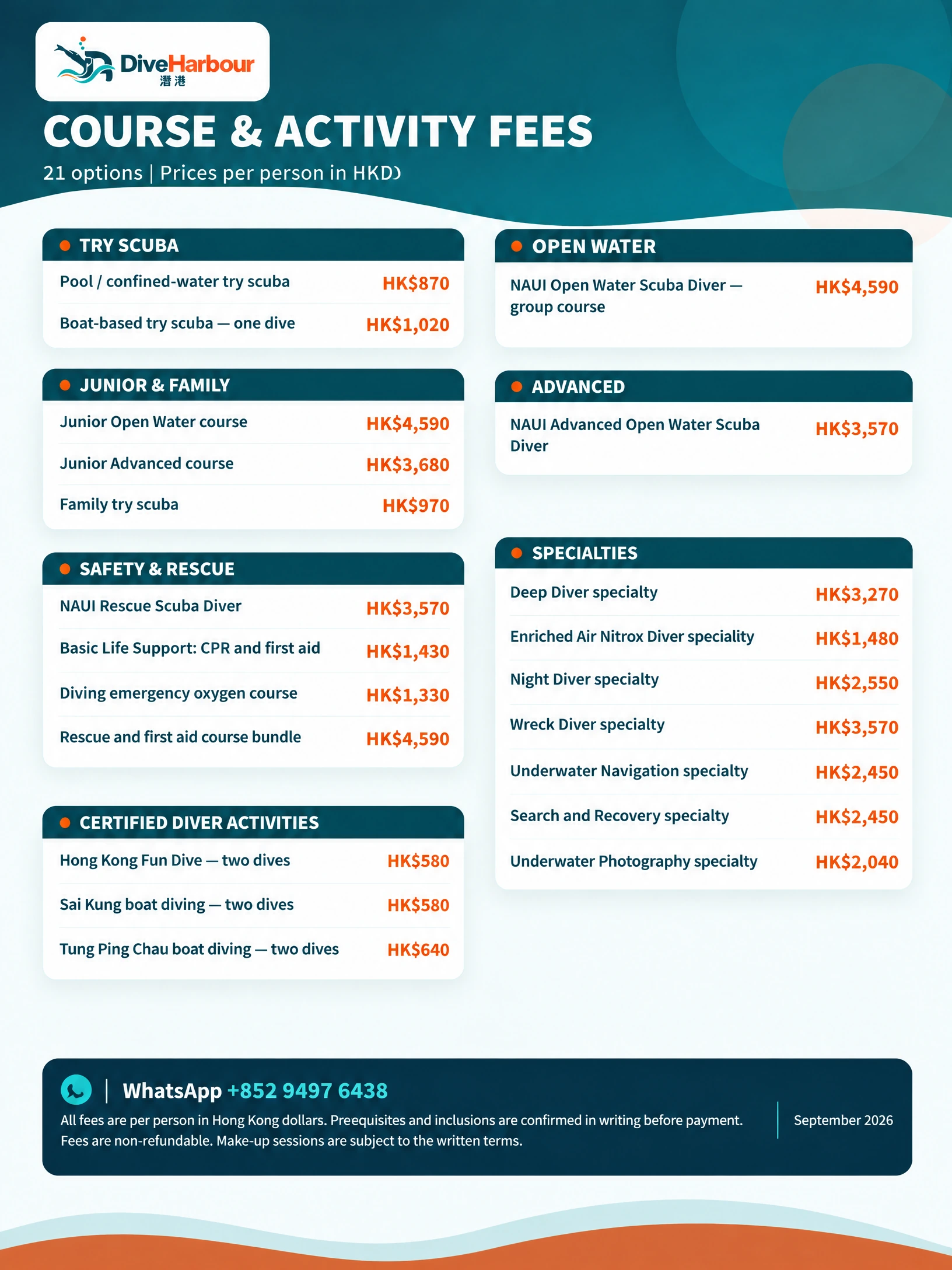
English price list for 21 DiveHarbour courses and activities, with fees per person in Hong Kong dollars
Tap the price list to view it at full size.

Plan your next dive

Course fees, clearly set out

Compare our published course and activity fees before choosing your next step. All prices are per person in Hong Kong dollars.

Before you book, we confirm prerequisites, materials, certification, equipment, venue and boat arrangements in writing. Ask us about fees for courses not listed here.

All fees are non-refundable. Make-up sessions are subject to the written terms.

Read all course fees
DiveHarbour course and activity fees per person in Hong Kong dollars
Course / activityPer person
Pool / confined-water try scubaHK$870
Boat-based try scuba — one diveHK$1,020
NAUI Open Water Scuba Diver — group courseHK$4,590
Junior Open Water courseHK$4,590
Junior Advanced courseHK$3,680
Family try scubaHK$970
NAUI Advanced Open Water Scuba DiverHK$3,570
NAUI Rescue Scuba DiverHK$3,570
Basic Life Support: CPR and first aidHK$1,430
Diving emergency oxygen courseHK$1,330
Rescue and first aid course bundleHK$4,590
Deep Diver specialtyHK$3,270
Enriched Air Nitrox Diver specialtyHK$1,480
Night Diver specialtyHK$2,550
Wreck Diver specialtyHK$3,570
Underwater Navigation specialtyHK$2,450
Search and Recovery specialtyHK$2,450
Underwater Photography specialtyHK$2,040
Hong Kong Fun Dive — two divesHK$580
Sai Kung boat diving — two divesHK$580
Tung Ping Chau boat diving — two divesHK$640