SAFE LEARNING · HAPPY EXPLORING
DiveHarbour

DiveHarbour · Practical guide

Advanced Dive Configuration Choices for Hong Kong

Advanced dive configuration choices should follow the environment, objective and training scope, not equipment fashion. Compare depth, darkness, breathing gas, wreck access and sidemount handling. Then check buoyancy, recent experience, equipment fit and supervision. This article gives you a practical comparison worksheet and a completed enquiry brief. Use both tools to choose a sensible next conversation with a qualified Hong Kong instructor.

By DiveHarbour9 min read
Ask about a course Read the guide
Illustration of advanced dive configuration choices for Hong Kong divers
Illustration · an underwater scene for comparing advanced dive configurations.

Instructor qualifications

One clear teaching conversation from first breath to next step

DiveHarbour brings together scuba teaching, swimming, lifesaving and water-rescue experience so you can ask practical questions before choosing a course.

  • PADI teaching backgroundTeaching experience across recognised scuba learning pathways.
  • SSI teaching backgroundClear explanations when you are comparing agency routes.
  • NAUI teaching backgroundA practical, standards-aware approach to learning and progression.
  • Swimming foundationWater confidence and calm, step-by-step practice matter.
  • Lifesaving experienceSurface awareness and prevention stay part of the conversation.
  • Pool rescue experienceControlled practice can build confidence before open water.
  • Beach rescue experienceLocal water context informs sensible preparation.
  • Kayak rescue experienceA wider water-safety perspective supports good judgement.
  • PWC rescue experienceAsk about the right learning route for your experience and goals.

A useful fact to keep in mind

Source-backed example: SSI's Advanced Wreck Diving standard lists a maximum depth of 30 metres and a linear distance of 40 metres for its named program.

Check the source
Start here

What should advanced dive configuration choices decide first?

How do environment and objective shape an advanced scuba setup?

Start with the dive problem, rather than the equipment list. Ask what you want to do, where you want to do it, and why.

Depth, darkness, gas, access and task loading create different demands. A configuration is useful only when it supports those demands.

PADI presents specialties as tools for exploration. Its descriptions connect buoyancy, wrecks, night navigation, depth planning, gas management and sidemount handling.

That does not make every specialty suitable for every diver. Certification, recent practice, medical status and instructor assessment still matter.

Begin with control. A diver who struggles to hold position may need skill practice before adding lights, cameras, extra cylinders or complex routes.

Read the Peak Performance Buoyancy course Hong Kong information when trim or weighting is your main concern.

The buoyancy control course Hong Kong option is also a useful discussion point for a configuration review.

Use this decision rule: choose the smallest change that solves the stated problem. Add training before adding complexity.

A local instructor should confirm the current agency standard, equipment availability, site conditions and class format. Do not infer availability from a course name alone.

  • Name the environment before naming the equipment.
  • State the skill or task you want to improve.
  • Check whether your current certification covers the planned activity.
  • List unfamiliar equipment before booking a session.
  • Keep instructor advice and current conditions in the decision.
Illustration of equipment preparation for advanced dive configuration choices
Illustration · checking equipment before a configuration change.
Guide · 02

When does depth favour a conventional configuration?

When should a Deep Diver specialty course be considered?

Depth changes more than the number on a computer. Gas use, narcosis, task loading, ascent planning and thermal comfort can all change.

PADI describes Deep Diver training as covering deep-dive planning, limits and gas management. That scope is different from simply descending deeper.

The Deep Diver specialty course Hong Kong page is the right starting point for current local prerequisites and format.

A deep diving course Hong Kong enquiry should state your certification, logged experience, intended depth and equipment familiarity.

Keep a conventional backmount setup when it is familiar, balanced and supported by your training. Familiarity can reduce task loading.

Do not change to doubles, stages or another gas merely to look advanced. Each change adds procedures, checks and failure points.

Technical diving moves beyond mainstream recreational limits through added training, equipment and risk management. DAN stresses that complexity raises responsibility.

A deeper recreational specialty is not automatically technical diving. Confirm the exact depth ceiling, gas, decompression status and supervision.

A practical decision is simple. If depth is the only new factor, keep the rest of the setup stable. If the dive exceeds the course scope, stop and redesign it.

Use the local price list only as a planning reference. The approved Deep Diver listing is HK$3,270 per person. Confirm current inclusions before payment.

Swipe the table to compare all columns.

Depth-configuration comparison worksheet
Planning questionConventional backmount responseDecision gate
Is the planned depth within current training?Keep the familiar setup and limits.If no, obtain the correct training first.
Will gas use rise at depth?Recheck gas planning and reserve rules.If the reserve cannot be defended, change the dive.
Is the equipment unfamiliar?Practise in a controlled setting first.Do not debut new equipment on a demanding dive.
Is decompression planned?Treat it as a different training pathway.Confirm agency standards and qualified supervision.
Guide · 03

How does darkness change an otherwise familiar setup?

When does a Night Diver specialty course make sense?

Night diving changes visual references and communication. Your route, entry, exit, buddy contact and light management need deliberate planning.

PADI describes Night Diver training as covering navigation, ascents, descents and light communication after sunset.

The Night Diver specialty course Hong Kong page can clarify the current course structure and equipment arrangements.

A night diving course Hong Kong question should mention your recent dives, light experience and preferred site.

Keep the first night setup simple. Use familiar buoyancy equipment, a primary light and a suitable backup plan.

Secure gauges, clips and lights before entry. Loose equipment can snag, obscure signals or disturb the seabed.

Agree on signals before descending. Decide how you will indicate low battery, separation, turn time and ascent.

A night configuration should also support surface logistics. Confirm the meeting point, launch timing, exit lighting and boat procedures.

Do not treat darkness as a reason to add every gadget. Visibility is lower, so task loading deserves a smaller setup.

Night specialty training is about a changed environment. It is not a shortcut to deeper, wreck or technical diving.

  • Carry a primary light and confirm the backup plan.
  • Practise light signals with your buddy before entry.
  • Secure hoses, clips, gauges and camera accessories.
  • Confirm entry, exit and surface-support arrangements.
  • Keep the first night plan familiar and conservative.
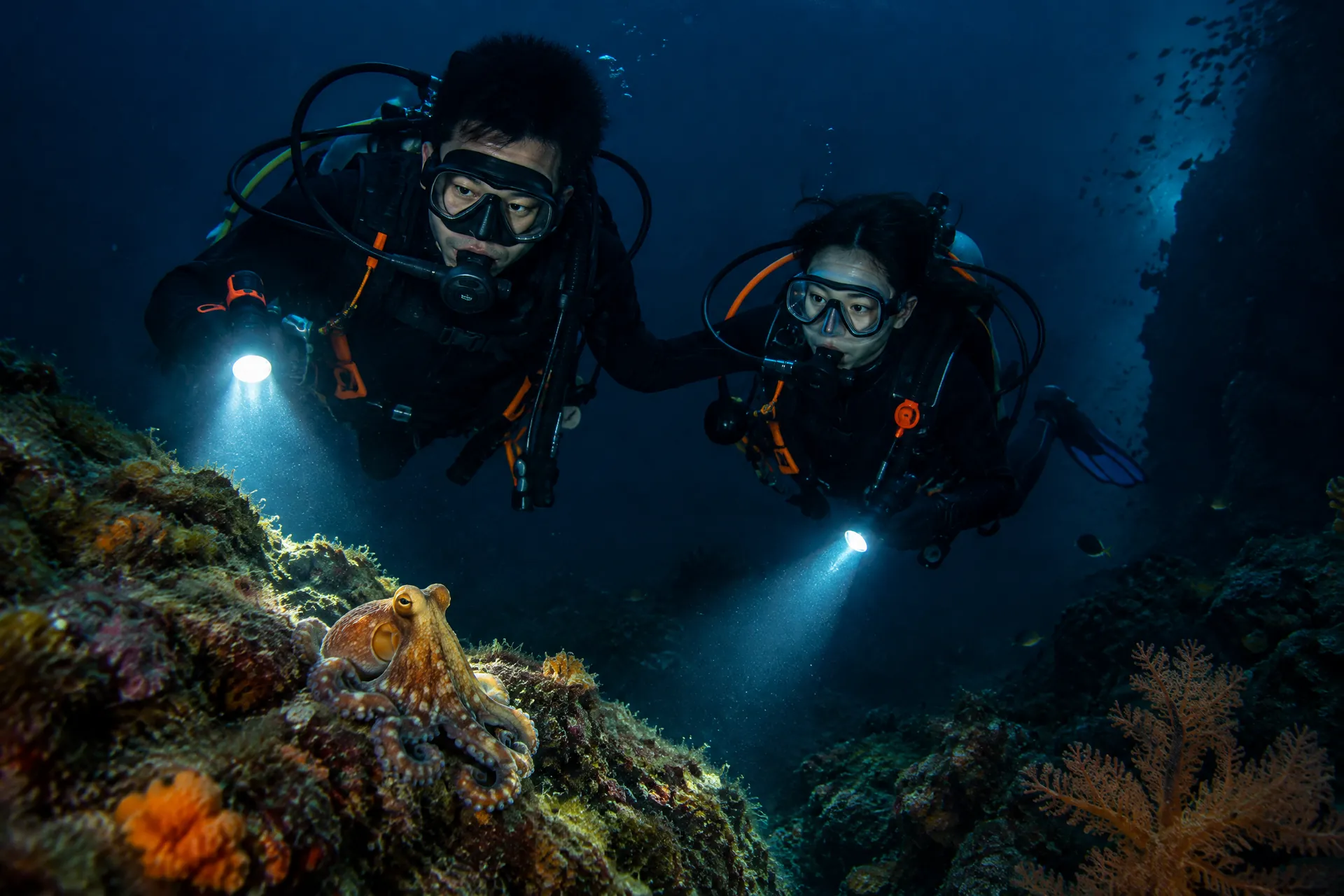
Illustration of a night-diving setup within advanced dive configuration choices
Illustration · a light and buddy plan for a night dive.
Guide · 04

When does gas planning favour Nitrox?

What does enriched air change, and what stays unchanged?

Nitrox is a breathing-gas choice, not a replacement for dive planning. The gas must be analysed, labelled and matched to depth.

PADI says Enriched Air Diver training can extend bottom time and shorten surface intervals on repetitive dives. It still requires oxygen exposure planning.

Read the Enriched Air Nitrox course Hong Kong page for the current local training route and inclusions.

An Nitrox certification course Hong Kong enquiry should state your planned depths, repetitive-dive schedule and gas-handling experience.

Nitrox does not make a diver deeper-qualified. It does not remove the need for a depth limit, reserve, buddy plan or ascent plan.

It may fit a repetitive boat day when the planned profile and oxygen exposure remain within training limits. The instructor or operator must confirm that fit.

The approved local reference lists Enriched Air Nitrox at HK$1,480 per person. It says practical dives, high-oxygen cylinders and boat fees may be separate.

That price is not a promise of a complete configuration. Ask what analysis tools, cylinders, gas fills, certification and practical training are included.

PADI notes that Nitrox can be combined with many other specialties. Combining courses still requires enough time and attention for each skill.

Choose Nitrox because the profile benefits from it. Do not choose it simply because the label sounds more advanced.

Swipe the table to compare all columns.

Nitrox decision gates for a repetitive dive plan
QuestionWhat to confirmPause when
What is the analysed mix?Record the oxygen percentage and maximum operating depth.The cylinder label or analysis is unclear.
Does the profile repeat?Compare bottom time, surface interval and oxygen exposure.The benefit is assumed without a planned profile.
What does the fee include?Ask about gas, cylinders, analysis, materials and certification.The quote is a package name without inclusions.
Does another specialty happen the same day?Allow time for separate knowledge and practical skills.The schedule encourages rushed training.
Guide · 05

How should wrecks and sidemount be assessed?

Which configuration fits access, trim and gas management?

Wreck and sidemount choices solve different problems. A wreck course focuses on a site type. Sidemount changes how cylinders are carried and managed.

PADI describes Wreck Diver training as safe exploration with responsible wreck-diving practices. That wording does not authorise every penetration.

The Wreck Diver specialty course Hong Kong page should confirm the current course scope and equipment plan.

A wreck diving course Hong Kong enquiry should ask whether the programme is no-penetration or limited penetration.

SSI provides a useful example. Its Advanced Wreck Diving standard describes limited, no-decompression penetration within the daylight zone.

That standard lists a maximum depth of 30 metres and a linear distance of 40 metres. Local agency standards may differ.

Sidemount can help with cylinder access, trim and movement. It also demands correct harness adjustment, clips, regulators and gas-management practice.

The recreational sidemount diving course Hong Kong page can clarify the intended recreational scope.

Ask about a sidemount diving course Hong Kong when you want configuration training, not an automatic technical qualification.

Do not combine a new sidemount harness with an unfamiliar wreck route on the same first dive. Separate the learning problems.

For an exterior wreck, ask whether buoyancy and navigation keep the route controlled. For limited penetration, confirm the standard's depth, distance and equipment boundaries.

For sidemount, ask whether you can clip, unclip and route regulators calmly. Add the configuration in controlled practice before using it on a demanding site.

If your goal is more gas, ask who manages reserves and failures. A higher-level pathway may be required rather than an equipment swap.

Illustration of a marine environment used to compare advanced dive configurations
Illustration · matching a configuration to the marine environment.
Guide · 06

How can you turn the comparison into a booking brief?

What should you send before discussing advanced dive configuration choices?

A good enquiry lets an instructor test fit quickly. It should describe the diver, the intended environment and the reason for changing configuration.

Use this completed example: “Certified diver, 42 logged dives, current in backmount, interested in a shallow wreck exterior.”

Add the missing facts. State your last dive, certification agency, planned month, preferred location and equipment ownership.

Mention whether you want deep, night, Nitrox, wreck or sidemount training. Say which problem you want solved first.

Ask whether the current session includes theory, confined-water practice, open-water dives, cylinders, gas analysis, boat fees and certification.

Ask about prerequisites and depth limits. Ask whether a medical questionnaire or physician evaluation is required for your circumstances.

Do not hide an unfamiliar setup or a long break. Honest information produces a more useful plan and safer supervision.

Use the following gates before paying. A “no” answer means pause, clarify or choose a simpler route.

Dates, meeting points, prices and availability must be confirmed directly. Fees are non-refundable unless written booking terms state otherwise.

Message DiveHarbour on WhatsApp at https://wa.me/85294976438 with the brief. Ask for the current course scope before committing.


  • Certification and agency, plus recent logged-diving history.
  • Target environment, depth, darkness, gas or access problem.
  • Current configuration and any unfamiliar equipment.
  • Preferred dates, group size, location and language.
  • Questions about prerequisites, inclusions, limits and written terms.
A sensible next step

Take the question with you

The best advanced configuration is the one that matches the environment, objective and confirmed training scope. Keep familiar equipment when it reduces task loading. Add depth, darkness, Nitrox, wreck or sidemount skills in a deliberate sequence. Message DiveHarbour on WhatsApp at https://wa.me/85294976438 with your completed brief and ask for current prerequisites, inclusions and limits.

Questions to ask

Common questions

Which specialty should I choose first?

Choose the specialty that addresses your clearest current problem. Buoyancy may come before depth, night or extra equipment. Ask an instructor to review your experience and intended environment.

Does Nitrox let me dive deeper?

No. Nitrox changes the breathing gas and oxygen exposure plan. It does not expand your certification depth or remove gas, reserve and ascent planning.

Is wreck training the same as technical penetration training?

No. Course scope varies. Some recreational wreck programmes avoid penetration, while limited-penetration standards define specific depth, distance and equipment boundaries. Confirm the named standard.

Is sidemount automatically a technical-diving setup?

No. Recreational sidemount training teaches a different equipment configuration. Technical sidemount adds different equipment, procedures and training requirements. Confirm the intended scope.

What should I include in my DiveHarbour enquiry?

Include certification, logged dives, last-dive timing, current setup, target environment, preferred dates, equipment questions and the configuration problem you want to solve.

Further reading

Official sources worth checking

  • PADI: Specialty Courses

    PADI describes buoyancy, wreck, night, deep, enriched-air and sidemount specialty objectives, including navigation, gas management, trim and cylinder handling.

  • Divers Alert Network: Technical Diving

    DAN explains that technical diving uses added training and technologies beyond mainstream recreational limits, and that complexity and equipment increase responsibility and risk.

  • SSI: Advanced Wreck Diving

    SSI specifies limited, no-decompression daylight-zone penetration for its Advanced Wreck Diving program, with maximum depth and linear-distance limits.

  • PADI Travel: PADI Night Diver

    The PADI Travel course listing requires Open Water certification and describes night navigation, buddy communication, entry and exit planning, and light use.

Continue exploring

Keep comparing practical questions before you choose a course, activity or preparation step.

Advanced & Specialties · Updated 2026-09-26

Choosing your next specialty: prerequisites and priorities

Compare sidemount vs wreck diving specialty prerequisites and choose an underwater navigation or search and recovery specialty by your goals, skills and equipment readiness.

sidemount vs wreck diving specialty prerequisites

Advanced & Specialties · Updated 2026-09-26

What to do after Advanced Open Water

Learn what to do after Advanced Open Water, from building experience through guided dives to choosing suitable specialty training for your goals.

what to do after Advanced Open Water

Advanced & Specialties · Updated 2026-09-26

Which specialty should you choose after Open Water?

Compare deep vs night vs Nitrox diving specialty options and decide which scuba specialty should I take after Open Water based on your goals, experience, comfort and next steps with DiveHarbour.

deep vs night vs Nitrox diving specialty
Your next step

Ask about diving courses

Message DiveHarbour on WhatsApp at https://wa.me/85294976438 with your certification, recent dives, goals and preferred configuration.

Ask about diving courses
English price list for 21 DiveHarbour courses and activities, with fees per person in Hong Kong dollars
Tap the price list to view it at full size.

Plan your next dive

Course fees, clearly set out

Compare our published course and activity fees before choosing your next step. All prices are per person in Hong Kong dollars.

Before you book, we confirm prerequisites, materials, certification, equipment, venue and boat arrangements in writing. Ask us about fees for courses not listed here.

All fees are non-refundable. Make-up sessions are subject to the written terms.

Read all course fees
DiveHarbour course and activity fees per person in Hong Kong dollars
Course / activityPer person
Pool / confined-water try scubaHK$870
Boat-based try scuba — one diveHK$1,020
NAUI Open Water Scuba Diver — group courseHK$4,590
Junior Open Water courseHK$4,590
Junior Advanced courseHK$3,680
Family try scubaHK$970
NAUI Advanced Open Water Scuba DiverHK$3,570
NAUI Rescue Scuba DiverHK$3,570
Basic Life Support: CPR and first aidHK$1,430
Diving emergency oxygen courseHK$1,330
Rescue and first aid course bundleHK$4,590
Deep Diver specialtyHK$3,270
Enriched Air Nitrox Diver specialtyHK$1,480
Night Diver specialtyHK$2,550
Wreck Diver specialtyHK$3,570
Underwater Navigation specialtyHK$2,450
Search and Recovery specialtyHK$2,450
Underwater Photography specialtyHK$2,040
Hong Kong Fun Dive — two divesHK$580
Sai Kung boat diving — two divesHK$580
Tung Ping Chau boat diving — two divesHK$640