

A useful fact to keep in mind
PADI states that a child must be 8 years of age or older to join the Seal Team, with no prior scuba experience necessary, water comfort expected and parental approval required.
Check the sourceCan an 8-year-old try scuba diving in Hong Kong?
Age, comfort and parental discussion
An 8-year-old may be able to join a suitable introductory programme, but age is only the first screening question. PADI’s official Seal Team description sets the minimum age at 8, says previous scuba experience is not necessary, and says children should be comfortable in the water with parental approval. That is a programme entry point, not a promise that every child will enjoy every session or that every Hong Kong operator currently runs it. PADI states that a child must be 8 years of age or older to join the Seal Team, with no prior scuba experience necessary, water comfort expected and parental approval required.
For a family, comfort matters more than enthusiasm on one afternoon. Can the child swim calmly, listen to an instructor, accept a mask and regulator on the face, and tell an adult when something feels wrong? A child who is curious but anxious may need a slower introduction in shallow, controlled water. A child who dislikes putting the face in water should not be persuaded through discomfort. Discuss swimming confidence, sensory preferences, attention span and previous water experiences honestly with the parent or guardian and instructor.
Junior activities are supervised learning experiences, not independent diving. The instructor should explain the water environment, participant-to-instructor arrangement, equipment size, communication signals and stopping plan. If a child feels cold, tired, frightened or simply no longer interested, stopping is a successful safety decision. For consent and family responsibility, read does a minor need parental consent for scuba training before making a booking.
- Treat willingness, water comfort and communication as readiness checks, not boxes to tick after payment.
- Keep the parent or guardian involved in briefing, forms, questions and the decision to continue.

PADI Seal Team Hong Kong for kids: what to confirm
Programme availability and suitable alternatives
PADI describes Seal Team as a pool-based programme built around AquaMissions. These themed activities can introduce basic scuba skills alongside playful tasks such as buoyancy, navigation, environmental awareness and underwater observation. The name therefore describes a structured junior programme, not a standard open-water certification. Ask DiveHarbour to confirm whether the exact programme is currently available, who delivers it, where it takes place and what is included.
Availability can change with instructor schedules, pool access, equipment sizing, weather and minimum group requirements. A useful enquiry covers the child’s age, swimming background, preferred language, relevant health questions and whether the family wants a one-off try or a multi-session format. Individual medical questions belong with a qualified clinician; an instructor can explain the activity and refer a parent to the appropriate form without making a diagnosis.
A younger child may prefer PADI Bubblemaker Hong Kong for kids as a shorter first taste, while an older, ready child may eventually discuss a junior certification pathway. Neither option should be selected by label alone. Compare the learning goal, depth and setting stated in writing, direct supervision and the child’s comfort. For a family day with non-scuba choices, see summer family diving activities Hong Kong so scuba is not the only successful outcome.
- Request the current programme name, agency, location, duration, equipment plan and cancellation terms in writing.
- Ask what happens if a child completes only part of a session; a flexible stop plan is more useful than pressure to finish.

A careful next step for young divers
Questions to discuss before any session
Begin with a short family conversation rather than a deposit. Let the child describe what looks exciting and worrying in their own words. Then message the operator with exact age, swimming experience, comfort with face immersion, known sensitivities and the parent’s preferred involvement. Ask whether the activity is confined water, how the child communicates underwater, and whether a parent observes poolside or joins only the briefing.
On the day, allow time for a dry briefing and equipment introduction before entering the water. The child should know how to signal to stop and should see that stopping is accepted without embarrassment. A good instructor watches breathing, body position, facial expression and attention, not only whether a task is completed. An early exit is not failure; it may be the information needed to choose a better future activity.
For parents comparing supervision in more detail, the junior scuba diving supervision plan for parents offers a discussion framework. If two adults want a separate experience while a child has their own plan, review private scuba lessons for couples Hong Kong only as a separate enquiry; it is not a substitute for junior supervision and should not divide adult attention during a child’s session.
- Agree a simple family stop signal before the session and repeat it during the briefing.
- Bring comfortable swimwear and realistic expectations; avoid scheduling the child when tired or rushed.

Choosing the right first-water format
A practical comparison for families
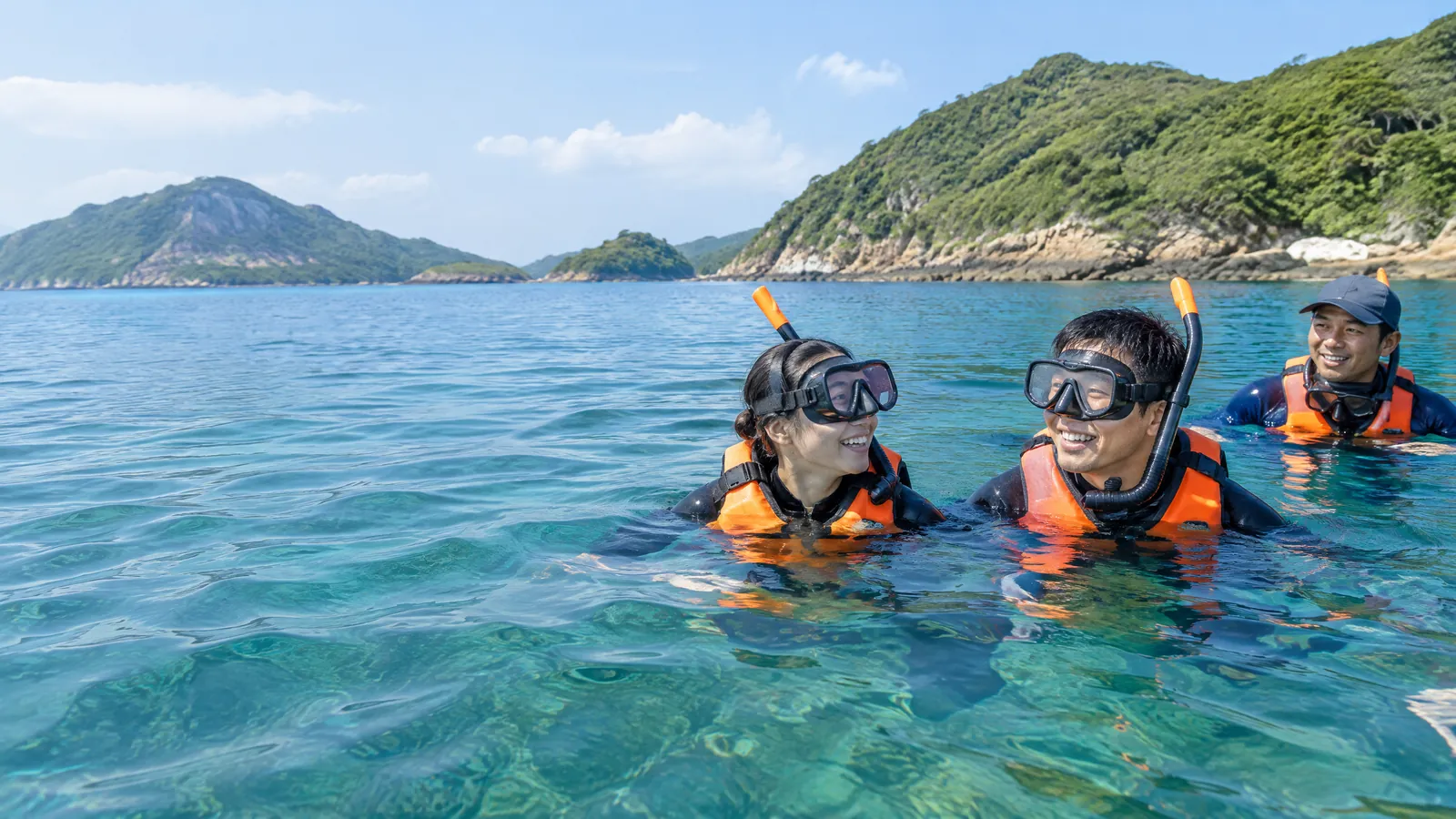
There is no single best first-water format. The right choice matches readiness and purpose. A pool-based junior programme may suit a child who enjoys repeated skill games, while a short try session may be better for a cautious beginner. Snorkelling can be a positive ocean introduction without asking the child to use scuba equipment. Use this comparison to frame a conversation with DiveHarbour, not to self-select from a course name.
Talk through what success means. For one family it may be the child calmly wearing a mask; for another it may be learning to float or observing a fish from the surface. A child can be interested in marine life without being ready for a regulator. Offer choices and listen to the answer. Pressure can turn an exciting family memory into an avoidable fear of water. A patient progression leaves room for curiosity to grow.
- Choose the least demanding format that still matches the child’s genuine interest.
- Keep a surface-based alternative ready so the family can enjoy the day whatever the child decides.

Safety, equipment and communication
What good preparation looks like
Children need equipment sized and adjusted for them, with an instructor explaining each item in age-appropriate language. Parents can ask how buoyancy is supported, how the child communicates and how the team keeps the group together. Do not coach a child to ignore ear pain, breathing discomfort or fear, and do not turn a photograph into a reason to remain underwater. The briefing and the operator’s written procedures should guide the session.
Hong Kong conditions vary, so ask whether the proposed activity remains in a controlled pool or moves outdoors, and what weather or water-quality decision would change the plan. Confirm meeting arrangements, supervision from arrival through departure, emergency contacts and who is responsible while changing or resting. A parent should disclose relevant medical history through the proper process, while a clinician handles fitness questions.
Preparation also includes time. A rushed child may look less ready than they really are. Build in an unhurried arrival, a toilet and hydration break, and a chance to handle equipment while still dry. Agree that the instructor can pause without needing to justify the decision to the family. Calm communication is a practical safety tool, not a sign that the activity is too serious for children.
- Check mask fit, warmth, rest breaks, communication and the route out of the water before starting.
- Never make a child hold their breath, descend or continue after signalling discomfort.
Booking conversation, pricing and family expectations
Confirm details before committing
Ask for an itemised explanation: instructor supervision, pool or venue, basic equipment, tanks if used, forms, session length and spectator arrangements. DiveHarbour can confirm the current price only after matching the child with an available programme; do not assume an adult try-dive price or junior certification price applies to Seal Team. If comparing a different family experience, the published listing for a family try activity is HK$970 per person, but that is not a quoted Seal Team price.
Before paying, read written booking and cancellation terms, including what happens when a child is unwell, the venue changes or an instructor decides the activity is unsuitable. Ask whether a partial session is charged as attended and whether a make-up is available under the stated terms. Keep expectations modest: the goal is a calm, supervised introduction and an informed next step, not a guaranteed certificate, depth or photograph.
Families should also ask what information is retained, who may collect the child at the end and whether photographs require separate consent. These questions are especially useful when several adults share responsibility. Write down the agreed meeting point, emergency contact and stop plan so nobody relies on a hurried conversation at the pool. A transparent booking process gives the child confidence before the first splash.
- Confirm exact programme, total fee, inclusions, payment timing, cancellation terms and parent-observer arrangements.
- Use the child’s response after the session to choose the next activity; do not pre-book a more advanced course automatically.

Compare three realistic first-water formats for a child
| Format | Best for | Check before booking |
|---|---|---|
| Seal Team-style pool programme | Water-comfortable child who enjoys repeated themed activities | Availability, age, direct supervision, session structure and equipment |
| Short introductory pool try | Cautious family wanting a small first step | Minimum age, stopping plan, shallow-water setting and inclusions |
| Snorkelling or family water activity | Child wanting ocean discovery without scuba equipment | Swimming comfort, flotation support, weather plan and adult supervision |
PADI Seal Team for Kids in Hong Kong — common questions
Is PADI Seal Team currently offered by DiveHarbour?Toggle answer
Please ask DiveHarbour to confirm current availability before making plans. The programme name alone does not mean every school offers it, and any arrangement should be discussed with the parent or guardian and matched to the child’s comfort and readiness.
What should parents ask before an 8-year-old tries scuba diving?Toggle answer
Ask about the exact programme, minimum age, supervision, confined-water setting, equipment, medical considerations and what happens if the child feels uncomfortable. An instructor can explain the activity, while a physician should handle individual medical clearance questions.
Does a child need previous scuba experience for Seal Team?Toggle answer
PADI’s official description says no prior scuba experience is necessary, while children should be comfortable in water and have parental approval. The operator still needs to assess the proposed session and explain its arrangements.
Can my child stop during the session?Toggle answer
Yes. Stopping or resting is a normal safety choice. Agree the signal in advance, tell the instructor about any concern immediately and ask how the session is handled if the child does not complete every activity.
Are fees refundable or can a missed session always be rescheduled?Toggle answer
Fees are non-refundable unless written booking terms say otherwise. Make-up sessions are available only where written terms permit them; a make-up or replacement date is not guaranteed. Read the terms before paying.
Take the question with you
The safest next step is a specific enquiry: tell DiveHarbour the child’s age, water comfort and what they hope to try, then ask whether a current, appropriately supervised junior pool programme is available. Let the instructor explain the setting and let parent and child decide without pressure. If Seal Team is not suitable today, another family water activity can still build confidence and curiosity.
Sources worth checking
- PADI Seal Team course: About the Course
PADI states that Seal Team is a pool-based AquaMission programme; a child must be 8 or older, needs no prior scuba experience, should be comfortable in water and requires parental approval.
- PADI Bubblemaker Program & Seal Team Course
PADI describes its introductory children’s scuba activity as taking place in shallow water for children aged 8 and older.
- Children and Diving
DAN discusses the importance of considering a child’s physical and emotional readiness and obtaining appropriate medical advice; this is general information, not individual medical clearance.
Useful next reads for your plan
If you are still comparing routes, these related pages give you practical questions to bring into your next conversation with an instructor.
Put your plan into practice
Useful planning guides
Junior scuba age decision guide for Hong Kong families
Use this junior scuba age decision guide worksheet to compare practical options, check key decision points, and confirm current details with DiveHarbour.
junior scuba age decision guide
