

A useful fact to keep in mind
There are 3 useful booking checks to complete: suitability and prerequisites, training scope and equipment, and weather, payment and make-up terms.
Night Diver specialty course Hong Kong
Build confidence after sunset
Night diving is not simply a daytime dive with a later start. Darkness changes how you read distance, find your buddy, manage a light and interpret the site. A well-planned Night Diver specialty course Hong Kong programme gives you a calm way to practise those decisions with qualified supervision, rather than asking you to improvise on a first solo night outing.
The attraction is real: familiar rocks can look completely different, small nocturnal creatures may become easier to notice, and a narrow beam encourages patient observation. The course should still be enjoyable without turning wildlife into a promise. Visibility, current, weather, boat logistics and the site's marine life vary, so the responsible goal is improved judgement and comfort, not a guaranteed encounter.
PADI describes its Night Diver Specialty as a way to experience a new underwater world under a dive light, while NAUI lists Night & Limited Visibility Diver among its specialty offerings. Those descriptions support the idea of a distinct specialty, but the exact certification pathway belongs to the agency and instructor delivering it.
- Bring your certification card or digital record, recent-dive information and any questions about health or confidence.
- Expect the instructor to adapt the plan when weather, visibility or your readiness makes a change sensible.
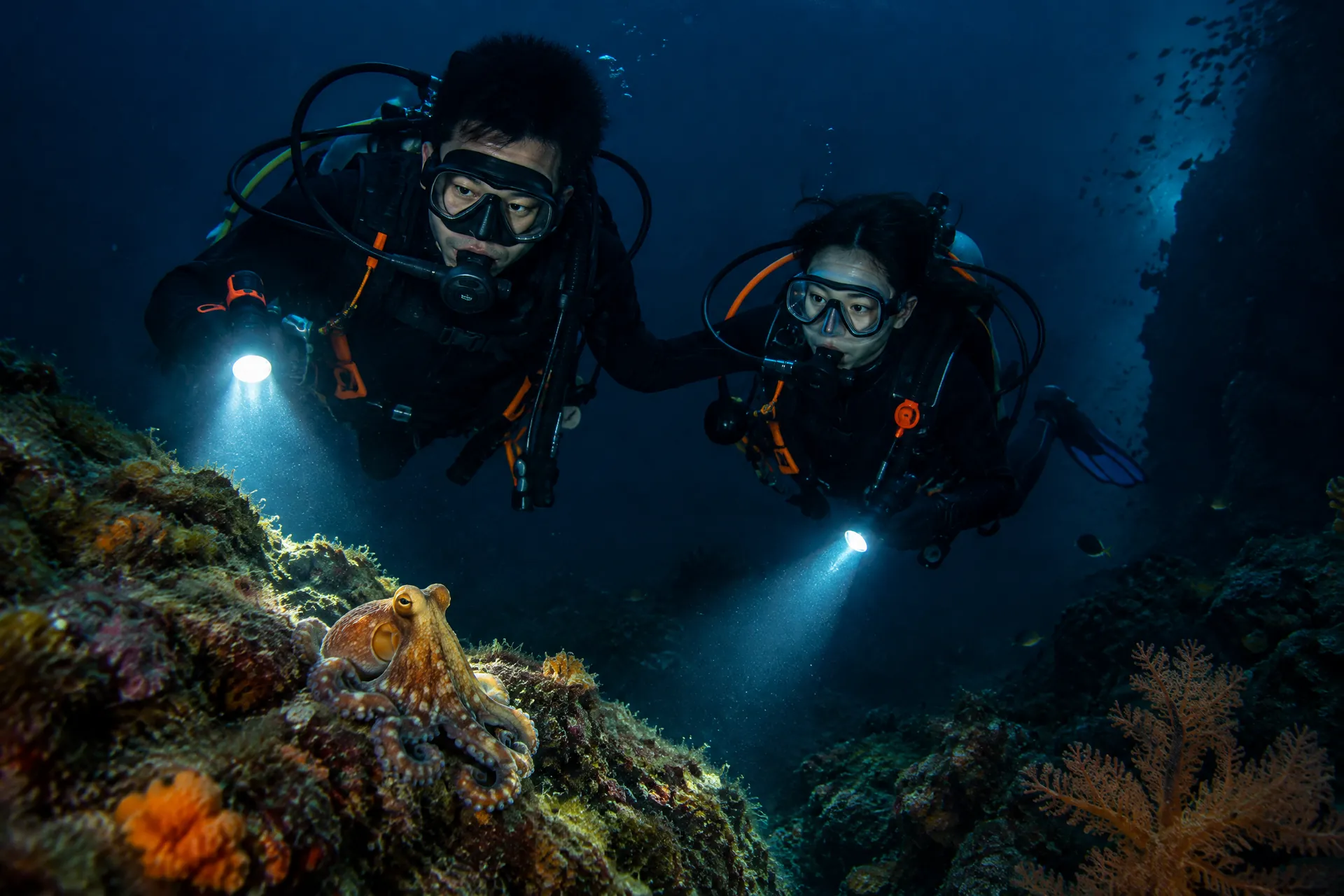
night diving course Hong Kong
Clarify the training pathway
A night diving course Hong Kong enquiry is easiest to assess when you share your current agency, certification level, approximate number of recent dives and whether you have previously dived from a boat. A specialty is generally for an already certified diver; it is not a shortcut around beginner training. Different agencies can set different age, certification, logged-experience or supervision requirements, and a local instructor may add sensible site-specific boundaries.
PADI's official course page presents night diving as a specialty for certified divers, but it does not make every agency's rule interchangeable. Ask which training standard applies, how many sessions are planned, whether theory is completed before the water work, and what counts as successful completion. If your certification is old or your last dive was a long time ago, a refresher or straightforward daytime dive may be a better first conversation than booking at once.
The current published reference price for the Night Diver specialty is HK$2,550 per person. Treat that as a planning figure only: the number of training dives, night light, cylinders, boat fee, equipment and certification arrangements should be confirmed before registration. Do not compare a headline figure with another operator's package until you know what is included.
- Ask for the agency, prerequisites, training outline, included equipment and any separate boat or certification charges in writing.
- Tell the instructor about seasickness, anxiety in low light, medication questions or a long gap since your last dive before choosing dates.

Choose a responsible night-dive plan
Discuss experience, conditions and support
Good planning starts on the surface. You should be briefed on the entry and exit, buddy arrangement, light signals, lost-buddy response, navigation references, expected depth and the plan if visibility or weather deteriorates. The group should know who leads, who follows and where to regroup. Night does not remove the need for conservative gas planning, buoyancy control, continuous buddy awareness and a clear turn or exit decision.
A dive light is useful, but it is not a licence to shine directly into another diver's eyes or chase animals. Ask how primary and backup lights are carried, how signals are made and how equipment is secured so that hands remain available. A small surface marker or other signalling equipment may be relevant to the local plan; the instructor should explain what is appropriate rather than expecting you to copy a generic kit list.
Hong Kong conditions can change with wind, rainfall, swell and site traffic. A date is therefore a proposed arrangement, not a guarantee that the original site or timing will be suitable. Confirm the weather contingency, meeting point and communication method. If the actual conditions do not support a controlled training dive, postponing or changing the plan is a safety decision, not a failure.

What you practise in low light
Turn new sensations into repeatable habits
Training should connect explanation with supervised practice. You may work on preparing and checking lights, entering with a calm pace, adjusting buoyancy without relying on a broad visual field, keeping a predictable position relative to your buddy and using agreed light or hand signals. You may also learn how to orient yourself with a limited set of references and how to pause when your workload rises. These are habits to rehearse, not stunts to perform for a certificate.
Surface preparation matters just as much. Check that batteries are charged, switches are protected from accidental activation, straps and clips are secure, and your exposure protection suits the water and duration. A buddy should know how to recognise a failing light or an anxious diver. Your instructor can explain the specific equipment configuration; avoid adding unfamiliar accessories immediately before a night session.
The most valuable outcome is a more honest self-assessment. Notice whether darkness changes your breathing, trim, navigation or ability to communicate. Tell the instructor early if you feel overloaded. A controlled ascent or exit, with the team following the agreed plan, is preferable to pushing through discomfort in order to appear confident.
- Practise signals and light etiquette on land before entering the water.
- Keep the plan simple enough that you can recall it when visibility and attention are limited.

Compare nearby specialty pathways
Choose training that matches your next goal
Night diving can sit within a wider development plan, but another specialty may better answer your immediate question. A diver who feels disoriented in daytime water may benefit from navigation work first; someone interested in depth should discuss the separate limits and risk controls of deep training. If wrecks are the attraction, ask whether the programme is non-penetration or includes a different, more demanding scope. The links below help you compare rather than assume that one course supplies every skill.
You can browse PADI specialty diving courses Hong Kong for the broader catalogue, then consider a deep diving course Hong Kong only if depth is genuinely your goal. Divers interested in structure and history can read about the Wreck Diver specialty course Hong Kong, remembering that wreck training and night training are not interchangeable.
For a longer-term progression conversation, NAUI Master Scuba Diver Hong Kong may be relevant, while an Advanced Open Water Diver course Hong Kong can be the more appropriate foundation if you have not yet built broad experience. Each page is a starting point for questions; confirm the current agency standard, instructor assessment and conditions before booking.

Prepare for a confident enquiry
Make the next decision practical
Before messaging DiveHarbour, write down your certification agency and level, approximate recent dives, last dive date, preferred language, equipment you already own and any concerns about night conditions. Say whether you want a certification pathway, guided experience or simply to understand the options. That context lets the team suggest a realistic conversation instead of sending a generic course description.
Use the briefing to check what happens before the first evening: reading or e-learning, knowledge review, equipment fitting, daytime orientation and emergency planning. Ask whether the course uses a shore entry or boat, how the group size is managed, and which parts depend on weather or site access. A clear answer should leave you knowing what to bring, what the instructor supplies and what remains subject to confirmation.
Fees are non-refundable unless the written booking terms say otherwise. Make-up sessions are available only where the written terms permit them; no reschedule date is guaranteed. Read those terms before paying, especially when a boat operator, weather contingency or certification body is involved. This keeps the financial decision as clear as the diving decision.
There are 3 useful booking checks to complete: suitability and prerequisites, training scope and equipment, and weather, payment and make-up terms. Completing these three checks before committing gives you a practical record of what has been agreed and what still needs confirmation.
- Send your questions in one message and ask for the current inclusions and written terms.
- Choose the plan you can approach with curiosity and margin, not pressure to complete a particular date.

Night Diver planning options to discuss
| Option | Best for | Check before booking |
|---|---|---|
| Specialty training | Certified divers who want structured after-dark skills | Agency prerequisites, sessions, instructor supervision and certification process |
| Daytime refresher first | Divers returning after a long break or feeling rusty | Recent-dive expectations, refresher scope and whether night training should follow |
| Guided night experience | Experienced divers seeking an organised outing rather than a specialty | Guide qualification, buddy plan, light requirements, conditions and what is not taught |
| Broader advanced pathway | Divers still choosing between navigation, depth, wreck or night skills | The exact outcome, limits, prerequisites and whether separate specialties are needed |
Night Diver training in Hong Kong — common questions
Who is a Night Diver course suitable for?Toggle answer
It is intended for divers whose existing certification and experience make an after-dark specialty appropriate. Suitability depends on your background, comfort, health and the planned training conditions, so discuss these details with a qualified instructor before arranging a course.
What should I confirm before choosing night diving in Hong Kong?Toggle answer
Ask about prerequisites, the training outline, equipment arrangements, location, weather contingencies and how communication and supervision are handled after sunset. DiveHarbour can clarify the current pathway and help match the enquiry to your experience and goals.
Do I need a particular certification or number of dives?Toggle answer
There is no single rule that applies to every agency or local provider. Share your current certification and recent experience; the instructor can confirm the applicable standard, any minimum age or prerequisite, and whether a refresher is sensible.
What if the weather changes after I book?Toggle answer
Night training depends on conditions and operational decisions. Ask about the written weather and cancellation terms before paying. Fees are non-refundable unless those written terms provide an exception, and make-up sessions are only available where the written terms permit them; a new date is not guaranteed.
Is the HK$2,550 price all-inclusive?Toggle answer
HK$2,550 per person is the published reference price for the Night Diver specialty. Confirm the current inclusions before registration, including training dives, light, cylinders, equipment, boat arrangements, materials and certification, because the final arrangement may depend on the agreed scope.
Take the question with you
Night diving is a rewarding next step when the plan matches your certification, recent experience and comfort rather than your calendar alone. Send DiveHarbour your background and goals, ask for the current agency requirements and written inclusions, and use the three booking checks above to decide whether Night Diver training—or a refresher or different specialty—fits you now.
Sources worth checking
- PADI: Scuba Diving at Night | PADI Night Diver Course
PADI describes the Night Diver Specialty as a course for experiencing the underwater environment after sunset under the glow of a dive light.
- NAUI Worldwide: Specialty courses
NAUI's official specialty-course directory includes Night & Limited Visibility Diver among its specialty offerings.
Useful next reads for your plan
If you are still comparing routes, these related pages give you practical questions to bring into your next conversation with an instructor.
Put your plan into practice
Useful planning guides
Advanced Dive Configuration Choices for Hong Kong
Plan your advanced dive configuration choices with a practical worksheet, clear decision points, and a direct check of current details with DiveHarbour.
advanced dive configuration choices
