

A useful fact to keep in mind
This is an editorial 5-part pre-entry check: attention, OK, problem, stop and low-air.
First scuba lesson buddy communication checklist
Agree signals, attention checks and stop meanings before entering the water
Your first lesson is not a test of how quickly you can make a hand sign. It is a chance to build a shared language with the person who will stay close to you. Before entering the pool, sit beside your buddy and instructor and agree how you will get attention, show OK, report a problem, ask to stop, indicate low air and point towards something. Different agencies, instructors and dive teams may teach small variations, so the briefing for that session always takes priority over a sign remembered from a video.
Begin with attention. A buddy who is looking at a mask strap or practising buoyancy may not see a small wave of the fingers. Decide whether you will gently tap a tank, sweep a hand through the buddy’s field of view or use another agreed audible cue. Never assume a loud bang or repeated noise is appropriate in every setting; ask the instructor how to attract attention without startling the group. Once your buddy looks at you, hold the signal clearly and wait for acknowledgement rather than turning away immediately.
Then check the meaning of the essential signals one by one. Make an OK sign, receive the same sign back and practise what you will do if the response is missing. Demonstrate a problem signal, point to the source if it is easy to identify, and agree that both divers will pause and communicate rather than push through discomfort. For stop or end-the-dive signals, confirm whether the next action is to stop an exercise, regroup with the instructor or begin the instructor-led exit sequence. The goal is shared meaning, not a memorised performance.
Write down or mentally rehearse the questions you want answered: How often will we check in? What should I do if I lose sight of you? Which direction should I point when I need help? What is the low-air signal used in this class? What signal means ‘I do not understand’? Asking these questions is good preparation, not an admission that you are unready. DAN’s official Alert Diver guidance recommends reviewing hand signals before a dive because it can increase group safety and reduce mental load, particularly when buddies are unfamiliar with each other.
- Look at your buddy before signalling; do not send important information into the water column and hope it is noticed.
- Use one clear signal at a time, then wait for acknowledgement or the instructor’s response.
- If a sign is unclear, pause and repeat the agreed clarification or stop signal instead of guessing.

Pool to open water first scuba lesson checklist
Carry the same communication habits from confined water into sea training
Pool sessions are useful because they let you practise communication while the environment is relatively controlled. Treat each exercise as a rehearsal for attention and teamwork, not as a promise that the sea will feel identical. Before progressing from the pool to open water, revisit the signals with the same buddy if possible, then listen again to the instructor’s site-specific briefing. Current, waves, boat noise, reduced visibility, a hood or thicker gloves can all change how easily a signal is seen or heard.
Your pool to open water first scuba lesson checklist should start at the surface. Confirm where you will wait, how you will stay with the group, what the entry and exit signals mean, and where the instructor expects you to position yourself. On a boat, also clarify how the team will indicate a change of plan before entry. Once below, make eye contact before a check-in, keep your signals within your buddy’s view and avoid swimming away while your buddy is still responding.
Practise communication around ordinary tasks. Ask your buddy to confirm that the mask, regulator and buoyancy equipment are comfortable using the signals your instructor has taught. Point to a direction and receive confirmation before moving. During a pause, show OK and wait for the reply. If you cannot see your buddy’s hands because of position or visibility, move into a safer, agreed position and regain attention; do not interpret silence as agreement. These small repetitions make it easier to notice a genuine problem later.
For Hong Kong learners, the most useful preparation is specific rather than dramatic: ask what the day’s water conditions may change, what equipment you will use and which signals your instructor wants you to use. If you are comparing a pool and open-water scuba course Hong Kong, check how the programme introduces skills and communication across settings. If theory is completed separately through PADI eLearning Open Water Hong Kong, bring any uncertainty to the practical briefing rather than assuming online wording replaces the instructor’s plan.
- Repeat signals after adding gloves, a hood, a mask or other equipment that may affect visibility and dexterity.
- Confirm the lost-attention and regroup process at the surface before entering open water.
- Tell the instructor promptly if nerves, cold, seasickness, fit or visibility makes communication difficult.

Make buddy communication calm and unambiguous
What to confirm with your instructor when a signal is unclear
Unclear communication is a reason to slow down, not a reason to improvise. First establish attention, then use the course’s agreed clarification or stop signal. Keep your body position stable and let your buddy or instructor explain the next step. If you are receiving a signal that you do not understand, point to yourself and indicate that you need clarification; do not nod automatically. A clear ‘not sure’ is more useful than a confident-looking mistake.
This is an editorial 5-part pre-entry check: attention, OK, problem, stop and low-air. It is not a universal agency standard; your instructor may add signals for direction, ascent, descent, ear discomfort, an out-of-air emergency or a lost buddy. Do not practise emergency responses independently from the taught procedure. Ask the instructor to demonstrate and supervise any skill that involves equipment, ascent or ending the dive.
Use the same calm tone above water. Agree that either buddy may call a pause without embarrassment, and that stopping an exercise is a normal part of learning. If one diver is anxious, the other should face them, give time to respond and bring the instructor into the conversation. Buddy communication is mutual care: you are not responsible for diagnosing a medical problem, forcing equal pace or persuading someone to continue. Report pain, breathing difficulty, panic or unusual symptoms to the instructor and seek appropriate medical advice when needed.
Before booking, you can read the published PADI Open Water course requirements Hong Kong and use it to prepare questions, while remembering that agency requirements and the instructor’s assessment govern the actual class. If you are simply exploring scuba diving course Hong Kong, tell the team that you want communication practice included in the first-lesson explanation.
- Pause, face your buddy and clarify; never continue an exercise just to avoid looking inexperienced.
- If conditions or feelings change, use the stop meaning agreed in the briefing and notify the instructor.
- Treat the instructor’s demonstrated procedure as the reference for that lesson.

A practical signal rehearsal for new buddies
Turn the checklist into a short, observable practice
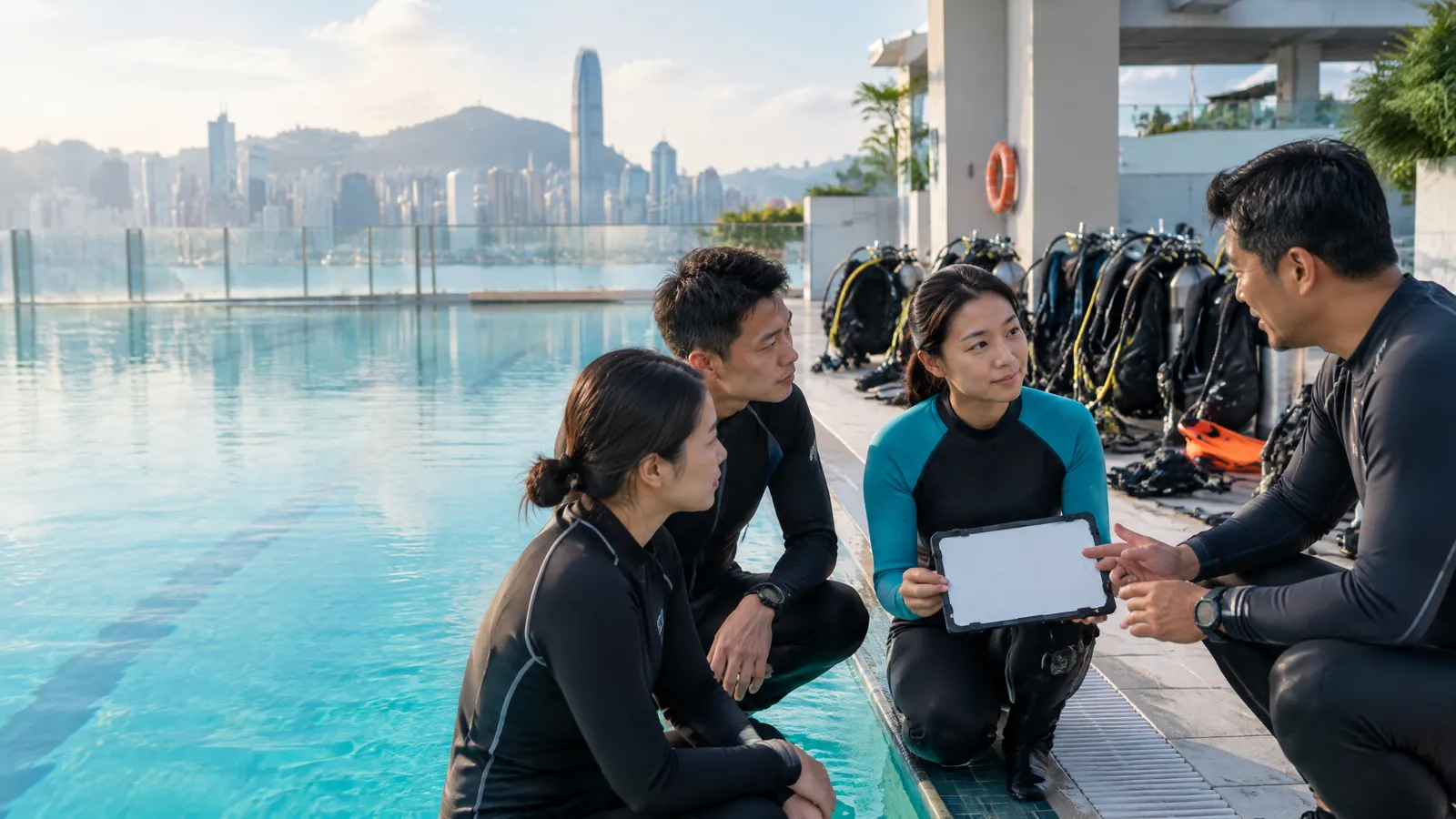
A good rehearsal is short enough to repeat and specific enough to reveal confusion. One buddy can act as the signal sender while the other deliberately looks away, then the sender uses the agreed attention cue. Swap roles, make eye contact and test OK, problem and stop. Next, ask each person to demonstrate low air and a request for help. The instructor can correct hand shape, timing or the action that follows. Keep the exercise at the level taught in class; it is not a licence to invent a new emergency drill.
After each signal, add a response. For OK, reply OK and continue only when the instructor says so. For a problem, acknowledge, stay together and identify whether the instructor should be involved. For stop, stop the exercise and wait for direction. For low air, show the taught signal and let the instructor lead the appropriate review. This sender-and-response pattern matters because seeing a sign is not the same as confirming that its meaning was understood.
If English is not your buddy’s strongest language, keep spoken explanations simple, use demonstrations and ask the instructor to confirm shared meaning. A slate, writing card or surface conversation may help with planning, but it should supplement—not replace—the taught visual and audible signals. Agree on one language for the briefing and take extra time with terms such as ‘stop’, ‘problem’, ‘stay’, ‘up’ and ‘look at me’.

Choose the right preparation for your first lesson
Compare a self-check, guided pool practice and course briefing
Different learners need different preparation. Someone who has never worn scuba equipment may benefit from a guided explanation and a slow pool rehearsal. Someone returning after a long break may need to say what feels unfamiliar rather than relying on memory. A course briefing remains essential in every case. Use the options below to decide what to ask for, not to self-qualify or bypass an instructor’s judgement.
If you want a broader route to learn to scuba dive in Hong Kong, ask how buddy communication is introduced before the first open-water session, whether the same signals are revisited after equipment changes and how you can raise a concern privately. A thoughtful provider should be able to explain the learning sequence without promising that one checklist guarantees a comfortable dive.

Questions to ask before and after the session
Use a debrief to make the next buddy conversation easier
Before the lesson, ask who will brief the signals, how buddy pairs are assigned and what happens if you need a pause. Ask whether pool and open-water sessions use the same communication conventions, and what equipment you should bring or expect. After the session, discuss one signal that felt natural and one that needed more time. Tell the instructor if the noise, visibility, gloves or pace made it hard to communicate. This feedback helps shape a realistic next step, whether that is another supervised practice or moving forward with the planned course.
Keep the checklist as a conversation starter rather than a certificate of readiness. Clear signals support teamwork, but they work alongside equipment checks, site briefings, appropriate training and honest self-assessment. If you are unsure, message DiveHarbour with your experience level and questions about first-lesson preparation so the team can explain the relevant course pathway.
Three useful ways to prepare buddy communication
| Preparation option | Best for | What to check |
|---|---|---|
| Self-check before arrival | Learners who want to organise questions | Write down attention, OK, problem, stop and low-air meanings to confirm with the instructor. |
| Guided pool rehearsal | First-time divers or anyone feeling nervous | Practise sender-and-response signals with equipment on, under supervision. |
| Open-water briefing and debrief | Learners moving from pool skills to sea conditions | Review visibility, noise, entry, regrouping and the site-specific stop process. |
| Extra clarification with the instructor | Buddies with language, equipment or confidence concerns | Agree how to pause, regain attention and ask for help without guessing. |
First Scuba Lesson Buddy Communication Checklist — common questions
Why practise buddy signals in the pool before open water?Toggle answer
Pool practice provides a controlled setting to learn attention, OK, problem and stop signals while focusing on your buddy. Repeating them before sea training helps make communication more familiar, although the instructor’s briefing remains the reference for each session.
What should buddies do when a signal is unclear?Toggle answer
Pause, establish attention and use the agreed clarification or stop signal rather than guessing. Keep the situation calm, stay with your buddy and tell the instructor what was unclear so the signal or procedure can be reviewed before continuing.
Should I use hand signals I learned from another agency or video?Toggle answer
Mention what you remember, but follow the signals and procedures taught for the current session. Agencies and instructors may use variations, and the important point is that both buddies and the instructor share the same meaning before entering the water.
Can I ask to stop a first scuba lesson?Toggle answer
Yes. Tell your buddy and instructor clearly if you feel uncomfortable, confused, unwell or unable to communicate. A pause or ending the session should be handled according to the briefing and does not require you to prove anything. Fees are non-refundable unless the written booking terms say otherwise; make-up sessions or a new date are available only where those written terms permit them, and no reschedule date is guaranteed.
What should I confirm about fees or a make-up session?Toggle answer
Ask for the written booking, cancellation and make-up terms before payment. Fees are non-refundable unless the applicable written terms provide an exception. A make-up session is offered only where those terms permit it, subject to availability, so neither a make-up nor a particular replacement date should be assumed.
Take the question with you
Before your first lesson, practise looking, signalling, receiving acknowledgement and pausing when meaning is uncertain. Bring your five-part checklist to the briefing, then let the instructor adapt it to the equipment, buddy pairing and water conditions on the day. If you can communicate one concern clearly and give your buddy time to respond, you are already building the calm teamwork that makes pool-to-open-water learning more useful. Contact DiveHarbour with your questions and use the instructor’s briefing as the final reference.
Sources worth checking
- DAN Alert Diver: Clarify Hand Signals Before Diving
DAN states that reviewing hand signals before a dive can increase group safety and decrease mental loading, especially when divers are unfamiliar with one another.
- Hong Kong Government: Diving
The Hong Kong Government provides public diving and water-recreation information for residents; learners should still follow the current instructor and site briefing for training decisions.
Useful next reads for your plan
If you are still comparing routes, these related pages give you practical questions to bring into your next conversation with an instructor.
Put your plan into practice
Useful planning guides
Scuba readiness check Hong Kong: a calm preparation guide
Use this scuba readiness check Hong Kong worksheet to compare practical options, check key decision points, and confirm current details with DiveHarbour.
scuba readiness check Hong Kong
