SAFE LEARNING · HAPPY EXPLORING
DiveHarbour

DiveHarbour · Practical guide

Private Hairpiece Try-On: A Discreet Shore-Event Plan

A private hairpiece try-on is best treated as a confidential consultation, not a required step for a shore activity or a guarantee of fit. Before booking, state the thinning area, privacy needs, event setting, measuring questions, and acceptable alternatives. Then confirm the exact piece’s base, coverage, fibre, attachment and care instructions.

By DiveHarbour10 min read
Ask about diving courses or coastal trip planning Read the guide
Private hairpiece try-on consultation discussion concept illustration
Illustration · Concept illustration: a private consultation conversation, not a real customer or fitting result.

Instructor qualifications

One clear teaching conversation from first breath to next step

DiveHarbour brings together scuba teaching, swimming, lifesaving and water-rescue experience so you can ask practical questions before choosing a course.

  • PADI teaching backgroundTeaching experience across recognised scuba learning pathways.
  • SSI teaching backgroundClear explanations when you are comparing agency routes.
  • NAUI teaching backgroundA practical, standards-aware approach to learning and progression.
  • Swimming foundationWater confidence and calm, step-by-step practice matter.
  • Lifesaving experienceSurface awareness and prevention stay part of the conversation.
  • Pool rescue experienceControlled practice can build confidence before open water.
  • Beach rescue experienceLocal water context informs sensible preparation.
  • Kayak rescue experienceA wider water-safety perspective supports good judgement.
  • PWC rescue experienceAsk about the right learning route for your experience and goals.

Brand relationship: DiveHarbour and OWNSTRAND share the same owner.

DiveHarbour and OWNSTRAND are operated by the same owner. OWNSTRAND links in this article are external product and selection references, not independent third-party recommendations, medical advice, product-effect claims, or DiveHarbour activity-safety endorsements. DiveHarbour handles shore and diving activity enquiries; OWNSTRAND handles product enquiries.

A useful fact to keep in mind

NAAF distinguishes partial toppers from full wigs and lists circumference, front-to-nape, ear-to-ear and temple-to-temple measurements as key wig-sizing measurements; a partial-piece consultation should confirm which measurements apply to the exact model.

Check the source
Key takeaways

Four points to carry forward

  • State your privacy needs before discussing styles or measurements.
  • Compare the exact coverage footprint with the thinning area.
  • Keep toppers, full wigs and men's hair systems as separate categories.
  • Plan a shore-based alternative without treating a try-on as an activity condition.
Start here

Private hairpiece try-on: start with the real decision

A private hairpiece try-on is a conversation, not a promised result

If localised thinning is affecting your confidence before a shore portrait, dinner, or coastal gathering, a discreet consultation can make the decision less rushed. The useful goal is not to leave with a particular piece. For a partial-coverage starting point, review hair toppers and then ask about the exact model. It is to learn whether the proposed coverage, base and wearing arrangement match the area you want to address.

Begin by describing the event in practical terms. Mention whether you expect photographs, wind, a hat, a change of clothes, or time in a private changing space. Keep the description shore-based. A try-on does not determine whether you may swim, dive, or use safety equipment, and it is never a substitute for the activity operator’s instructions.

Ask what privacy arrangements can be discussed before you travel. Useful questions include whether the consultation is one-to-one, how measurements are handled, whether a support person may attend, and how photographs or personal details are treated. These are requests to clarify, not promises that a particular room, staff member, or process is available.

You can also decide in advance what would make you pause. For example, you might want to leave without purchasing, compare a partial piece with a broader option, or return to the question after a medical review. A good appointment leaves room for those choices instead of turning a try-on into a commitment. You can also use the shore-event styling brief to organise the visible event details.

  • Name the event, setting, date pressure and privacy preference.
  • Ask which parts of the consultation can happen before an in-person visit.
  • Separate appearance decisions from activity eligibility and safety decisions.
  • Agree with yourself that leaving undecided is an acceptable outcome.
A try-on may inform your choice, but it is not a prerequisite for joining a DiveHarbour activity and does not guarantee a particular appearance or fit.
Guide · 02

Prepare a privacy-first consultation brief

Bring only the information needed to discuss coverage and comfort

A short written brief helps you stay in control when the topic feels personal. Record the area you notice, such as the crown, parting, temples, or a small front section. Add the direction of your existing hair, the look you usually wear, and whether you prefer a removable or more tailored discussion.

Bring a few neutral references rather than a large gallery of idealised images. A recent photograph in ordinary indoor light can show the current parting. An event photograph can show the neckline, collar, hat, or styling direction. Treat these as discussion aids, not evidence that an identical result can be produced.

Write down the questions you do not want to forget. Ask what information is needed for a private appointment, what will be measured, whether the base dimensions refer to the piece or finished hair, and which details can be checked before any decision. Ask how a viewing differs from a fitting, since those terms may describe different steps.

If you are arranging a coastal event, set a decision deadline that leaves time for a separate shore-day plan. Do not assume a catalogue page means a model is in stock, or that a style shown online can be viewed in person. Ask about the exact model and keep unconfirmed details marked as questions.

  • A simple description of the thinning area and desired coverage.
  • One or two current photographs taken in ordinary lighting.
  • The event setting, clothing neckline, headwear and photography needs.
  • A written list of privacy, measurement, care and alternative questions.

Swipe the table to compare all columns.

Consultation brief: what to state and what to ask
TopicState before the appointmentAsk for confirmation
PrivacyWho you want present and what feels discreetHow viewing, measuring and personal details are handled
CoverageCrown, parting, temple or front area you want to discussWhether the exact base reaches that area
EventShore setting, photographs, hat and clothing necklineWhich appearance questions can be answered before the event
DecisionWhether you are comparing or simply gathering informationWhat remains optional and what is not confirmed
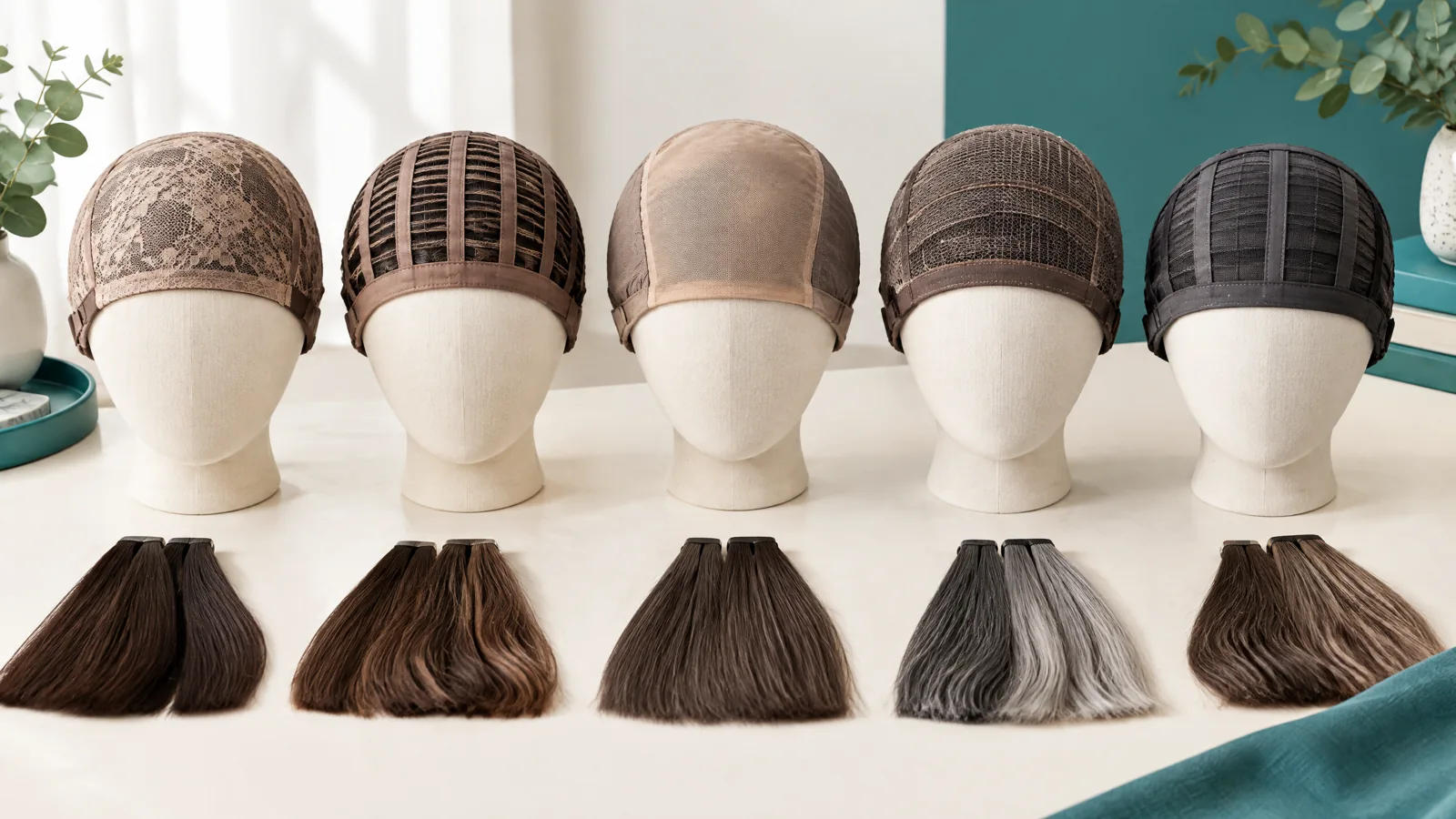
Hairpiece base and coverage comparison concept illustration
Illustration · Concept illustration: comparing base coverage and construction, not a specific product demonstration.
Guide · 03

Measure the area and inspect the base

Use the exact footprint, not a category name, to discuss coverage

A topper is intended for partial coverage, so the important first comparison is the area you want covered against the piece’s stated base footprint. Ask for the base length and width, what those measurements refer to, and where the attachment points sit. A hairstyle photograph cannot answer those questions by itself.

NAAF explains that a professional can measure a person for wig sizing and lists circumference, front to nape, ear to ear over the top, and temple to temple around the back as key full-wig measurements [1]. For a partial piece, ask which measurements apply to the exact model rather than treating that list as a universal topper formula.

Discuss the edge transition as carefully as the centre coverage. Ask how much of your existing hair needs to remain available for blending, whether the parting direction matters, and whether the base can sit over the area without extending into a place you do not want covered. Do not infer fit from another model with a similar name.

Attachment is a separate question from base construction. Ask whether the exact item is described as removable, what the maker’s instructions say, and whether any fitting or adjustment is actually included. For a separate men's category, the custom men's hair system page is a reference for questions, not proof that every design can be customised. Do not add adhesive, clips, ties, or other changes yourself, especially when the event involves equipment or movement.

  • Mark the visible area you want to discuss, without diagnosing its cause.
  • Ask for the exact base dimensions and attachment description.
  • Check how your existing hair will meet the perimeter.
  • Treat missing specifications as questions, not as evidence of a match.
Guide · 04

Compare a topper with other partial-piece choices

Keep coverage, fibre, base and wearing instructions distinct

A hair topper is not simply a smaller version of every wig. NAAF describes toppers as partial hairpieces that can blend with existing hair, while full wigs provide total scalp coverage [1]. That distinction is useful for a localised area, but it does not decide what will suit you. Your coverage goal, remaining hair, comfort preference and care routine still matter.

For fibre, ask whether the exact model is synthetic or human hair, and what care and heat instructions apply. If human hair is part of your comparison, use human hair topper as a category reference, not a fit promise. A human hair label does not automatically establish Remy status, colour permission, or heat permission. A synthetic label does not make every item identical. Use the maker’s instructions for the named piece, not a general rule borrowed from another product.

For a male reader with a defined thinning area, a men's hair system may be a separate category to discuss. It should not be treated as interchangeable with a topper, toupee, or full wig. Clarify the intended coverage, base, material, attachment and care for the exact option. The word custom also needs explanation: ask what can actually be customised.

If one partial option does not cover the area or does not fit your comfort priorities, ask about alternatives without framing them as failures. A broader wig, a different base, a simpler shore hairstyle, or postponing the decision may all be reasonable discussion outcomes. No category name can guarantee a natural-looking result for every wearer.

  • Partial coverage and whole-head coverage are different decisions.
  • Fibre labels do not settle care, heat, colour or maintenance questions.
  • Base construction and attachment should be checked separately.
  • A men's hair system is a distinct category, not a synonym for a topper.
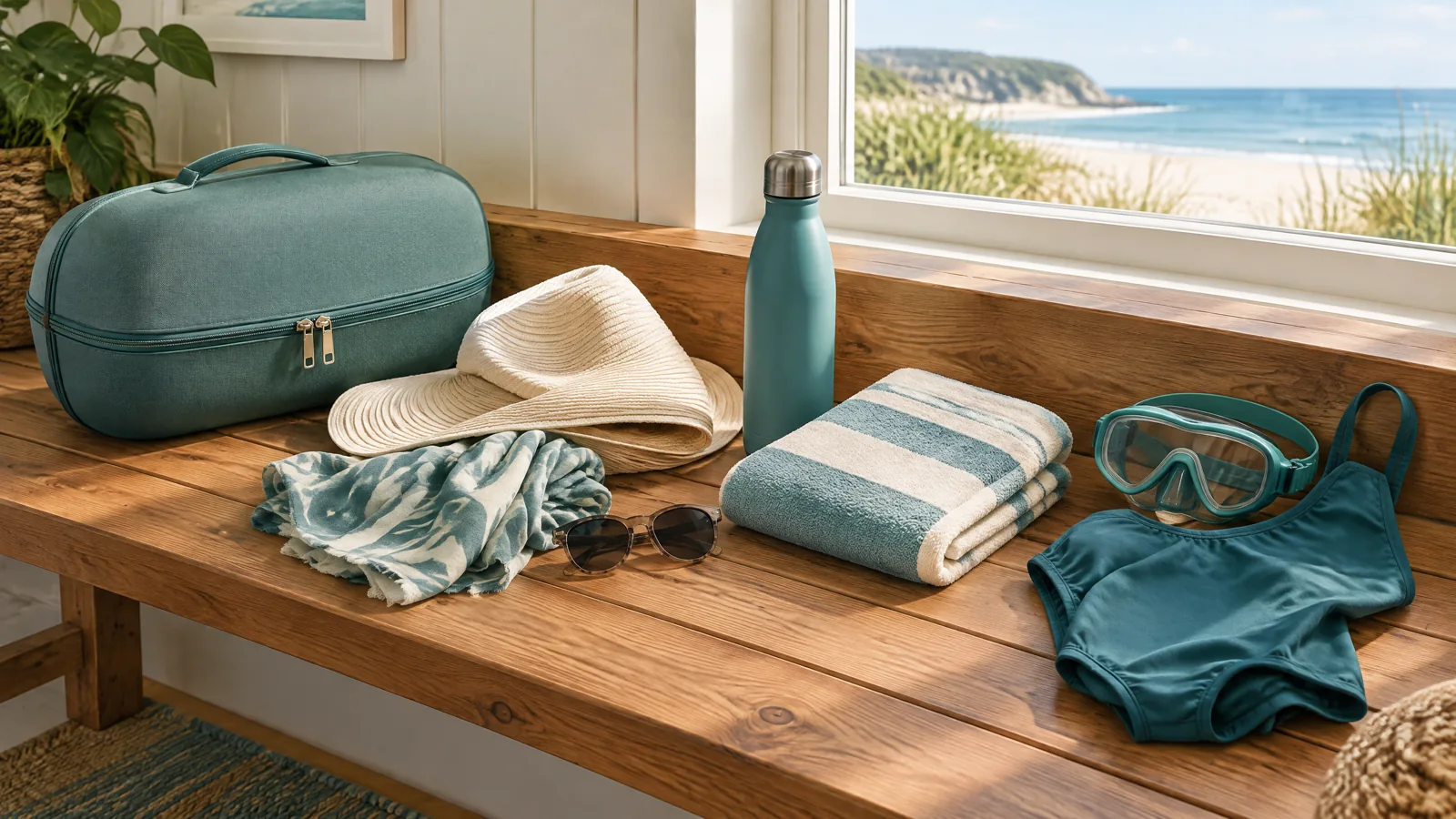
Shore-day hairpiece transition and storage concept illustration
Illustration · Concept illustration: a shore-based transition plan, not evidence of water use or customer experience.
Guide · 05

Plan the shore event around the consultation

Make the event brief specific without making the try-on a condition

Once you know what you want to ask, prepare a shore-event styling brief that covers the visible setting rather than promising a result. For appointment logistics, keep a separate list of shore salon appointment questions. Note the likely wind, sun, camera distance, neckline, hat, and time between arrival and photographs. Also note where you could pause, change, or return the piece to its case if the plan feels uncomfortable.

A consultation can inform an appearance choice, but it cannot approve swimming, diving, or any other water activity. Follow the exact product instructions and the activity operator’s requirements. If those instructions do not clearly address your situation, choose a shore alternative and keep safety equipment unchanged.

For a local enquiry, the only confirmed OWNSTRAND shop unit is Unit 2103, 50 Hoi Yuen Road, Kwun Tong, Hong Kong; area-search terms are not separate branches. Ask OWNSTRAND directly about the exact consultation or product details you need. Do not assume opening hours, stock, timing, phone support, or a fitting service from a directory phrase.

Keep transport and privacy practical. If you are travelling with a friend, decide whether they should join the consultation or wait nearby. If the event is soon, ask what can be reviewed before committing to travel. The point is to reduce surprises, not to create pressure to complete a try-on before the activity.

  • Describe the shore setting, not an imagined underwater use case.
  • Leave time for a change of plan, rest, or a simple uncovered style.
  • Keep any diving or swimming enquiry with the activity operator.
  • Ask the product provider for exact instructions and unconfirmed details.

Swipe the table to compare all columns.

Exact-piece comparison before you decide
DetailWhy it mattersQuestion to record
Coverage footprintA partial piece must relate to the area you want coveredWhat are the stated base length and width?
FibreHuman hair and synthetic fibre have different care questionsWhich fibre is confirmed for this model?
Base and attachmentConstruction does not automatically describe fasteningWhat base and wearing method apply to this item?
CareHeat, washing and styling permissions can be product-specificWhich instructions should I follow exactly?
AlternativeAnother category may better match broader coverage or comfort needsWhat other option should I compare, and why?
Guide · 06

Turn the appointment into a clear next step

A private hairpiece try-on should end with questions answered

At the end of the conversation, repeat the facts you believe are confirmed. Name the proposed coverage area, base description, fibre, attachment, care instructions, and any measurement still outstanding. Then separate those facts from preferences, such as wanting a softer outline or a less noticeable transition in photographs.

If the thinning is new, rapidly changing, painful, inflamed, or worrying for another reason, pause the cosmetic decision and seek appropriate medical advice. The American Academy of Dermatology says hair-loss assessment begins with finding the cause, and notes that wigs and concealers do not slow hair loss or regrow hair [2]. This article cannot diagnose the cause.

If chemotherapy, postpartum shedding, or another health context is part of your appearance question, keep the discussion cosmetic and private. Ask your healthcare team about medical matters and whether a planned activity is appropriate. A hairpiece consultation cannot provide treatment advice, activity clearance, or a substitute for clinical care.

Before leaving, decide whether you need a written specification, another viewing, a different coverage category, or no purchase at all. For later questions, use the exact model name or reference. That habit prevents an answer about one piece from being mistaken for a promise about every topper or hair system.

  • Restate confirmed specifications and list unknowns separately.
  • Keep medical questions with a qualified healthcare professional.
  • Choose a second discussion, an alternative, or no purchase without pressure.
  • Save the exact model reference for any later product enquiry.
Coastal portrait styling discussion concept illustration
Illustration · Concept illustration: planning a coastal portrait, not a real OWNSTRAND product, shop or result.
A sensible next step

Take the question with you

Prepare a short privacy brief, describe the area you want covered, and ask for the exact base, fibre, attachment and care details. Treat the private hairpiece try-on as one optional step in an appearance decision. Keep your shore-day backup separate, and leave medical questions with your healthcare team.

For diving or shore-activity questions, contact DiveHarbour and describe the activity, equipment and event plan. For product, measurement, privacy or availability questions, contact OWNSTRAND through the relevant product enquiry route. The two enquiries have different responsibilities.

Questions to ask

Common questions

Do I need a private hairpiece try-on before a shore activity?

No. A try-on is an optional appearance consultation. It is not a prerequisite for a DiveHarbour activity, and it does not decide whether an activity is suitable.

What should I ask about a topper for localised thinning?

Ask about the exact coverage footprint, base dimensions, fibre, base construction, attachment, care instructions and how your existing hair would blend at the edges.

Is a human hair topper automatically the right alternative?

No. Human hair is a fibre description, not a guarantee of fit, Remy status, heat permission, colour suitability or availability. Compare the exact model with other options.

Can a consultation confirm that I can swim or dive with a hairpiece?

No. Follow the exact product instructions and ask the activity operator about the activity. If the situation is unclear, choose a shore alternative and do not modify safety equipment.

Further reading

Official sources worth checking

  • [1] Wigs and Toppers: Understanding the Basics

    NAAF states that toppers or partial hairpieces are for partial hair loss and blend with existing hair, while full wigs offer total scalp coverage; it lists four key wig measurements.

  • [2] Hair loss: Diagnosis and treatment

    The American Academy of Dermatology says effective hair-loss treatment begins with finding the cause and that wigs and concealers do not slow hair loss or regrow hair.

Continue exploring

Keep comparing practical questions before you choose a course, activity or preparation step.

Coastal life and hairpieces · Updated 2026-11-06

Private Wig Fitting Chat: Plan a Quiet Shore Event

Plan a private wig fitting chat for a beach portrait or shore event. Prepare measurements, privacy questions, and a clear next step before choosing.

private wig fitting chat

Coastal life and hairpieces · Updated 2026-11-06

Topper or full wig shore: a practical coastal day guide

Topper or full wig shore planning for portraits and dinners: compare coverage, outfit changes, privacy, care, and questions to ask before your coastal day.

topper or full wig shore

Coastal life and hairpieces · Updated 2026-11-06

Online Wig Measuring List for a Remote Hairpiece Enquiry

Use this online wig measuring list to record measurements, colour references, dates, and questions before a remote hairpiece enquiry. Check each detail.

online wig measuring list
Your next step

Ask about diving courses or coastal trip planning

Message DiveHarbour on WhatsApp to discuss diving courses or coastal trip planning, along with your experience and preferred dates.

Ask about diving courses or coastal trip planning
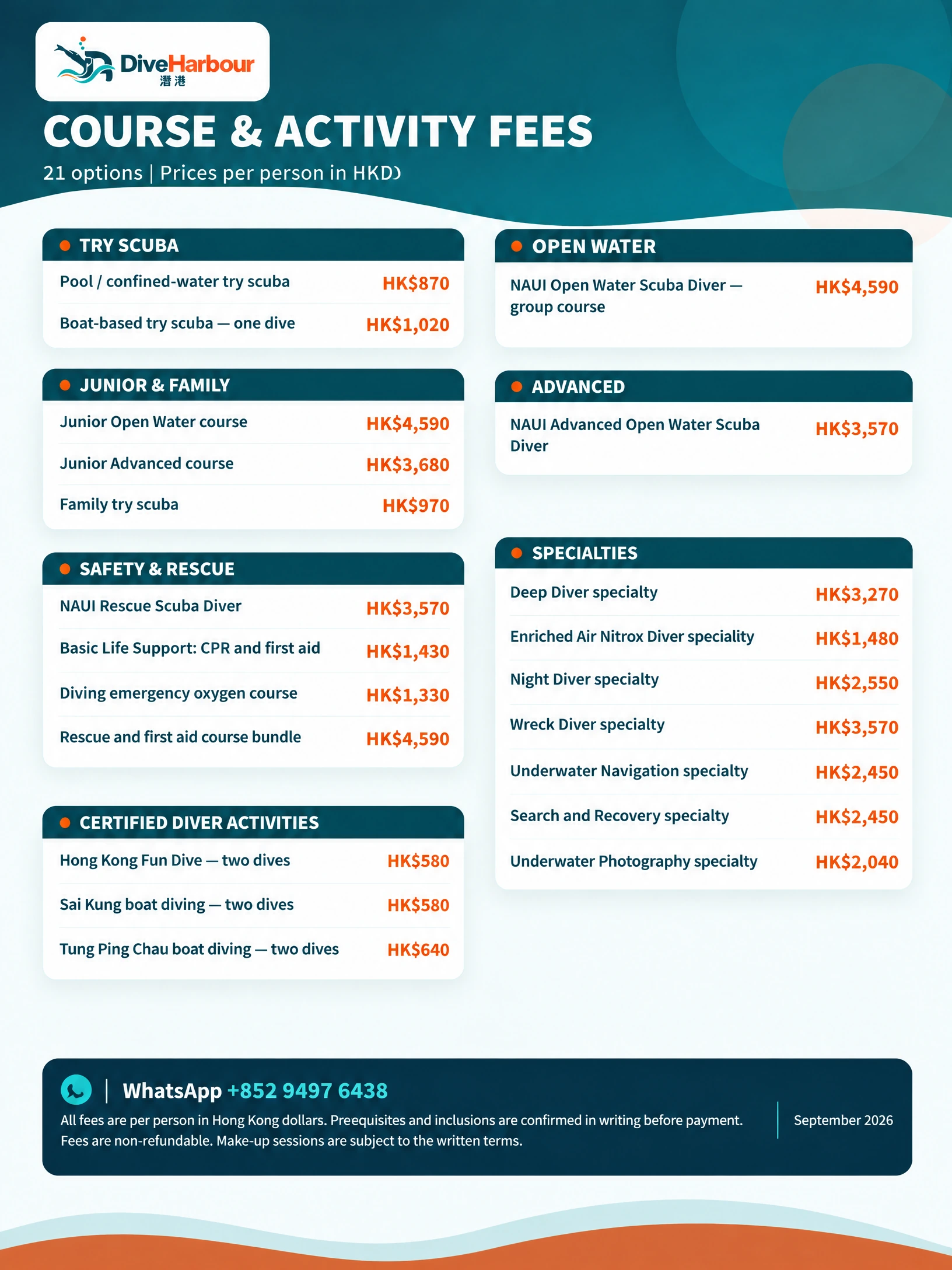
English price list for 21 DiveHarbour courses and activities, with fees per person in Hong Kong dollars
Tap the price list to view it at full size.

Plan your next dive

Course fees, clearly set out

Compare our published course and activity fees before choosing your next step. All prices are per person in Hong Kong dollars.

Before you book, we confirm prerequisites, materials, certification, equipment, venue and boat arrangements in writing. Ask us about fees for courses not listed here.

All fees are non-refundable. Make-up sessions are subject to the written terms.

Read all course fees
DiveHarbour course and activity fees per person in Hong Kong dollars
Course / activityPer person
Pool / confined-water try scubaHK$870
Boat-based try scuba — one diveHK$1,020
NAUI Open Water Scuba Diver — group courseHK$4,590
Junior Open Water courseHK$4,590
Junior Advanced courseHK$3,680
Family try scubaHK$970
NAUI Advanced Open Water Scuba DiverHK$3,570
NAUI Rescue Scuba DiverHK$3,570
Basic Life Support: CPR and first aidHK$1,430
Diving emergency oxygen courseHK$1,330
Rescue and first aid course bundleHK$4,590
Deep Diver specialtyHK$3,270
Enriched Air Nitrox Diver specialtyHK$1,480
Night Diver specialtyHK$2,550
Wreck Diver specialtyHK$3,570
Underwater Navigation specialtyHK$2,450
Search and Recovery specialtyHK$2,450
Underwater Photography specialtyHK$2,040
Hong Kong Fun Dive — two divesHK$580
Sai Kung boat diving — two divesHK$580
Tung Ping Chau boat diving — two divesHK$640