A Low-Maintenance Colour Plan for Hong Kong Shore Days
A low-maintenance colour plan is not a permanent-colour promise. It is a written choice about how often you visit the shore, how much fade you can accept, which parts of your appearance matter on camera, and when you can realistically revisit a provider. Track those limits first, then ask focused questions about colour, timing, upkeep, and any separate water-activity decision.
Illustration · Concept illustration: planning colour upkeep around a coastal schedule, not a guaranteed result.
Instructor qualifications
One clear teaching conversation from first breath to next step
DiveHarbour brings together scuba teaching, swimming, lifesaving and water-rescue experience so you can ask practical questions before choosing a course.
PADI teaching backgroundTeaching experience across recognised scuba learning pathways.
SSI teaching backgroundClear explanations when you are comparing agency routes.
NAUI teaching backgroundA practical, standards-aware approach to learning and progression.
Swimming foundationWater confidence and calm, step-by-step practice matter.
Lifesaving experienceSurface awareness and prevention stay part of the conversation.
Pool rescue experienceControlled practice can build confidence before open water.
Beach rescue experienceLocal water context informs sensible preparation.
Kayak rescue experienceA wider water-safety perspective supports good judgement.
PWC rescue experienceAsk about the right learning route for your experience and goals.
Brand relationship: DiveHarbour and DT HUB share the same owner.
DiveHarbour and DT HUB are operated by the same owner. DT HUB links in this article are references to external service and product information, not independent recommendations, medical-effect claims, or water-activity safety endorsements. DiveHarbour handles diving and shore activities; DT HUB salon, hairpiece, academy, and hair-growth services require separate enquiries.
A useful fact to keep in mind
The American Academy of Dermatology says sun can make dyed, bleached, or permed hair dry, rough, faded, and brittle, so a colour plan should include realistic sun exposure and upkeep questions rather than a permanence promise.
Count shore days before choosing a colour direction, rather than treating low maintenance as a universal result.
Write your acceptable fade in observable terms, such as a softer contrast or a visible root line.
Keep colour timing, product handling, and personal water-activity suitability as three separate conversations.
Use a provider brief with current-hair history, reference light, revisit limits, and a simple shore-day fallback.
Start here
Low-maintenance colour plan: define the job before the shade
A low-maintenance colour plan starts with limits, not a promise
Start by describing the job your colour needs to do. A frequent shore-goer may want a look that still feels intentional between visits, but that goal can mean several different things: less obvious contrast at the roots, a softer change as tone shifts, or simply fewer appointments in a busy season. Write the priority in plain language before discussing a specific shade. ‘I can revisit every few months’ is more useful than ‘make it low maintenance.’
The word ‘low maintenance’ should never be read as permanent, universal, or independent of hair history. The American Academy of Dermatology says sunlight can make hair weak, dry, rough, faded, and brittle, particularly when hair is dyed, bleached, or permed. It advises protecting hair from sun exposure, including with a wide-brimmed hat. Use that information to set a realistic upkeep conversation, not to predict what your own colour will do. [1]
If you are starting a local appearance enquiry, hair salon ngau tau kok is an area information page, not proof of a branch in Ngau Tau Kok, opening hours, availability, or a suitable result. Treat it as a place to form questions about scope. Your brief should still state your current colour, past chemical work, shore-day pattern, and the amount of change you can tolerate between visits.
Guide · 02
Measure shore frequency before choosing a maintenance rhythm
Turn a coastal routine into a colour-upkeep calendar
Look at the next eight to twelve weeks rather than an idealised year. Note how often you expect to be outside, whether those days involve long periods in open sun, and whether photographs or dinners follow the activity. The point is not to assign a fixed appointment interval. It is to reveal which weeks are genuinely busy and whether your preferred colour needs to look acceptable when a planned revisit is delayed.
Separate the setting from the styling goal. A sunny promenade, a shaded harbour lunch, and an evening meal can place different emphasis on contrast, shine, and visible regrowth. Record the light in which you usually see yourself, plus the light used in any reference photo. If you cannot revisit before an important date, mark that as a constraint and ask what changes in appearance are reasonable to expect, rather than asking for a guarantee.
For an event that combines a shore activity with a prepared appearance, makeup and hair styling kwun tong can be a starting point for a separate scope enquiry. It does not confirm a colour plan, a personal fit, or a fixed preparation time. Ask whether the conversation covers only styling, or whether colour history and upkeep questions must be addressed separately before any appointment is considered.
Swipe the table to compare all columns.
Compare maintenance planning by real shore-day pattern
Shore-day pattern
Write down first
Question to ask
Frequent open-sun days
How often you are outdoors and when photos happen
Which upkeep changes should be expected if a revisit is delayed?
Occasional weekend plans
The next date when the colour must look intentional
What information about timing and previous services is needed?
Mixed shore and dinner days
Which frame, neckline, or face detail matters most
Is appearance styling separate from colour work and product handling?
Uncertain activity schedule
The latest date you can make a decision calmly
Which activity, provider, or healthcare question still needs confirmation?
Illustration · Concept illustration: a consultation note showing timing, light, and acceptable change.
Guide · 03
Describe acceptable fade and revisit tolerance
Choose the change you can live with between colour conversations
Write down what ‘fade’ means to you in visible terms. You might accept a softer version of the original contrast, a less vivid tone in bright light, or a root line that is noticeable only in close photographs. You might not accept a sharp boundary near the face. These are preference statements, not predictions. They help a provider understand which trade-off matters most when fewer visits are the priority.
If added length or fullness is part of the visual brief, hair extensions kwun tong is only a starting point for asking what is included and what maintenance questions remain. Do not assume an extension option solves colour upkeep, matches every light, or suits every activity. Ask how the colour conversation, appearance changes, removal or adjustment questions, and shore-day timing would be handled as separate topics.
Use this short decision sequence before you request an opinion:
Mark the next date when your hair must look camera-ready and the date you could realistically revisit.
Describe the most noticeable change you can accept between those dates, using a photo or a plain comparison.
List previous colour, lightening, perming, or other chemical work that a provider should know about.
Choose one feature that must stay consistent, such as the face frame, parting, or overall depth.
Guide · 04
Keep sun, pool, and water-activity questions separate
A shore itinerary is not a colour-performance or activity-safety test
Colour scheduling and activity suitability answer different questions. The American Academy of Dermatology advises caution around sun- and pool-filled holidays for people who regularly have blond colour or highlights, because lightening can make hair more susceptible to UV and chlorine-related damage. That is general hair-care guidance, not a personal rule about when you may colour. Ask the colour provider about timing, and ask the relevant activity provider and healthcare professional any separate suitability questions. [1]
If your plan includes summer diving Hong Kong, use the seasonal activity information to organise dates, not to infer that a colour, product, or hairstyle is suitable for entry into the water. A colour appointment, product instructions, equipment compatibility, and your personal clearance are different decisions. If any one of them remains unconfirmed, keep the appearance plan on shore rather than trying to make it serve as activity protection.
For an appearance option that may be discussed alongside a colour brief, hair extensions hong kong is product and service information only. It does not establish waterproofing, chlorine resistance, attachment security, or compatibility with a mask, helmet, or other safety equipment. Ask what the provider needs to assess, and never treat a hair product as a substitute for activity guidance.
Illustration · Concept illustration: a shore-side routine and fallback, not a water-safety solution.
Guide · 05
Build a provider brief that can be answered
Put colour history, timing, and safety questions on one clear page
A useful brief is short enough to read before a consultation. Put your current hair colour, the date of any recent chemical service, the look you want to preserve, and the next date when you need the appearance to be presentable. Add two references taken in different light, with a sentence explaining what you like in each. This helps the provider discuss limits without mistaking a filtered image for a promised outcome.
The FDA advises following the dye package directions and caution statements. It also says to patch-test before using dye, repeating the test each time, and not to use the dye if a rash develops. It says not to leave dye on longer than directed, to rinse the scalp well after dyeing, to wear gloves for application, and never to mix different hair-dye products. Use these as questions to confirm with the responsible provider and product instructions, not as a personal prescription. [2]
If a removable appearance change is being considered for a shore-side photo or dinner, clip in hair extensions hong kong can be reviewed as a separate product-information starting point. It does not mean a clip-in item is suitable for water, exercise, wind, or safety equipment. Ask about when it should be fitted, removed, stored, and kept away from any activity where it could interfere with equipment or personal safety.
Swipe the table to compare all columns.
A one-page brief for a low-maintenance colour discussion
Brief field
Example note
Why it matters
Current condition
Current colour, recent services, and visible areas of concern
Gives the provider context before discussing options
Fade tolerance
A softer contrast is acceptable; a sharp face-frame change is not
Turns a vague upkeep goal into an observable preference
Revisit limit
I cannot plan another visit before the next shore-heavy period
Makes timing and trade-offs part of the conversation
Separate checks
Ask about label directions, product handling, and activity suitability separately
Prevents appearance planning from becoming a safety assumption
Guide · 06
Turn the plan into a simple decision and fallback
Keep one shore-day option that does not depend on perfect timing
Finish by writing three lines: the colour priority, the maximum upkeep you can manage, and the date when you will reassess. A good plan can say, ‘I prefer a softer contrast, I can revisit only after the next busy shore period, and I need the face frame to remain readable in daylight.’ It does not need to name a technique before a provider has considered your hair history and stated limits.
Add a fallback for the day itself. That could mean choosing a shaded portrait, using a wider composition, keeping an alternate outfit, or postponing a water activity while you remain on shore. A fallback is not an admission that the original plan will fail. It is a way to avoid forcing colour, products, or equipment decisions into a single rushed moment.
Keep the fallback about appearance logistics, not a promise that hair will resist the environment. If your dates sit in a colder season, winter diving Hong Kong can help with activity planning, but it does not confirm colour or product suitability.
Review the calendar after each shore period. Note the light in which you saw the colour, the amount of change you accepted, and which question was left unanswered. That record makes the next conversation more specific. It also keeps the goal honest: fewer unnecessary decisions and better timing, rather than a claim that colour will never need attention.
Illustration · Concept illustration: organising questions for a provider and product labels.
A sensible next step
Take the question with you
The most useful low-maintenance colour plan is a small decision record: how often you go shore-side, which visible change you can accept, when you can revisit, and what must be checked separately. Bring that record to a provider, update it after real daylight use, and keep colour care distinct from any decision about entering the water.
For DiveHarbour, ask about diving or shore-activity dates through the appropriate activity information and keep personal activity suitability separate. For DT HUB, use the linked salon, styling, extension, or product pages only as starting points for service and product questions. Neither organisation should be treated as a substitute for the other’s scope, a medical assessment, or a water-safety confirmation.
Questions to ask
Common questions
Does low-maintenance colour mean I will not need future appointments?
No. In this guide, low maintenance means choosing a pattern of change and revisits that fits your calendar. Sun exposure, previous chemical work, your accepted fade, and the look you need for future events can all affect the questions you should ask. A provider must assess your own situation; no colour plan should be treated as permanent.
Should I colour my hair just before a shore holiday or activity?
Do not assume timing from a general article. AAD advises caution around sun- and pool-filled holidays for people who regularly have blond colour or highlights, while colour timing, product instructions, and personal water-activity suitability remain separate questions. Ask the responsible provider and activity or healthcare professional where relevant, and keep an unconfirmed plan on shore.
What should I include when asking about colour upkeep?
Share your current colour, recent services, the next important date, how often you expect to be outdoors, the light in your reference photos, and the amount of visible change you can accept. Also ask what the service includes, which label directions apply, and what requires a separate consultation. Do not rely on a service page to decide personal fit.
Are extensions or removable pieces a shortcut for low-maintenance colour?
Not automatically. They change the appearance conversation but do not remove questions about matching, fitting, storage, removal, upkeep, or activity compatibility. Treat any extension or clip-in information as a separate product enquiry. Never assume an item is waterproof, secure in water, or compatible with safety equipment without explicit confirmation from the relevant provider.
FDA says to follow package directions and do a patch test each time before dyeing hair, and not to use the dye if a rash develops.
Continue exploring
Three useful next reads
Keep comparing practical questions before you choose a course, activity or preparation step.
Coastal life and image planning · Updated 2026-11-06
Outdoor-light reference brief for coastal photo planning
Use an outdoor-light reference brief to plan light, framing, neckline and styling limits for a coastal shoot. Read the checklist and ask better questions.
Coastal life and image planning · Updated 2026-11-06
Shore styling tool choice: build a compact shore-day kit
Use shore styling tool choice to sort essential tools, power limits, cleaning needs, and backup options before a coastal day. Read the practical guide.
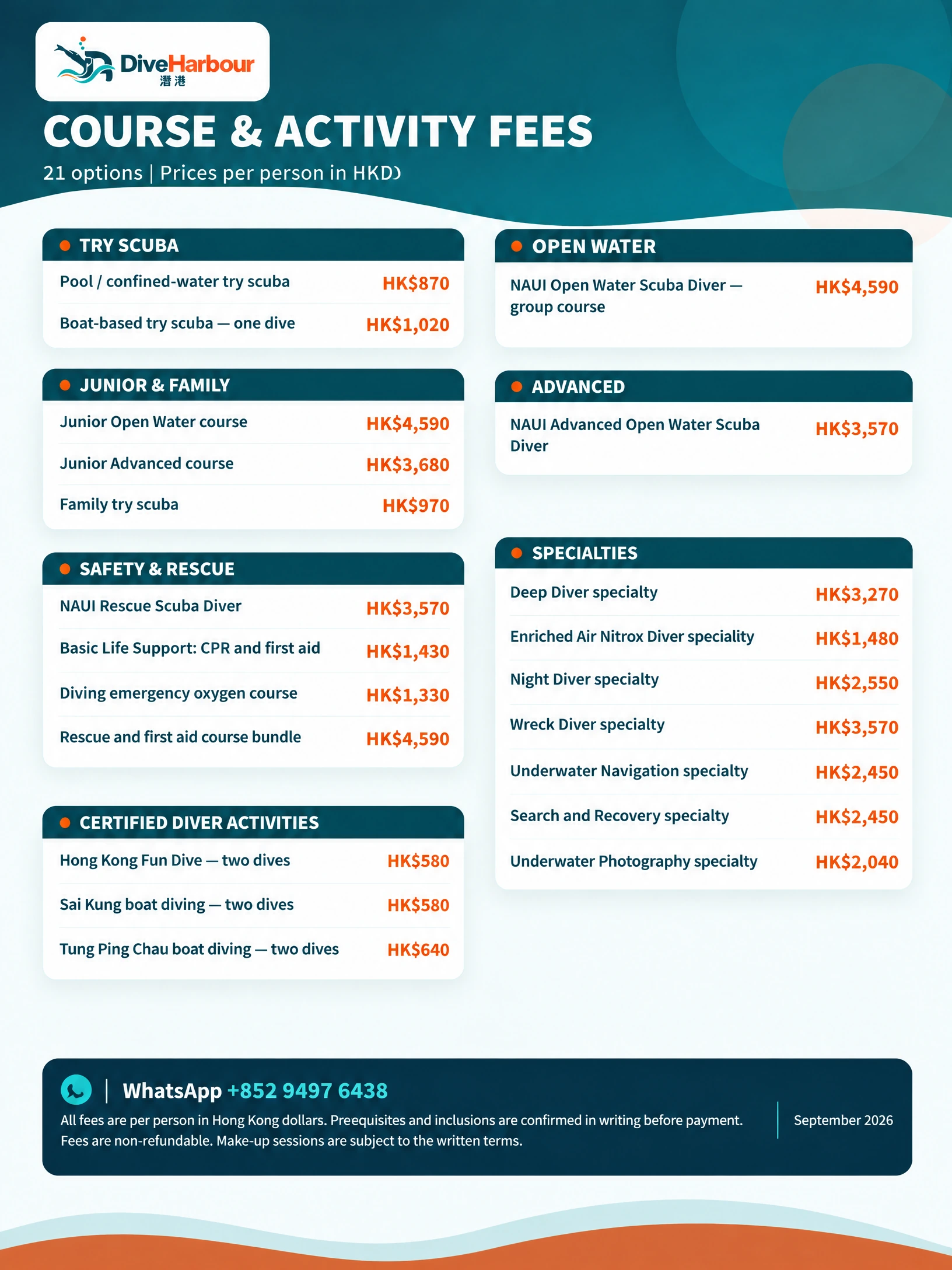
Compare our published course and activity fees before choosing your next step. All prices are per person in Hong Kong dollars.
Before you book, we confirm prerequisites, materials, certification, equipment, venue and boat arrangements in writing. Ask us about fees for courses not listed here.
Read the Sai Kung diving Hong Kong guide to learn about the setting, then explore the Sai Kung scuba diving course page. Certified divers can use our Hong Kong fun dive guide to check experience requirements and activity arrangements. Locations remain subject to weather and sea conditions.
Explore the responsibilities and entry requirements in our Divemaster course Hong Kong guide, then review the scuba instructor course Hong Kong route. Professional training differs from recreational progression, so confirm experience requirements and assessment arrangements first.