Family Styling Roles for a Coastal Event | DiveHarbour
Family styling roles work best when one adult owns the schedule and provider questions, children choose preferences they can explain, and each event segment has a reset plan. Start with clothing and comfort, then confirm what may change before photos or dinner. Keep any water activity under its own operator and adult-supervision rules; styling is an appearance decision, not a prerequisite. This guide turns a busy coastal day into a shared brief without promising a particular result.
Illustration · Concept illustration: a family assigning clothing, timing, and provider questions before a coastal event.
Instructor qualifications
One clear teaching conversation from first breath to next step
DiveHarbour brings together scuba teaching, swimming, lifesaving and water-rescue experience so you can ask practical questions before choosing a course.
PADI teaching backgroundTeaching experience across recognised scuba learning pathways.
SSI teaching backgroundClear explanations when you are comparing agency routes.
NAUI teaching backgroundA practical, standards-aware approach to learning and progression.
Swimming foundationWater confidence and calm, step-by-step practice matter.
Lifesaving experienceSurface awareness and prevention stay part of the conversation.
Pool rescue experienceControlled practice can build confidence before open water.
Beach rescue experienceLocal water context informs sensible preparation.
Kayak rescue experienceA wider water-safety perspective supports good judgement.
PWC rescue experienceAsk about the right learning route for your experience and goals.
Brand relationship: DiveHarbour and DT HUB share the same owner.
DiveHarbour and DT HUB are operated by the same owner. DT HUB links in this article are external service and product information references, not independent third-party recommendations, medical-effect claims, or water-activity safety endorsements. DiveHarbour handles diving and coastal activities; DT HUB salon, hairpiece, academy, and hair-growth services require separate enquiries.
A useful fact to keep in mind
UNICEF says children should be informed and involved in matters affecting them, with their views given due weight according to age and maturity [1].
Name one adult to own the schedule, provider questions, and final family brief.
Give each child a real but age-appropriate choice about comfort, clothing, and acceptable appearance changes.
Separate a provider’s service scope from your own event timing, budget, and fallback decisions.
Treat water participation, supervision, and operator requirements as a separate conversation from styling.
Start here
Family styling roles start with one shared brief
Family styling roles: assign the decision owner before choosing a look
A family coastal event may contain a waterfront portrait, a meal, a walk, and an optional water segment. Those moments do not need one identical hairstyle or one person making every choice. Begin by naming the outcome that matters most, such as comfortable photos before lunch or an easy change before dinner. Then write down which requests are fixed, which can change, and who has authority to confirm each part.
The adult lead should collect the date, venue, arrival time, clothing notes, photo priorities, and the amount of time available for a reset. Children can describe what feels comfortable, what they want to wear, and what they do not want changed. UNICEF describes participation as informed, voluntary involvement in matters affecting children, with views given due weight according to age and maturity [1]. That supports listening seriously without handing a young child an adult scheduling burden.
If the family is researching colour, henna hair colour hong kong is a service-information starting point, not a family decision or a result promise. Ask the provider what the service covers and what timing it needs. Ask what information they want from each person and whether the planned date leaves room for a change in appearance. Keep a child’s preference and the provider’s confirmation as two separate notes.
A useful brief has three labels beside every request: child preference, adult requirement, or provider question.
Guide · 02
Split responsibilities by age and event segment
Who chooses, who packs, and who confirms
Age is not a styling category; it is a reason to adjust the size of a person’s role. A young child might choose between two comfortable tops or say whether a hat feels acceptable. An older child or teenager may help describe a preferred silhouette, keep track of personal items, and suggest a fallback look. An adult remains responsible for the schedule, transport decisions, money questions, and any instruction that must be confirmed with a provider.
Do not ask a child to negotiate an appointment or interpret an unfamiliar service description. Instead, let the child hear a plain explanation and respond without pressure. UNICEF identifies consultative, collaborative, and child-led forms of participation, and says children’s views should be considered in line with age and maturity [1]. In practical terms, the child contributes information about their own comfort while the adult owns the commitment made on behalf of the group.
For a budget conversation, hair colour price hong kong should be treated as an information page to check, not as a quoted family total. Ask what is included and which assumptions affect the scope. Ask whether each person needs a separate consultation and what could change if the appointment or event plan changes. Record the provider’s reply beside the relevant person rather than assuming one answer applies to everyone.
Adult lead: owns the date, contact details, budget questions, and final confirmation.
Child: states comfort preferences, clothing choices, privacy boundaries, and acceptable changes.
Second adult: checks bags, breaks, transport timing, and the fallback plan for a tired child.
Provider: confirms service scope, preparation requests, timing assumptions, and questions still unanswered.
Swipe the table to compare all columns.
Role map for a family styling brief
Person
Owns
Checks with others
Adult lead
Schedule, contact, budget questions, final confirmation
Adult when a choice affects timing or group photos
Second adult
Bag, breaks, transitions, and fallback timing
Adult lead before changing the sequence
Styling provider
Service scope and preparation information
Adult lead before treating a suggestion as confirmed
The person who enjoys the look does not have to be the person who confirms the appointment.
Illustration · Concept illustration: separate preference notes for family members under changing coastal light.
Guide · 03
Make clothing and comfort a shared check
A family styling roles plan should protect comfort without forcing sameness
Use clothing as a comfort conversation before it becomes a visual brief. Note whether a child dislikes tight collars, loose accessories, heavy layers, or a change made close to photographs. An adult should check the day’s practical conditions and schedule pauses. CDC guidance for outdoor care advises caregivers to consider protective clothing, shade, hydration, and breaks [2]. It also stresses choosing outdoor equipment and activities appropriate to a child’s age. These are planning prompts, not permission for a particular activity.
For photographs, divide the brief into three levels. “Must keep” might be a familiar shirt or a child’s usual parting. “Open to change” might be a tucked strand, a different accessory, or a jacket removed after the first group photo. “Do not change” might be a texture, head covering, or privacy boundary. This makes it easier for a provider to suggest options without treating a child’s hesitation as a problem to overcome.
If an adult is considering hair perm kwun tong, use the page only to start a scope conversation. Ask what information is needed for each person. Ask how the planned event date affects the decision and how much everyday adjustment the family is prepared to manage. Do not assume that a service suitable for one family member, or one appointment sequence, should be copied for a child or sibling.
Comfort notes belong beside the outfit reference, because a visually coordinated family is not successful if one member cannot enjoy the day.
Guide · 04
Plan changes without turning them into surprises
Use segment cards for photos, meals, and optional water time
Write the day as a short sequence rather than one large appointment. For each segment, note the intended look, the person who checks it, the time available, and the acceptable fallback. A portrait may need a tidy front view. A meal may need hair moved away from the face. An outdoor walk may make a child prefer a familiar style. The point is not to predict every change. It is to agree on who can make a small change and when the group simply keeps the current look.
When comparing a provider, perm salon kwun tong can be one reference for questions about scope, location information, and consultation details. It is not evidence that a style will suit a particular child or remain unchanged through a coastal day. Ask about preparation, timing assumptions, changes to the brief, and the information the provider needs before anyone treats the page as a plan.
Give the child a simple change signal, such as “pause,” that any adult will respect. Pack only agreed essentials: the clothing layer, approved accessories, a comb or brush the family already uses, and a note of the fallback look. Avoid adding products or tools just because a photograph shows them. If a child becomes tired, uncomfortable, or uncertain, the adult can move to the fallback without describing that choice as a failure.
A fallback is part of the original plan: it protects time and dignity when the first idea no longer fits the moment.
Illustration · Concept illustration: a calm appearance reset between photos, a meal, and the next shore segment.
Guide · 05
Write a provider brief that can answer real questions
Family styling roles are a communication tool, not a promise
Send one concise brief for the group, then separate each person’s details underneath. Include the event date, each segment, and the clothing or photo reference. Add current hair length or routine as the family describes it, plus what must stay unchanged and what may be adjusted. Add the adult contact who can answer questions and the latest point at which the family can change the plan. This reduces the chance that a provider hears only “family look” and fills in the rest by assumption.
If a digital option is being considered, digital perm hong kong is another service-information reference to review with the provider. Ask whether the page describes the service the family is actually asking about and which details differ between family members. Ask what questions remain before committing. Do not present a catalogue label as an outcome, a fixed appointment duration, or proof that a child should receive the same service as an adult.
When the provider replies, mark each answer as confirmed, needs clarification, or outside the stated scope. Keep price, timing, preparation, and change questions visible rather than burying them in a group chat. If a child has a strong preference or a firm no, write it in plain language and ask how the provider will respect it. A clear “not included” answer is useful because it tells the family to make a different plan instead of improvising on the day.
Swipe the table to compare all columns.
Segment card for a coastal family day
Event segment
Primary owner
Before confirming
Arrival and first photo
Adult lead
Check clothing notes, arrival buffer, and the child’s no-change request
Meal or indoor stop
Second adult
Check comfort, accessories, and whether a reset is actually wanted
Optional water time
Named supervising adult and activity provider
Review current operator terms and keep styling decisions separate
Departure photo
Adult lead
Use the agreed fallback instead of adding an unconfirmed change
The best brief gives a provider enough context to answer, while leaving the family free to decline a suggestion.
Guide · 06
Keep styling separate from water-activity decisions
Confirm appearance, supervision, and participation on different lines
A hairstyle, colour, outfit, or provider reply does not establish that anyone is ready for a water activity. If the day includes water, put that segment on its own card. The adult lead should read the relevant operator information, check the family’s participation choices, and name the adult responsible for supervising the child. CDC guidance says adults play a key role near water through close and constant supervision and by avoiding distractions [2]. A stylist should not be treated as the water supervisor, and styling should never be framed as a prerequisite.
Families who are separately exploring a DiveHarbour option can read about the family scuba diving experience Hong Kong page for that activity’s own information. Participation remains a separate family choice. Confirm the operator’s current requirements and the adult’s responsibilities directly with the activity provider. Confirm each child’s willingness with the family. Do not use a styling appointment or this article as activity clearance.
The same separation applies when reviewing family scuba diving activities for kids Hong Kong. A child may enjoy the coastal event but decline the water segment, while another family member may choose to participate under the provider’s terms. Keep the shoreline plan, styling brief, and water-activity confirmation in different sections of the family notes. That prevents one decision from being mistaken for another.
Before leaving, read the plan aloud in language every child understands. Explain what happens first and which choices are theirs. Explain which decisions belong to adults and how to ask for a pause. If the event changes, update the adult-owned plan rather than asking a child to absorb the new responsibility. That small habit keeps family styling roles useful after the photographs are finished.
Appearance planning can support a good coastal day, but it cannot approve participation, replace supervision, or override a child’s choice.
Illustration · Concept illustration: a practical checklist that keeps styling questions separate from activity decisions.
A sensible next step
Take the question with you
Family styling roles become practical when every request has an owner, every child has a respected voice, and every event segment has a fallback. Write the brief before contacting a provider, confirm only what the provider actually covers, and keep appearance choices apart from water participation and supervision. That sequence leaves more room for a relaxed family day because no one has to solve an unassigned decision at the shoreline.
For styling, colour, perm, or other DT HUB service information, make a separate enquiry with DT HUB and confirm scope, timing, and any charges directly. For diving or coastal activities, contact DiveHarbour about its own activity information and requirements. Neither side of the plan should be treated as a substitute for the other, and no family member needs to join a water activity to use this styling guide.
Questions to ask
Common questions
How much say should a child have in the family look?
Invite a child to express preferences about comfort, clothing, photographs, and acceptable changes in a way that suits their age and maturity. An adult still owns the schedule, provider questions, and final commitments. The goal is meaningful input, not a demand that the child manage adult logistics [1].
Who should confirm the appointment or service details?
Name one adult as the confirmation owner. That person should check scope, preparation, timing assumptions, price questions, and what happens if the brief changes. A child’s preference should be included in the message, but a child should not be expected to interpret or negotiate service terms.
Can a styling plan confirm that a child can join water time?
No. Styling covers appearance and provider communication. Any water segment needs its own review of the activity provider’s current terms, adult supervision arrangement, and each child’s willingness. A hairstyle, colour, or appointment does not provide activity clearance or replace close adult supervision [2].
What if a child changes their mind on the event day?
Use the agreed fallback rather than treating the change as a disruption. Pause, remove the disputed request, and let the adult lead update the segment card. A familiar outfit or simple arrangement is often more useful than adding an unconfirmed adjustment under time pressure.
UNICEF describes child participation as informed and voluntary involvement in issues affecting children and says views should be given due weight according to age and maturity.
CDC states that adults play a key role in protecting children near water through close and constant supervision and avoiding distractions.
Continue exploring
Three useful next reads
Keep comparing practical questions before you choose a course, activity or preparation step.
Coastal life and image planning · Updated 2026-11-06
Outdoor-light reference brief for coastal photo planning
Use an outdoor-light reference brief to plan light, framing, neckline and styling limits for a coastal shoot. Read the checklist and ask better questions.
Coastal life and image planning · Updated 2026-11-06
Shore styling tool choice: build a compact shore-day kit
Use shore styling tool choice to sort essential tools, power limits, cleaning needs, and backup options before a coastal day. Read the practical guide.
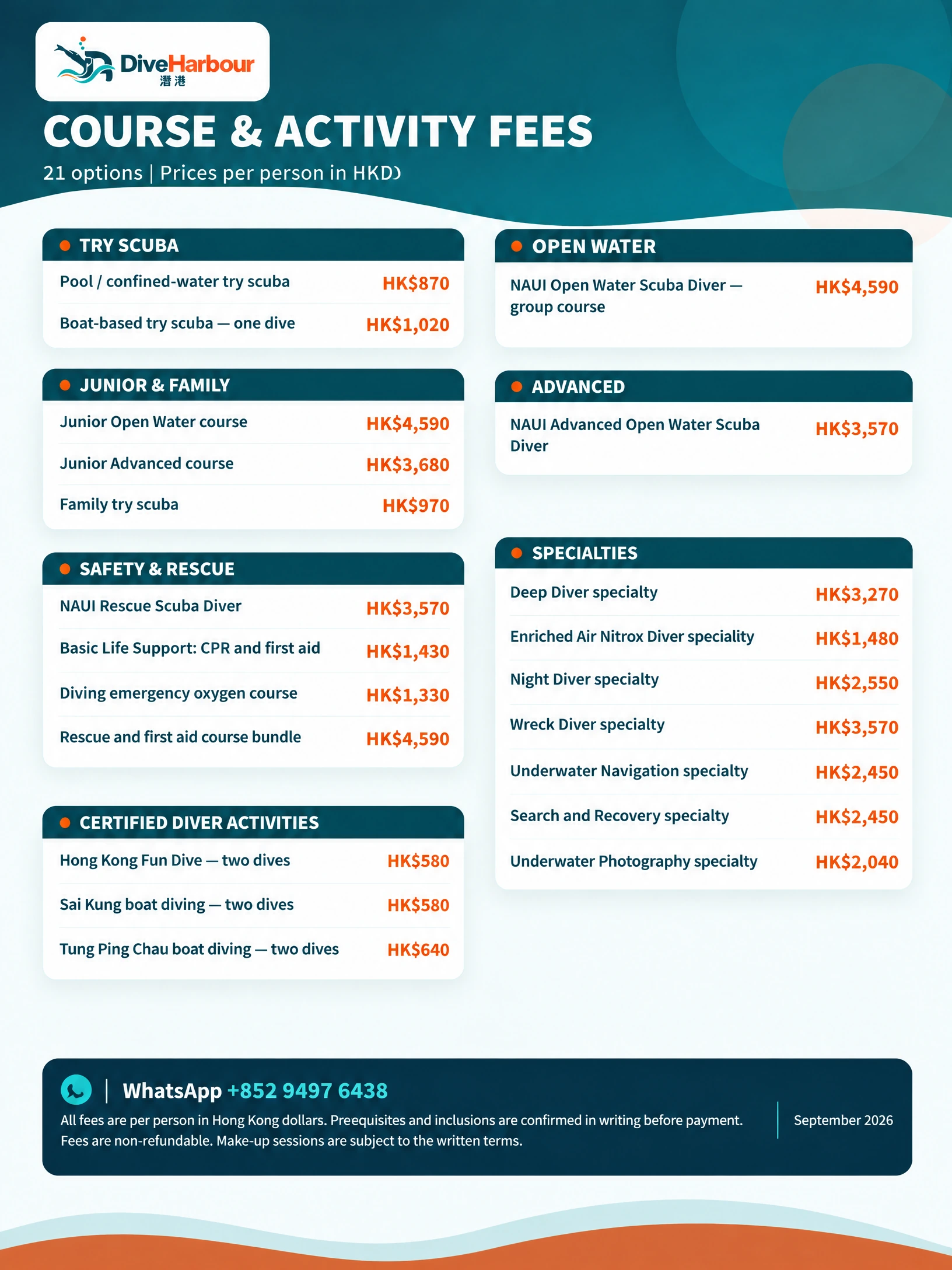
Compare our published course and activity fees before choosing your next step. All prices are per person in Hong Kong dollars.
Before you book, we confirm prerequisites, materials, certification, equipment, venue and boat arrangements in writing. Ask us about fees for courses not listed here.
Read the Sai Kung diving Hong Kong guide to learn about the setting, then explore the Sai Kung scuba diving course page. Certified divers can use our Hong Kong fun dive guide to check experience requirements and activity arrangements. Locations remain subject to weather and sea conditions.
Explore the responsibilities and entry requirements in our Divemaster course Hong Kong guide, then review the scuba instructor course Hong Kong route. Professional training differs from recreational progression, so confirm experience requirements and assessment arrangements first.